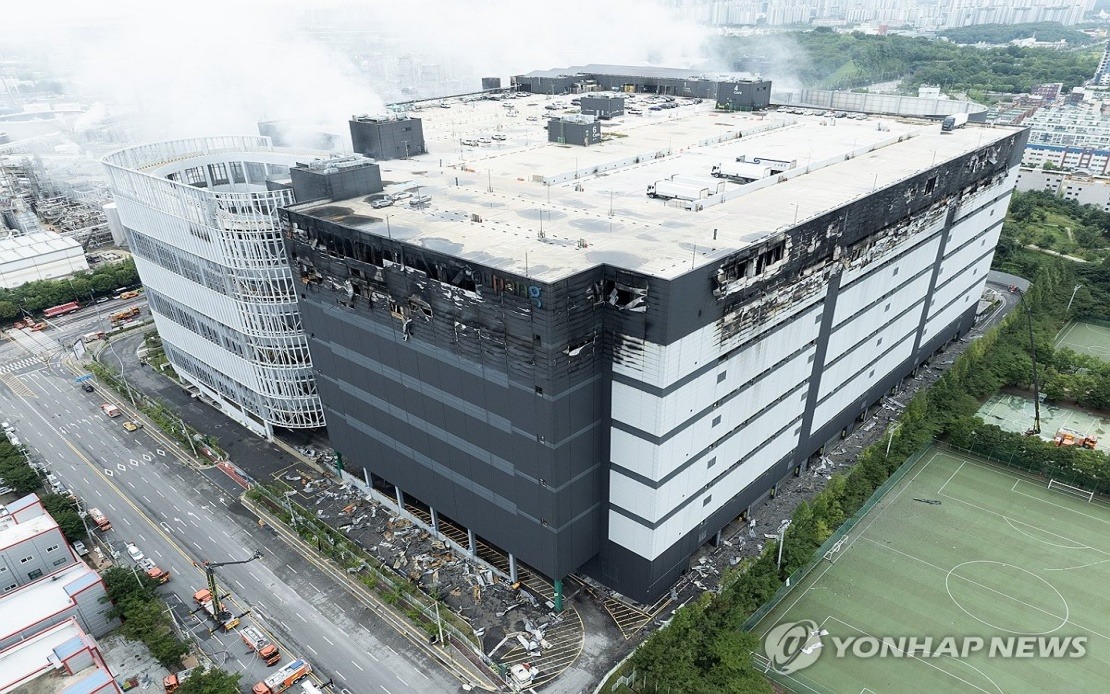
Firefighting authorities in South Korea announced Monday evening that a colossal warehouse blaze ravaging a Coupang logistics facility in Incheon had finally been brought under initial control, concluding a gruelling three-day battle against one of the region's most challenging industrial fires. The declaration came at 8 p.m. local time, marking a critical turning point in a firefighting operation that mobilised unprecedented resources following a national emergency directive issued Saturday morning.
The warehouse complex, situated in Incheon just west of Seoul, presented extraordinary difficulties for emergency responders from its earliest hours. The sheer scale of the facility, combined with its intricate internal structure and the vast quantities of combustible materials stored within, created conditions that overwhelmed conventional firefighting approaches throughout much of the weekend. Despite the deployment of 812 firefighters and 231 specialised pieces of equipment—a mobilisation scale reflecting the severity authorities assigned to the incident—progress remained agonisingly slow until Monday's breakthrough.
The arrival of significant rainfall on Monday provided unexpected but crucial assistance to the firefighting effort. As moisture saturated the surrounding area and penetrated portions of the burning structure, the rate of fire spread diminished noticeably and combustion became less intense. This natural phenomenon, combined with the accumulated expertise and exhaustion-tested resilience of the firefighting teams, finally allowed personnel to establish meaningful control over what had threatened to become an uncontrollable conflagration.
The human cost of the disaster extended far beyond the warehouse itself. Local authorities had issued a comprehensive evacuation order late Sunday, affecting all residents living within a 116-metre radius of the warehouse's ramp zone, a precautionary measure reflecting genuine concern about potential explosions and toxic smoke dispersal. This decision displaced approximately 178 people, who found temporary shelter in nearby schools converted into emergency accommodation facilities.
The disruption rippled through the local community's essential services. Educational institutions across the vicinity faced mandatory closures on Monday as authorities prioritised resident safety. One elementary school suspended operations entirely, whilst fourteen daycare centres in the surrounding districts remained shut. Parents faced last-minute childcare arrangements whilst schools awaited confirmation that air quality and structural safety had returned to acceptable levels.
The incident highlights the particular vulnerabilities of massive logistics operations that have become increasingly common across East Asian metropolitan regions, including Southeast Asia. As e-commerce platforms expand their warehouse footprints to support rapid delivery expectations, the concentration of flammable inventory in single locations creates proportionally larger fire risks. The Coupang warehouse fire demonstrates how quickly such operations can overwhelm local emergency response capacities, even in a technologically advanced nation with well-funded fire services.
For Malaysian and regional observers, the incident carries important implications for urban planning and industrial safety protocols. Southeast Asian nations hosting similar mega-warehouse operations should examine whether their current emergency response frameworks possess adequate capacity to handle fires of comparable magnitude. The South Korean experience suggests that reliance on conventional firefighting equipment alone proves insufficient when dealing with vast complexes containing diverse combustible materials.
The three-day duration of this fire also underscores how environmental factors can either accelerate or decelerate industrial disasters. Monday's rainfall, whilst beneficial, arrived only after 61 hours of uncontrolled burning. In a region experiencing increasingly erratic weather patterns, emergency planners must consider how climate variability might affect their ability to respond to similar incidents in future. Conversely, the mobilisation of over 800 personnel demonstrates what becomes possible when regional and national resources are coordinated under unified command structures.
As recovery efforts continue and investigation teams begin examining the fire's origin, the broader question of industrial safety in densely populated areas becomes increasingly pressing. The evacuation of nearly 200 people from residential zones adjacent to a commercial facility, coupled with the closure of schools and daycare centres, reveals the extent to which large-scale industrial operations intersect with civilian infrastructure. This proximity creates inherent risks that cannot be entirely eliminated through firefighting capacity alone, demanding instead more fundamental questions about zoning, building codes, and hazardous material storage protocols.
The incident also reflects the extraordinary pressures placed on emergency services across developed economies where e-commerce infrastructure has expanded dramatically in recent years. South Korea's firefighting authorities, despite their professional excellence and technological advantages, required three full days and hundreds of personnel to contain what might have been a catastrophic loss of life in other contexts. Regional fire services, particularly those in Southeast Asia where warehouse development has accelerated alongside economic growth, may face similar challenges with fewer resources available.
Moving forward, the Coupang warehouse fire will likely become a case study in industrial fire management, emergency evacuation procedures, and the coordination of large-scale emergency responses. Insurance companies, regulatory agencies, and facility operators across the region will scrutinise the incident's timeline and response patterns to identify lessons applicable to their own operations. For residents of Incheon and surrounding communities, the three-day ordeal serves as a stark reminder of how quickly industrial infrastructure can pose direct threats to civilian safety, even in established metropolitan areas with sophisticated emergency systems in place.

