South Korea stands on the precipice of eliminating a controversial food tradition that has survived for over four centuries, as the country's landmark dog meat ban approaches full implementation in February 2027. The transition represents a profound cultural shift for a nation where the practice has deep historical roots, transforming attitudes shaped by centuries of tradition, colonial legacy, and economic necessity. With only months remaining before the ban becomes absolute, the remaining dog meat farms, restaurants, and vendors face an uncertain future, marking the end of an era that once seemed unshakeable in Korean society.
The journey toward this prohibition has been extraordinarily long and contentious. Lawmakers passed the landmark legislation in January 2024 after decades of fierce debate between animal rights advocates and those defending the practice as a cultural right. Rather than imposing an immediate ban, policymakers granted dog farmers a three-year grace period to wind down their operations, reflecting the difficulty of dismantling an industry with deep institutional roots. This measured approach has proven remarkably effective—according to South Korea's Ministry of Agriculture, Food and Rural Affairs, more than 80 percent of the approximately 1,500 known dog meat farms had already ceased operations by May 2026, leaving fewer than 300 facilities still in business.
To facilitate this transition, the South Korean government deployed significant financial incentives and support mechanisms. Farmers have been offered compensation of up to 600,000 won (approximately US$426) for each dog, alongside low-interest loans and comprehensive job-transition assistance programmes including employment counselling. These measures acknowledge the genuine hardship facing rural communities whose livelihoods depended on dog farming for generations. The dual approach of providing both the carrot of financial support and the stick of imminent legal prohibition has accelerated the industry's collapse far more effectively than legal enforcement alone might have achieved.
The transformation has reverberated through the dog meat supply chain with particular severity. At Seoul's Gyeongdong Market, one of the few remaining venues where dog meat is still openly sold, vendors report that prices have surged dramatically from approximately 20,000 won per kilogram in 2024 to 60,000 won today—a tripling that reflects both scarcity and reduced demand. This price inflation paradoxically makes the remaining product less accessible to the traditional consumer base, accelerating the death spiral of the industry. Vendors themselves have become reluctant to discuss the trade publicly, recognising that the cultural consensus has fundamentally shifted against them.
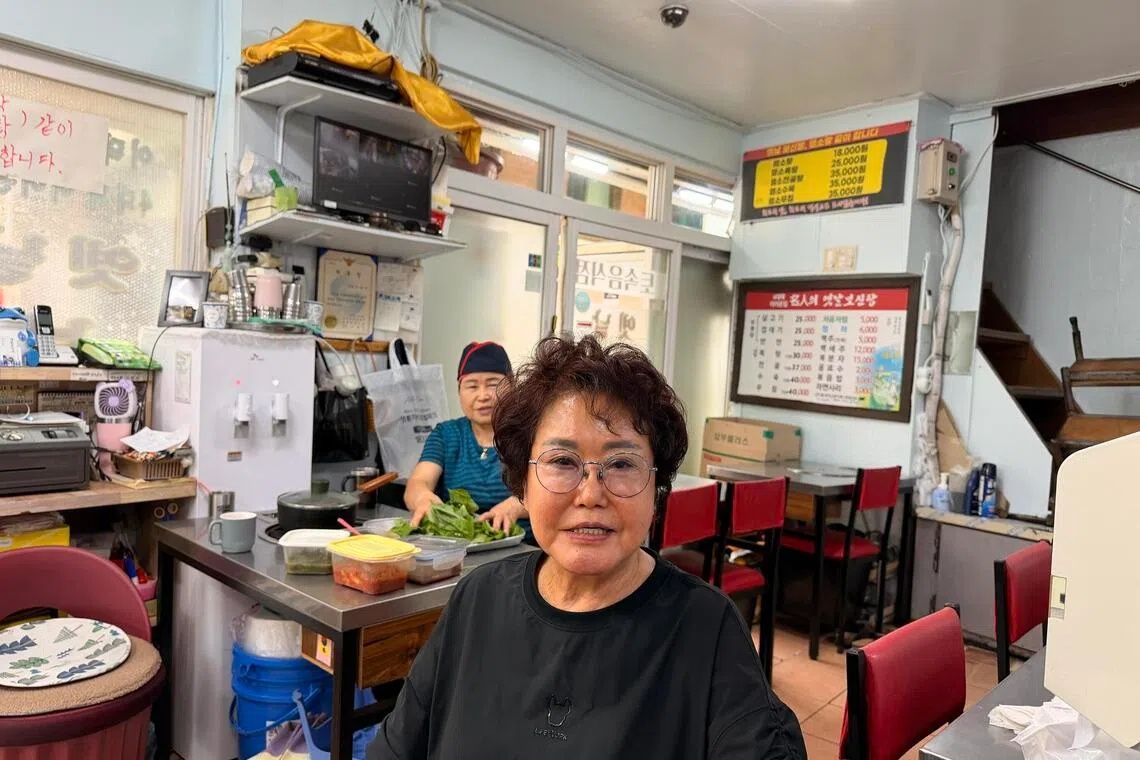
Restaurant owners who built their livelihoods around dog meat cuisine face perhaps the most acute challenge. Lee Deok-sung has operated a boshintang—dog meat stew—restaurant near Seoul's popular Dongdaemun Market for forty-five years, watching clientele and profit margins erode simultaneously. The summer season, traditionally the peak demand period when Korean consumers believed the protein-rich stew replenished energy depleted by extreme heat, has become a commercial disaster. Lee reports that this year's boknal, the three hottest days of summer, will likely be the last before the ban takes full effect. She has already raised prices from 16,000 won to 25,000 won per bowl, yet still struggles to break even daily, forced to offload inventory before dinner service concludes.
Across a narrow alley, Lee Kyung-ja operates another long-established boshintang restaurant that has served the neighbourhood for over four decades. Both restaurants have attempted to adapt by introducing black goat stew earlier in 2026, selected because its texture and gamey flavour closely approximate dog meat. Yet this substitution has failed to gain traction with loyal customers who explicitly prefer the original dish for its superior taste. Lee Kyung-ja, now seventy-five years old, confronts not merely a business crisis but an existential question about her future. At an age when career reinvention becomes exponentially more difficult, she faces the prospect of rebuilding a customer base from scratch or accepting that retirement may be imminent.
The cultural and medical dimensions of dog meat consumption have proven more resilient than commercial factors alone might suggest. Traditional Korean medicine practitioners continue recommending dog meat to patients recovering from serious illness, perpetuating belief systems rooted in centuries of medical practice. The Donguibogam, a seventeenth-century medical text compiled by royal physician Heo Jun during the Joseon Dynasty, explicitly described dog meat as a warming food believed to replenish energy and vitality. These associations with health restoration have survived into modernity, creating demand among consumers motivated by therapeutic conviction rather than mere culinary preference or nostalgia.
Historical context reveals how dog meat consumption became embedded in Korean society through multiple overlapping processes. While records suggest the practice dates at least to the Joseon Dynasty, the tradition became far more widespread during Japan's colonial rule from 1910 to 1945 and in the aftermath of the devastating Korean War. During this period of acute poverty and systematic food shortages, dog meat emerged as an inexpensive protein source available to populations otherwise unable to afford adequate nutrition. This economic foundation transformed a minor dietary practice into a widespread cultural institution, creating generational habits and commercial infrastructure that persisted even after prosperity rendered the nutritional necessity obsolete.
The story of DeeJay, a Labrador rescued from a farm in Wonju by musician Annie Ko in 2015, encapsulates the broader transformation occurring across South Korean society. Ko, who had never previously owned a pet, was moved by the trembling puppy—the runt of a litter that had spent its first three months confined in a cramped cage. Her decision to adopt him represented not merely a personal choice but a statement of values aligned with the emerging consensus against dog farming. The non-profit organisation Humane World for Animals, which facilitated DeeJay's rescue, has successfully relocated approximately 2,800 dogs from farms to adoptive families in the United States, Britain, and Canada. DeeJay remains the only survivor from his original litter to stay in South Korea, a poignant symbol of how rescue interventions cannot save the system itself, only individual animals within it.
The ban's approach to animal welfare reflects broader changes in how South Korean society conceptualises the relationship between humans and companion animals. Public opinion has shifted decisively toward viewing dogs as sentient beings deserving protection rather than as food commodities. This transformation has occurred alongside South Korea's rapid urbanisation and growing middle-class pet ownership, creating a powerful constituency for animal protection legislation. Younger Koreans, in particular, view dog farming as incompatible with contemporary ethical standards, viewing the ban not as cultural loss but as moral progress aligning the nation with international norms.
The complete closure of the dog meat industry by February 2027 will represent a remarkable societal transition accomplished within a single decade of intense political effort. Unlike prohibitions imposed through external force or sudden criminal enforcement, South Korea's approach built consensus through extended debate and offered economic alternatives to affected parties. This model suggests that even deeply entrenched cultural practices can be eliminated when societies experience sufficient value shifts and when policymakers design transitions that acknowledge the legitimate interests of affected communities. The success of this effort will likely influence how other nations approach controversial food traditions facing growing opposition from domestic and international animal welfare advocates.

