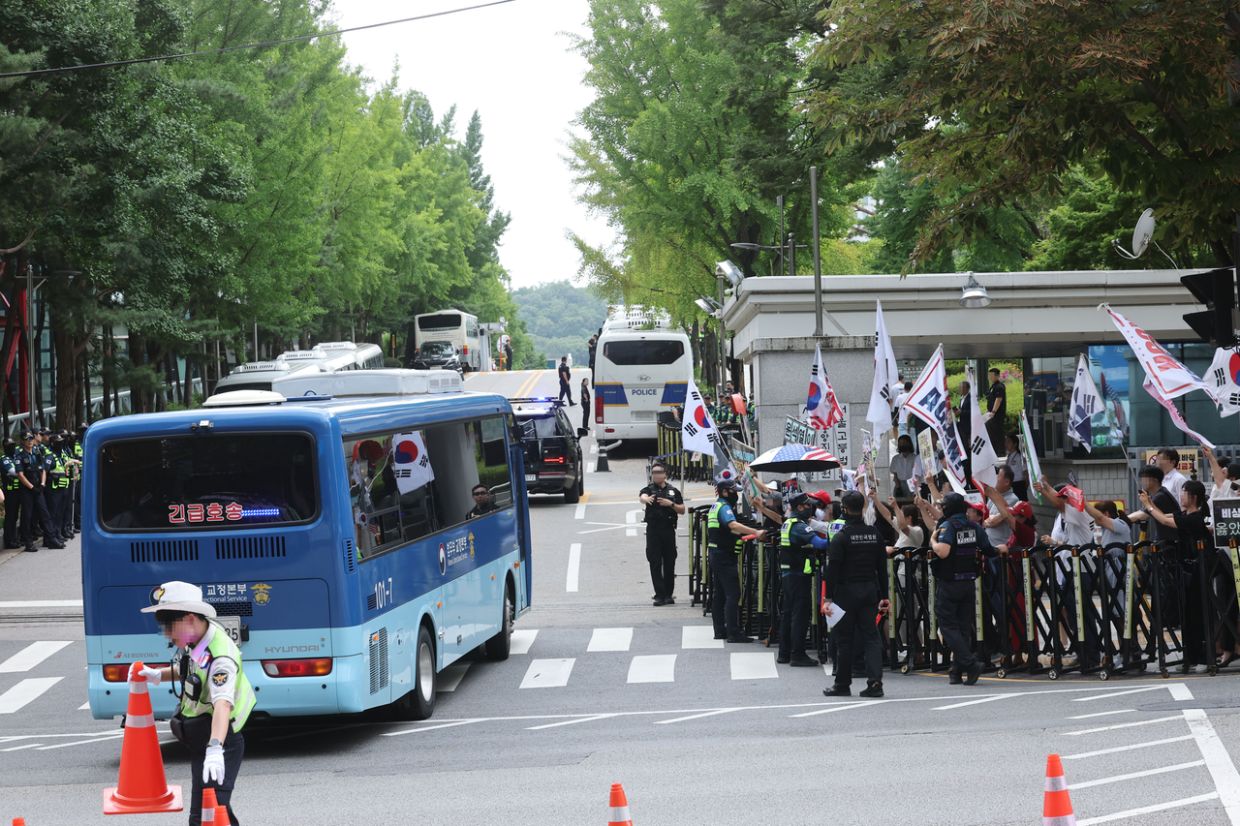
South Korea's ex-President Yoon Suk Yeol faces a two-year prison sentence following his conviction on Monday by Seoul Central District Court for accepting complimentary political polling services worth 27.92 million won during his successful 2021-2022 presidential campaign. The court determined that political broker Myung Tae-kyun supplied 14 opinion surveys to Yoon's campaign without proper compensation, constituting a violation of the country's strict Political Funds Act, which governs how candidates finance their electoral activities and which contributions they may legally receive.
The ruling represents a significant development in South Korea's ongoing battle against electoral misconduct, a perennial concern in the country's competitive political landscape. Judge Lee Jin-gwan emphasised the democratic importance of campaign finance transparency, noting that opinion polls carry substantial weight in shaping voter behaviour and that their integrity underpins electoral legitimacy. The judge stated that when political candidates circumvent formal funding regulations to obtain polling services—effectively receiving in-kind contributions worth substantial sums—the resulting distortion of public opinion threatens the fundamental fairness of the election process itself.
Prosecutors had pursued a more expansive case, alleging that Yoon and his then-wife Kim Keon Hee, who would become first lady, conspired to receive 58 free surveys valued at over 270 million won from Myung across an eighteen-month window spanning June 2021 through March 2022. However, the court's evidentiary findings proved more restrictive, establishing sufficient proof only for fourteen of the contested surveys. This discrepancy between prosecutorial allegations and judicial findings underscores the high legal threshold required to prove election law violations in South Korea, even when circumstances appear suspicious.
The court's reasoning centred on establishing that Yoon's wife had granted Myung authority to control crucial aspects of the polling operation—including when surveys would be conducted, what questions they would contain, the methodology employed, and whether results would be publicised. Critically, the judges found that Yoon himself possessed knowledge of this arrangement and implicitly approved it by accepting the benefits. This pattern of successive, tacit consent among Yoon, his wife, and Myung constituted the legal violation, demonstrating a deliberate coordination to circumvent campaign finance rules.
A second dimension of the case involved an alleged quid pro quo arrangement concerning the nomination of former lawmaker Kim Young-sun to represent the ruling People Power Party. Evidence presented to the court indicated that Yoon had promised Myung the party's presidential nomination for Kim Young-sun in exchange for the continuous provision of favourable polling data. The court found that following this promise, Yoon's then-chief of staff Chang Je-won subsequently exerted pressure on the party's nomination machinery to advance Kim Young-sun's candidacy. Nevertheless, the court stipulated that establishing such an explicit exchange was not technically necessary to find a violation of the Political Funds Act—the receipt of unpaid services itself constituted the core offence.
The case against Myung Tae-kyun, the political broker who orchestrated the polling provision, resulted in an 18-month prison sentence, with the court ordering his immediate detention. This parallel conviction signals that South Korean courts treat the supplier of illegal campaign contributions with seriousness equivalent to their recipients, reinforcing that both sides of corrupt transactions bear responsibility. Myung's comparatively lighter sentence relative to Yoon's reflects judicial assessment that the broker bore less organisational authority in the scheme, despite his instrumental role in facilitating it.
A striking divergence emerged in the separate case involving Yoon's wife, former first lady Kim Keon Hee, who faced identical Political Funds Act charges relating to the same polling services. Both the trial court and appellate court had acquitted her, determining that prosecutors failed to meet their burden of proving she received quantifiable financial benefit equivalent to the surveys' market value or that the polling services were provided specifically in exchange for Kim Young-sun's nomination. This acquittal stands in sharp contrast to Monday's conviction, suggesting that courts applied different evidentiary standards or found the evidence of Yoon's personal involvement more compelling than evidence regarding his wife's culpability.
The divergent outcomes highlight ambiguities within South Korean election law that leave considerable discretion to judges regarding what constitutes sufficient proof of illegal campaign contributions. The fact that identical allegations resulted in conviction for one family member but acquittal for another raises questions about consistency in jurisprudence and may provide grounds for appellate challenges. South Korea's Supreme Court is scheduled to deliver a final ruling in Kim Keon Hee's case on Thursday, potentially clarifying whether her acquittal will stand or whether the higher court will realign the outcomes.
For Malaysian and Southeast Asian observers, the Yoon case illustrates the challenges democracies face in regulating campaign finance and preventing the normalisation of in-kind contributions that circumvent legal frameworks. Many regional democracies struggle with similar issues—whether opinion polling, media access, or other campaign services—where the line between permissible support and illegal contribution remains contested. South Korea's rigorous approach, despite its imperfections, demonstrates serious commitment to enforcing electoral rules against even the highest political office holders, a principle that resonates across democracies concerned with strengthening institutional safeguards against abuse of power.
The conviction's implications extend beyond individual punishment to signal that former heads of state cannot expect immunity from prosecution for campaign finance violations. This precedent carries weight throughout East Asia, where questions of accountability for former leaders remain politically sensitive. Yoon's case establishes that a presidency does not shield individuals from electoral law enforcement once they leave office, potentially influencing how other regional leaders view their legal exposure for campaign-era conduct. The case also underscores how democracies depend on transparent campaign financing to prevent wealthy individuals or corporations from gaining outsized influence through unreported contributions of goods and services.
Looking forward, the sentencing raises questions about whether Yoon will pursue further appeals to South Korea's highest court, a likely scenario given the severity of the conviction. His defence team may argue that the evidence of his personal knowledge and consent remains circumstantial, or that the retroactive application of campaign finance standards to his 2021-2022 campaign exceeded judicial authority. The coming months will determine whether this conviction stands as the final word on Yoon's electoral conduct or represents merely one stage in prolonged legal proceedings that could preoccupy South Korean politics for years. Either way, the case demonstrates that no political figure, regardless of their tenure in the presidency, enjoys blanket protection from accountability under the law.

