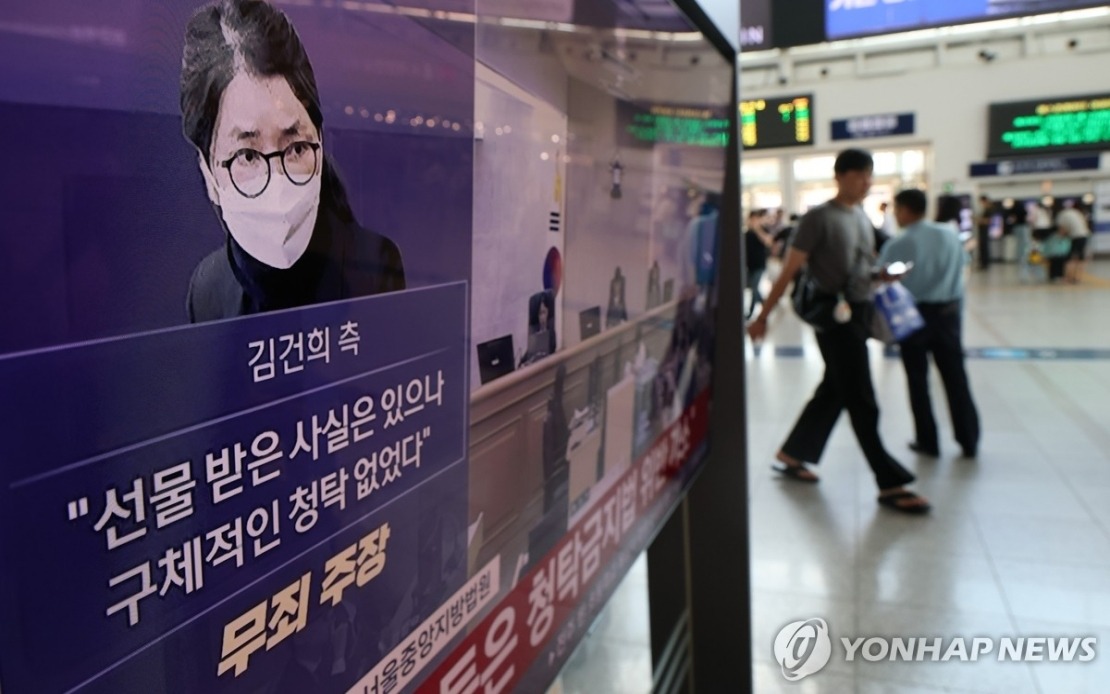
A Seoul court has sentenced former South Korean first lady Kim Keon Hee to seven years in prison for a systematic pattern of accepting expensive gifts in exchange for government appointments and other favours, marking a significant moment in South Korea's ongoing anti-corruption efforts. The Seoul Central District Court delivered the verdict on Friday after finding Kim guilty on all charges related to accepting bribes disguised as presents, including luxury jewellery, designer bags, and artwork worth a combined 300 million won.
The case centres on Kim's conduct during her time as the wife of ousted former President Yoon Suk Yeol, when she allegedly leveraged her position to solicit valuable gifts from businesspeople and officials seeking her influence. The most significant transaction involved a Van Cleef & Arpels necklace and other jewellery items worth more than 100 million won, which Kim allegedly received from a construction company chairman between March and May 2022 in exchange for helping secure a government position for the chairman's son-in-law. The court established that the bribery scheme operated during the period when Yoon held office, from May 2022 until his removal from power in April 2025.
Presiding judge Cho Sun-pyo delivered sharp criticism of Kim's behaviour during the televised hearing, emphasizing that she had fundamentally betrayed the ethical expectations attached to her role. The judge stated that Kim had treated her position as first lady purely as a vehicle for personal enrichment rather than as a platform for advancing national interests or public welfare. This characterization underscores how the court views the case not merely as individual criminal acts but as a broader violation of public trust and institutional integrity.
Beyond the necklace, the indictment detailed a catalogue of luxury items that Kim had received in what prosecutors argue were thinly veiled quid pro quo arrangements. In April 2022, she accepted a golden turtle ornament from Lee Bae-yong, former head of the National Education Commission, allegedly in exchange for facilitating his appointment to that position. The same year, she received a Dior handbag worth 5.4 million won from a pastor, and subsequently accepted a Vacheron Constantin watch from another businessman in September 2022. In February 2023, investigators uncovered that Kim had obtained a painting by renowned artist Lee Ufan from a former prosecutor, ostensibly as repayment for her assistance in securing his nomination for electoral office.
The court's judgment also highlighted Kim's apparent awareness of the illegality of her actions, as evidenced by her attempts to conceal the misconduct once investigations commenced. Judge Cho noted that Kim either returned certain gifts after authorities began probing the matter or falsely claimed she had purchased the items herself. These calculated efforts to obstruct justice and minimize her culpability further convinced the court that Kim acted with full knowledge that her conduct violated legal and ethical standards.
Special counsel Min Joong-ki's investigation team had requested an even harsher sentence of seven and a half years, indicating prosecutors believed the evidence warranted maximum punishment. The final seven-year sentence, while slightly less than demanded, nevertheless represents a substantial custodial term that reflects the severity with which South Korean courts treat corruption involving high-ranking officials and their families. Kim's legal team has indicated they plan to appeal the conviction, suggesting a protracted judicial process ahead.
The court extended accountability beyond Kim herself, recognizing that bribery requires participation from multiple actors. The construction company chairman received a one-year suspended sentence, while the businessman who provided the watch was handed a ten-month suspended sentence. A pastor involved in one of the transactions faced a fine of 8 million won, demonstrating the court's differentiated approach to culpability based on each individual's role in the scheme.
This verdict represents only one chapter in what has become an expanding legal reckoning for Kim. An appeals court had previously sentenced her to four years in prison in a separate corruption case, meaning she now faces a combined substantial prison term across multiple convictions. The accumulated sentences reflect the breadth of improper conduct that investigators and prosecutors have documented against the former first lady.
Kim's legal troubles extend beyond these bribery matters into allegations that would strike at the heart of democratic processes. She faces upcoming trial proceedings related to accusations that members of the Unification Church were coerced into joining the People Power Party, the political organization that her husband led, ahead of the 2022 presidential election. Specifically, prosecutors allege this manipulation was designed to influence the party's presidential primary process to ensure Yoon's selection as the party's nominee. Such allegations, if proven, would suggest that the impropriety extended beyond personal enrichment to encompassing potential manipulation of electoral competition itself.
The case carries significant implications for South Korea's ongoing struggle with institutional corruption and the challenge of enforcing accountability against those with proximity to presidential power. The conviction demonstrates that South Korean courts are willing to impose serious penalties against former first ladies, breaking what some observers might have viewed as a protected status traditionally afforded to spouses of sitting or recent presidents. This development suggests a maturing commitment to equal application of anti-corruption laws regardless of an individual's former position or family connections.
For the broader region, the Kim Keon Hee case illustrates the visibility and intensity of South Korea's anti-corruption mechanisms, where judicial proceedings receive live television coverage and high-level officials face genuine jeopardy of significant imprisonment. The case also underscores how corruption investigations in South Korea increasingly focus on the networks surrounding political leaders, examining not just official conduct but the relationships and material exchanges that grease decision-making at the highest levels of government. As South Korea continues to process these legal matters, the verdicts will likely shape discussions throughout East Asia about executive accountability and the appropriate boundaries of spousal influence in political systems.

