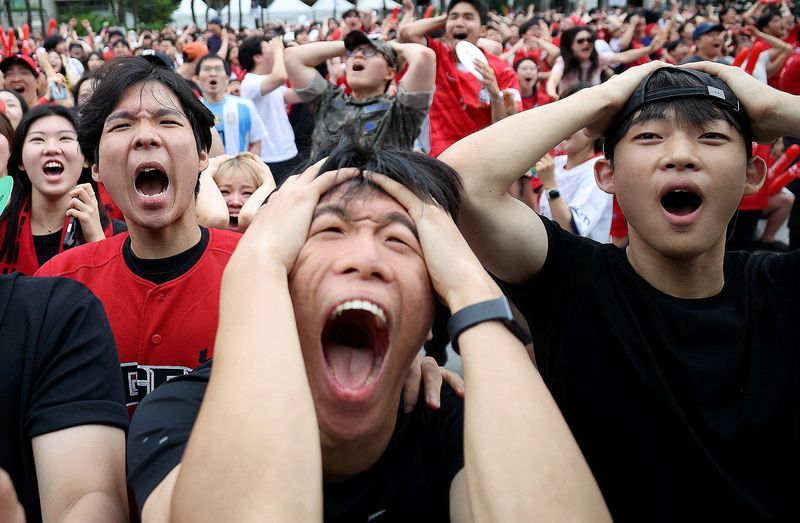
South Korea's shock elimination from the World Cup has triggered an unusually direct political response, with President Lee Jae Myung publicly expressing frustration over the national team's failure to advance from what should have been a manageable group stage. The team's successive defeats to Mexico and South Africa left them finishing third in Group A, missing out on qualification among the eight best third-placed teams that progress to the knockout rounds. Lee's candid reaction on social media underscores how deeply the sporting disappointment has resonated across the nation, transforming a football setback into a broader governance issue.
The president's intervention goes well beyond typical sports commentary, zeroing in on what he characterises as systemic failures in appointment processes. Lee pointedly criticised the decision-making that elevated coach Hong Myung-bo to lead the national team in 2024, framing the move as emblematic of a wider problem affecting South Korean institutions. His assertion that "personnel decisions are everything" suggests a view that incompetence at the top level inevitably cascades downward, undermining team performance regardless of talent available to selectors. This argument resonates in a country where governance and institutional integrity remain politically sensitive topics.
The controversy surrounding Hong's reappointment predates the World Cup campaign itself. Korean media outlets had previously raised questions about the opaque nature of the hiring process and alleged preferences shown toward certain candidates over others, despite Hong's denials of any impropriety. The appointment had been viewed with suspicion by observers who questioned whether merit-based criteria had been properly applied. As the team's performances deteriorated and elimination became inevitable, these earlier concerns resurfaced with renewed intensity, giving Lee's criticism substantial public backing.
The political fallout has extended beyond presidential statements into grassroots movements. A petition calling for Hong's removal posted on the national assembly's website accumulated sufficient signatures to advance to the initial review stage remarkably quickly, reflecting public anger over the failed campaign. More strikingly, social media has amplified images of South Korean businesses displaying notices banning Hong from their premises, a visceral expression of popular frustration that underscores the emotional investment citizens place in national sporting endeavours. Such displays, while extraordinary, indicate the depth of feeling triggered by the team's underperformance.
Lee's broader critique extends beyond Hong to the institutional structures that permitted the appointment in the first place. He highlighted the difficulty of monitoring and holding accountable those wielding appointment authority, suggesting that lack of transparency and weak oversight mechanisms enable poor decisions to proceed unchecked. His concern that competence gets subordinated to factional loyalty or personal connections reflects longstanding anxieties in South Korean public discourse about meritocratic versus patronage-based systems. By framing the World Cup exit as symptomatic of these institutional deficiencies, Lee positions the sporting failure as evidence of governance problems requiring systematic reform.
The president's call for a Ministry of Culture, Sports and Tourism investigation carries political weight. Such a formal inquiry would examine not only Hong's performance as coach but potentially the entire appointment process, creating opportunities to scrutinise decision-making procedures and accountability mechanisms. An official investigation signals that Lee views the matter as serious enough to warrant government attention and could lead to policy changes affecting how sports leadership positions are filled. For Southeast Asian observers, this demonstrates how national sports failures can trigger institutional soul-searching in neighbouring countries.
International context proves important here. South Korea has long positioned itself as a football power in Asia, regularly qualifying for World Cup tournaments and performing competitively. An early group-stage exit therefore represents a significant reversal rather than merely disappointing performance. The gap between expectations and results amplified public dissatisfaction and created space for political criticism that might otherwise have been contained as purely a sports matter. Lee's intervention reflects awareness that the public mood has shifted from disappointment to demands for accountability.
The timing of Lee's response also merits consideration. His immediate and forceful statement on social media contrasts with measured official responses from sporting bodies, suggesting he recognised political opportunity in channelling public frustration toward institutional reform arguments. By framing the World Cup exit as connected to broader governance failures, Lee transformed a sporting controversy into a vehicle for advancing his administrative priorities around transparency and meritocracy. This approach has implications for how Southeast Asian politicians might similarly weaponise international sporting setbacks for domestic political purposes.
For Malaysian and regional observers, the South Korean case illustrates how intensely football remains intertwined with national pride and political messaging across East Asia. The willingness of a sitting president to personally attack a national coach, and the public appetite for accountability expressed through petitions and boycotts, demonstrates the political salience of sporting performance in these contexts. South Korea's experience also raises questions about appropriate boundaries between political leadership and sports administration, and whether government investigation into coaching decisions represents proper oversight or inappropriate interference.
Moving forward, the outcome of the Ministry of Culture, Sports and Tourism investigation will likely determine whether procedural changes actually materialise or whether this episode proves a temporary eruption of public frustration. The investigation could produce genuine reforms to appointment processes for national team positions, or it might conclude with symbolic gestures that leave underlying structures largely unchanged. For sports administrators across Asia monitoring these developments, the South Korean experience offers both cautionary lessons about the political risks of opaque recruitment and potential templates for how accountability mechanisms might be strengthened.
The broader lesson extends beyond football to how national institutions handle leadership selection during periods of visible failure. Public confidence hinges partly on perceived fairness of processes and demonstrated competence of results. When these diverge sharply, as in South Korea's case, political pressure mounts rapidly. Lee's intervention, while unconventional in its directness, may ultimately serve to strengthen governance standards if investigations lead to meaningful procedural reform. Alternatively, if seen as purely politicised score-settling, it could undermine trust in government handling of sports administration. The Korean example thus carries implications worth monitoring for other nations grappling with similar questions about merit, accountability, and institutional integrity.

