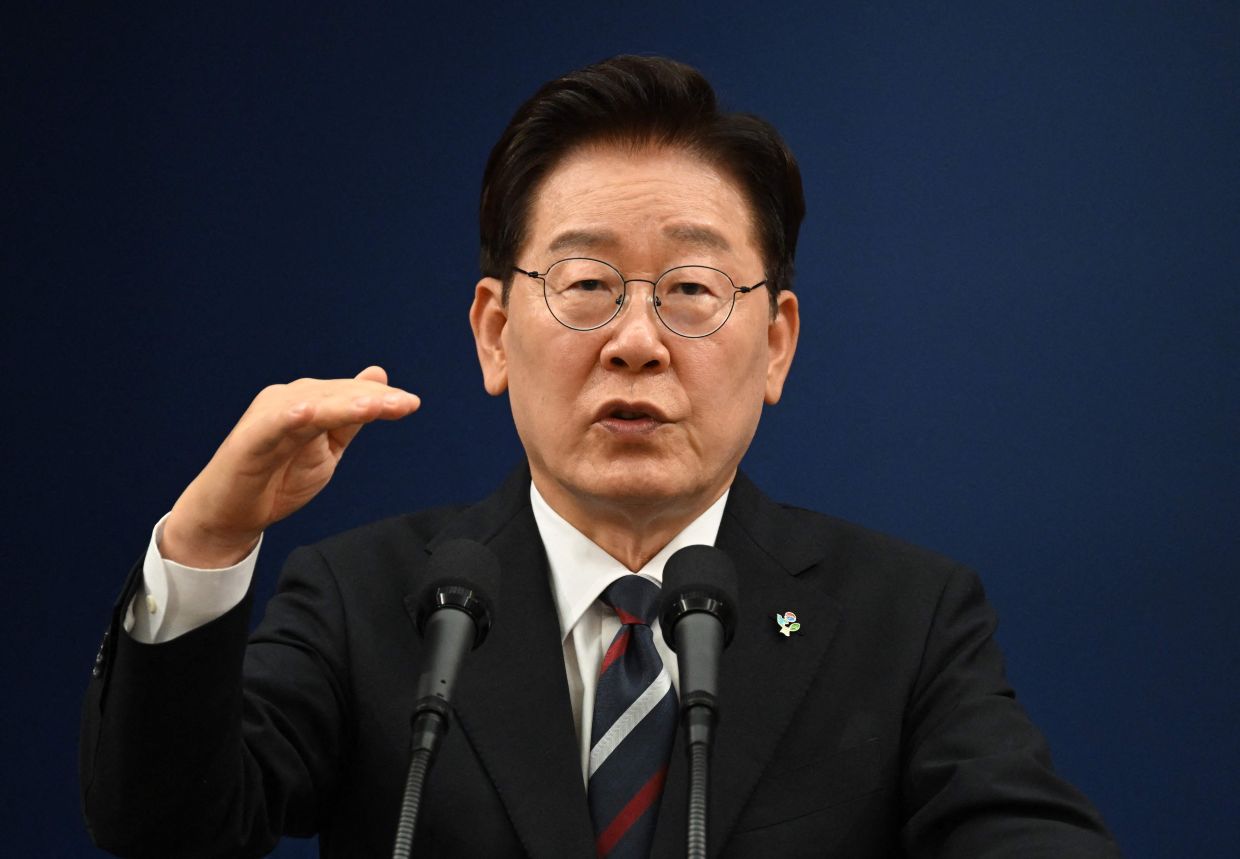
South Korean President Lee Jae Myung has experienced a significant erosion of public support, with his approval rating slipping below the critical 50 per cent threshold for the first time since assuming office on June 4, 2025. According to polling data released on June 22 by Realmeter, South Korea's leading independent pollster, Lee's approval stood at 46.7 per cent, marking the fifth consecutive week of decline. More strikingly, disapproval ratings have now surpassed approval for the first time during his presidency, with 49.7 per cent of respondents expressing negative views of his performance. This crossover point represents a watershed moment in his political fortunes, suggesting that public sentiment has fundamentally shifted from cautious optimism to active discontent.
The trajectory of Lee's approval ratings reveals a steep and sustained downward spiral over recent months. Starting from a robust 60.5 per cent in early May, his support has contracted rapidly through successive weeks—59.3 per cent, 59.1 per cent, and 55.2 per cent—before ultimately breaching the psychologically significant 50 per cent barrier in mid-June. This consistent decline of several percentage points per week indicates not merely temporary fluctuations typical of early presidential honeymoons, but rather a fundamental recalibration of public confidence in his leadership. The timing of this deterioration matters considerably, as it occurs barely three weeks into his presidency, leaving him with substantial ground to recover if he is to establish a stable political foundation for his remaining term.
Comparative analysis places Lee's declining fortunes within a broader pattern affecting recent South Korean presidents. His former predecessor, Yoon Suk Yeol, experienced a similar crossover from positive to negative approval ratings in June 2022, merely six weeks into his presidency. However, other recent occupants of the Blue House faced even lengthier honeymoon periods: former President Park Geun-hye required approximately sixteen months before disapproval exceeded approval in June 2014, while former President Moon Jae-in maintained majority support for approximately nineteen months into his term before experiencing the same reversal in December 2018. Lee's trajectory suggests he will establish an unfortunate record for the speed at which public confidence deteriorates following a new presidential inauguration, reflecting either extraordinary challenges facing his administration or fundamentally shifted expectations among South Korean voters.
The primary architects of Lee's collapsing approval ratings can be traced to two interconnected political crises. First, the June 3 local elections descended into administrative chaos when ballot shortages forced officials to improvise emergency voting procedures in numerous precincts nationwide. This failure raised serious questions about the competence of electoral authorities and cast shadows over the integrity of the electoral process itself—concerns that resonate deeply in a democracy still vigilant about safeguarding its hard-won institutions. Second, and equally damaging, the ruling Democratic Party of Korea has become engulfed in factional warfare over leadership succession ahead of an August 17 party convention scheduled to elect a new chairman. Rather than presenting a unified front to reassure voters, the party has instead showcased precisely the kind of internal division and self-interested manoeuvring that historically erodes public confidence in political institutions.
Realmeter's analysis attributes the approval ratings collapse to what it characterizes as "growing demands for accountability following the election management fiasco and escalating infighting within the ruling party over its leadership race." These two issues have substantially outweighed potentially positive developments that might otherwise have buttressed Lee's standing. The presidential office itself has highlighted the success of Lee's recent European diplomatic visit and the South Korean stock market's breakthrough above the 9,000-point milestone on the Kospi index. However, these accomplishments pale in comparison to the visceral impact of election administration failures affecting millions of voters directly and the spectacle of senior party figures publicly feuding over control of party machinery.
Geographic analysis reveals notable regional variation in the collapse of Lee's support, with the deepest declines occurring in traditionally conservative strongholds where one might expect his base to remain most loyal. In Daegu and North Gyeongsang Province, historically bastions of conservative political strength, Lee's approval fell 9.9 percentage points to merely 34.6 per cent—a dramatic showing of erosion even among his presumed natural supporters. The Greater Seoul metropolitan region, encompassing the capital itself plus the surrounding Incheon and Gyeonggi Province areas, has also witnessed substantial deterioration. In Incheon and Gyeonggi, approval dropped 7.6 percentage points to 44.8 per cent, while Seoul itself saw a 7.6 percentage point decline to 39.8 per cent. This weakness in Seoul and its surroundings carries particular significance, as this densely populated region drives national political dynamics and represents moderate voters increasingly concerned about economic conditions.
Income and asset inequality has emerged as an unexpected but potent factor undermining Lee's political position. Realmeter specifically noted that "concerns over widening disparities in the asset market appeared to erode support among moderate voters," suggesting that the symbolic success of the Kospi index breakthrough may actually have backfired by highlighting the wealth divide separating ordinary citizens from those benefiting from equity market gains. This observation carries implications extending well beyond South Korea, as similar patterns have emerged across developed democracies where stock market performance diverges sharply from wage growth and living standards for middle-class households. Such disconnects breed political resentment and create openings for anti-establishment political movements, as voters feel their concerns are ignored while elites celebrate abstract financial indices.
Demographic analysis by political ideology reveals a concerning pattern of fragmenting support across the political spectrum. Among moderate voters—often the decisive swing constituency in democratic elections—positive assessments fell 4.9 percentage points to 47.5 per cent, suggesting Lee may be losing precisely the centrist consensus necessary to govern effectively. Support among liberals declined more modestly by 3.2 percentage points to 80.4 per cent, indicating that his base coalition within the centre-left Democratic Party remains substantially intact despite factional conflicts. Conversely, conservatives edged down only 0.7 percentage point to 19.8 per cent, reflecting the fact that Lee's support among rightwing voters was already minimal given his Democratic Party affiliation. The mathematical implication of these trends is troubling: Lee's coalition is hollowing out at its middle rather than consolidating at its ideological core.
The separate Realmeter survey measuring party support rather than presidential approval ratings reveals dynamics potentially more consequential for Lee's governing prospects than his personal approval numbers. While the conservative People Power Party retained a narrow 2.2 percentage point advantage over the Democratic Party (42.3 per cent versus 40.1 per cent), this gap has compressed significantly from previous weeks as internal conflicts have weakened conservative cohesion. The People Power Party has confronted mounting pressure responding to controversies surrounding the June 3 ballot shortages, including contentious debates over whether to hold a complete election rerun and abolish early voting mechanisms. Such internal disputes over appropriate remedial responses have accelerated what Realmeter describes as "a continued exodus of younger voters in their 20s and 30s" from the conservative coalition—a particularly troubling trend for a party seeking to build durable electoral majorities.
The Democratic Party's modest rise in party approval ratings, meanwhile, appears driven by opportunistic positioning rather than substantive policy accomplishments. Following a bipartisan agreement to launch a National Assembly investigation into election administration failures, the Democratic Party has benefited from what analysts describe as a "crisis-management phase" where emphasis on party unity has temporarily overshadowed factional tensions. Support for the Democratic Party rose 2.1 percentage points to 40.1 per cent as the party's base consolidated around opposition to what they frame as conservative mismanagement of the electoral process. However, this rebound should be understood as contingent and potentially fragile, dependent on maintaining the appearance of party discipline that internal leadership rivalries threaten to fracture.
The presidential office's formal response to the approval ratings collapse struck a studied tone of humility while offering little concrete indication of substantive policy adjustments. Cheong Wa Dae issued a statement indicating willingness to "accept the numbers humbly and take greater heed of people's concerns and expectations," characterizing the approval fluctuations as reflecting "the public's assessment of both economic conditions and the overall conduct of state affairs." This formulation—embedding electoral discontent within a broader framework of economic and governance concerns—allows the presidential office to acknowledge public dissatisfaction without conceding that specific recent decisions warrant reversal or reconsideration. For Malaysian observers, this diplomatic language echoes standard responses from embattled administrations globally, typically preceding either genuine policy shifts or merely cosmetic adjustments designed to create the appearance of responsiveness.
Looking forward, Lee Jae Myung faces a politically precarious situation with limited obvious pathways to restore eroded public confidence in the immediate term. The election administration failures cannot be undone, and the Democratic Party's internal leadership contests will likely continue generating headline-dominating conflicts through August's party convention. However, historical precedent suggests that presidential approval ratings do not follow inexorably downward trajectories—external events, genuine policy accomplishments, or even the simple passage of time allowing acute controversies to fade can stabilize or even improve political standing. For regional observers in Malaysia and Southeast Asia, the South Korean case illustrates how electoral mismanagement and internal party dysfunction can rapidly transform initial presidential honeymoons into political liabilities, with implications extending across the region's own developing democracies increasingly subject to similar pressures.