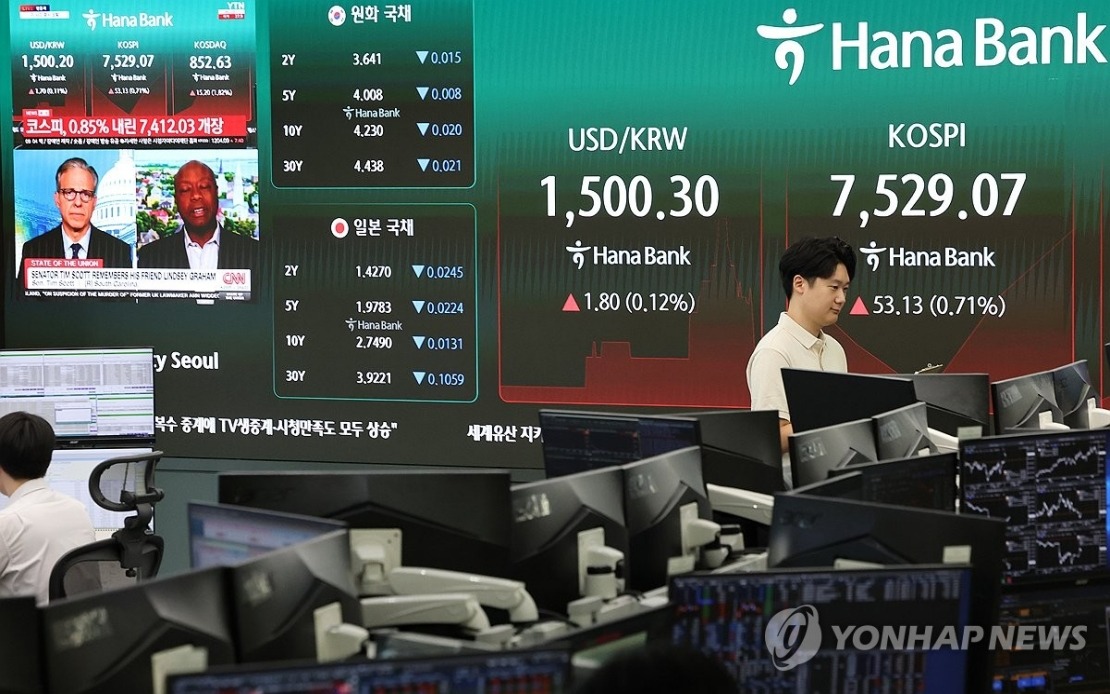
South Korea's stock market came to an abrupt standstill on Monday afternoon as heightened geopolitical risks in West Asia sent investors scrambling for the exits. The Korea Exchange (KRX) activated a marketwide circuit breaker mechanism just after 1:28 p.m. local time, suspending all trading in KOSPI-listed shares for twenty minutes after the benchmark index shed more than eight percent from the previous session's closing level. The automatic halt underscores how rapidly external shocks can reverberate through financial markets in an increasingly interconnected region, with ripple effects potentially reaching Malaysian investors and businesses.
The trigger for Monday's sharp selloff centred on renewed military brinkmanship between the United States and Iran over control of the Strait of Hormuz, one of the world's most critical energy supply routes. This strategic waterway between the Persian Gulf and the Gulf of Oman handles roughly one-third of global seaborne petroleum trade, making any disruption to shipping lanes a matter of acute concern for energy-dependent economies throughout Asia. South Korean investors reacted with particular alarm given their nation's vulnerability to oil price shocks and its heavy reliance on imports of Middle Eastern crude to fuel both industry and power generation.
The circuit breaker mechanism itself represents a safeguard designed to prevent panic-driven market crashes through enforced trading halts. When the KOSPI declines by a predetermined threshold—in this case, approximately eight percent from the previous close—the system automatically suspends all transactions for a fixed period, allowing market participants time to reassess positions and absorb new information before returning to trading. This structural feature aims to preserve market integrity and reduce the likelihood of cascading sell orders that could amplify losses during periods of acute uncertainty.
Monday's activation marked the seventh instance this calendar year that KRX has deemed conditions severe enough to impose a marketwide circuit breaker. This frequency merits attention from regional observers, as it suggests underlying volatility in Asian equities and heightened sensitivity to geopolitical developments. For Malaysian investors with exposure to Korean stocks or regional indices, such episodes serve as reminders of how concentrated risk can manifest across borders and how seemingly distant conflicts can translate into immediate portfolio consequences.
The Strait of Hormuz dispute carries particular weight in Asian financial calculations because the region depends overwhelmingly on hydrocarbons flowing through that narrow passage. Any credible threat to transit—whether through military action, blockade, or accident—raises energy costs across the supply chain. South Korea, which imports virtually all its crude oil and natural gas from foreign sources, faces among the highest exposure to supply disruptions in the developed world. This structural vulnerability means Korean equity markets will remain hypersensitive to any news suggesting Hormuz-related instability.
Beyond the immediate trading halt, Monday's market turbulence illustrates a broader pattern affecting emerging and developed markets throughout Southeast Asia and the Pacific. When global risk sentiment deteriorates suddenly, capital tends to flow away from regional bourses toward perceived safe havens such as US Treasuries or the Japanese yen. This flight to safety can drain liquidity from smaller markets and amplify volatility in countries already grappling with currency pressures or current account imbalances.
The role of automated trading systems in modern markets adds another layer of complexity. Circuit breakers were designed partly to counter the destabilizing effects of algorithmic trading, which can execute massive sell orders faster than human traders can reassess fundamental conditions. Yet they also raise questions about whether brief trading halts genuinely restore calm or merely delay inevitable selling when underlying concerns remain unresolved. If investors resume trading convinced that geopolitical tensions will persist, the initial rebound following a halt may prove temporary.
Investors monitoring Korean financial markets should consider whether Monday's decline reflects a proportionate response to actual Hormuz-related supply risks or instead represents overreaction driven by momentum selling. The fundamental question separating justified caution from panic lies in assessing whether the US-Iran escalation will genuinely disrupt oil flows—and if so, for how long. Current assessment among energy markets suggests most market participants believe the Strait remains passable despite tensions, yet this consensus can shift rapidly on breaking news.
The implications for Malaysian readers extend across multiple dimensions. Malaysian companies with exposure to Korean supply chains or equity investors holding KOSPI positions face direct consequences from Korean market volatility. More broadly, Monday's circuit breaker activation serves as a reminder that regional financial stability depends on managing geopolitical risks extending far beyond Southeast Asia's borders. Energy prices, currency movements, and capital flows all connect Malaysian interests to developments in the Middle East and Northeast Asia in ways that may not be immediately obvious to casual observers.

