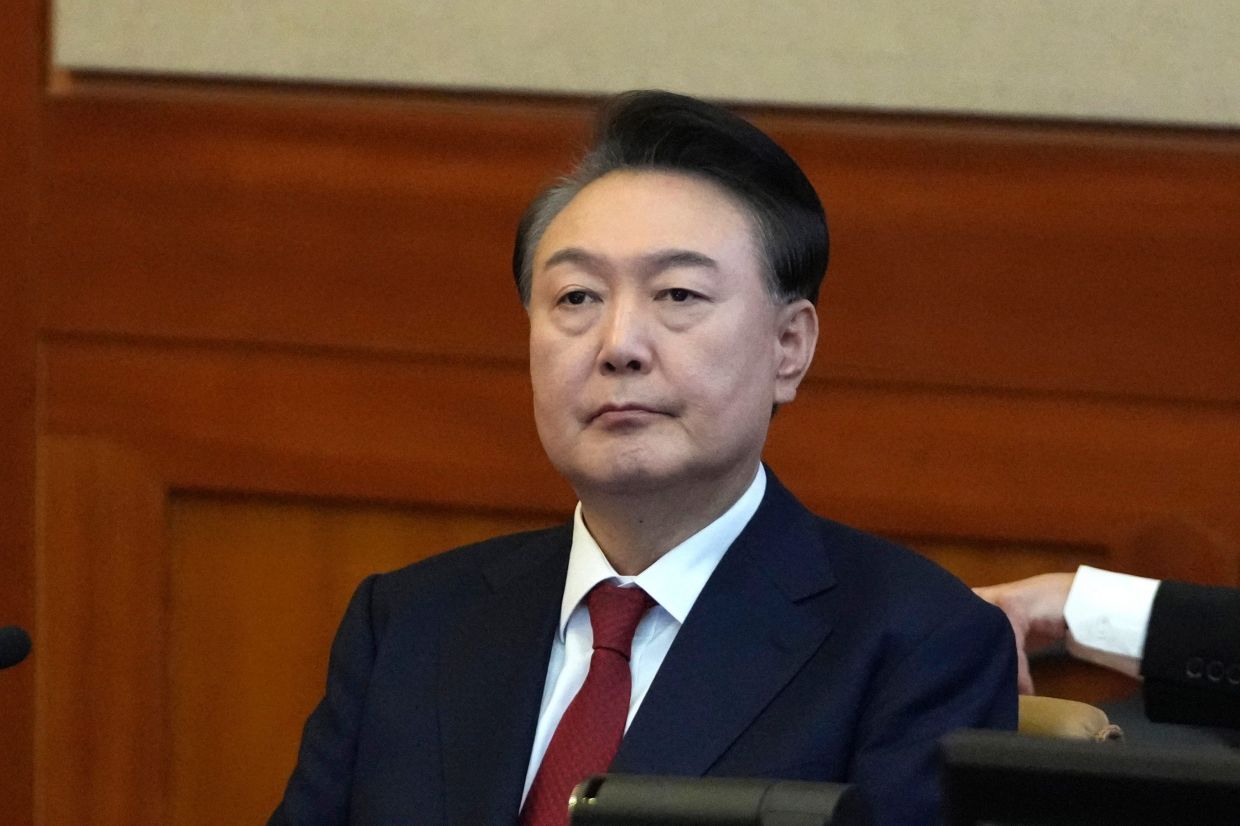
South Korea's highest court has confirmed a seven-year prison sentence against former president Yoon Suk Yeol in connection with his ill-fated martial law declaration and the turmoil that followed. The Supreme Court's decisive ruling on Thursday closes the final chapter on the constitutional crisis triggered by Yoon's shocking late-night address in December 2024, which suspended civilian rule for approximately six hours before lawmakers voted to overturn it. The decision represents a significant development in South Korea's ongoing political reckoning and carries implications for the region's stability and democratic governance.
The Supreme Court's judgment addresses a complex web of charges extending well beyond the martial law announcement itself. Yoon faced accusations that he had systematically circumvented proper governmental procedures by summoning only a select group of cabinet ministers for deliberations immediately preceding his controversial decree. Prosecutors demonstrated that the ex-president had orchestrated the creation and subsequent destruction of a fraudulent martial law order bearing forged signatures purportedly from the prime minister, establishing a pattern of deliberate deception at the highest levels of government. The charges also encompassed his direction of officials to circulate misleading statements to international media outlets, an effort to shape the global narrative surrounding his actions during those turbulent hours.
Beyond these administrative infractions, Yoon stood accused of obstructing his own lawful arrest by enlisting presidential security personnel to block investigators' attempts to detain him after the National Assembly had nullified his martial law declaration. This obstruction represented perhaps the most damaging dimension of the case, demonstrating an apparent willingness to deploy state security apparatus against legitimate judicial processes. The military dimension of the accusations was equally grave, involving allegations that Yoon had directed an army commander to erase records stored on secure military communication devices, further suggesting a systematic effort to destroy evidence of his decision-making processes.
The journey through South Korea's legal system has been remarkably swift and contentious. A lower court initially sentenced Yoon to five years in January after convicting him on the majority of charges. An appellate tribunal subsequently upheld this conviction in April whilst adding a guilty verdict on the misleading press release charge, raising the sentence to seven years. Prosecutors had initially demanded a substantially harsher penalty of ten years, suggesting the courts exercised restraint in their final calculations. The Supreme Court's affirmation of the seven-year term signals judicial consensus across multiple levels regarding both the gravity of Yoon's conduct and the appropriate consequences for his actions.
The announcement of the Supreme Court's decision was notably clinical in tone, with the presiding judge tersely declaring all appeals dismissed and asserting that the lower court's judgment "contained no errors." This language foreclosed any suggestion of judicial doubt or lingering ambiguity about Yoon's culpability. Yoon's legal team responded swiftly with expressions of "deep regret," alleging that the Supreme Court had reached its conclusion "without sufficient deliberation." They subsequently announced plans to mount a constitutional challenge to the ruling and indicated their intention to file formal complaints, suggesting they view the decision as potentially vulnerable on procedural or fundamental rights grounds rather than on the underlying facts.
The December 2024 martial law declaration itself remains unprecedented in modern South Korean history. Yoon's shocking televised address announcing the suspension of civilian government rule triggered immediate domestic turmoil, with large-scale public protests erupting throughout the nation. International financial markets registered anxiety through sharp declines in South Korean equities, whilst diplomatic partners including the United States expressed surprise and concern about the sudden rupture in constitutional governance. The brevity of the martial law period—roughly six hours before lawmakers assembled for an emergency parliamentary session to vote it down—prevented more extensive institutional disruption, yet the episode's reverberations continue to reshape South Korea's political landscape and regional standing.
Yoon's defence has centred throughout these proceedings on claims of patriotic motivation, with the former president insisting his martial law declaration served exclusively "for the sake of the nation." He has justified the extraordinary measure as necessary to confront what he characterised as "anti-state forces" threatening the republic, along with purported security threats emanating from North Korea. In a separate criminal proceeding, a court convicted Yoon of orchestrating drone flights into North Korean airspace, assigning him a 30-year sentence on the theory that he was manufacturing a crisis atmosphere to justify his martial law intervention. This additional conviction paints a picture of calculated preparation rather than spontaneous emergency response, substantially undermining his narrative of defensive national action.
The political consequences of Yoon's removal and imprisonment have already reshuffled South Korea's governing coalition. He was ousted in April 2025 through the impeachment process directly triggered by the martial law crisis, creating a presidential vacuum resolved through elections that elevated Lee Jae Myung of the centre-left Democratic Party to the nation's highest office. This transition reflects both public rejection of Yoon's political project and institutional resilience in managing the constitutional emergency without greater damage. For Malaysia and other Southeast Asian democracies, Yoon's case offers cautionary lessons about executive overreach and the potential consequences when elected leaders attempt to bypass constitutional restraints under claims of emergency.
The Supreme Court's confirmation of the seven-year sentence brings judicial finality to this particular strand of proceedings, though Yoon continues to contest the separate 30-year conviction related to the drone incident. His incarceration during ongoing appeals to constitutional courts creates an extraordinary situation wherein a former head of state faces potential decades of imprisonment while still maintaining formal legal arguments about the legitimacy of his original actions. This protracted legal struggle underscores South Korea's commitment to holding even former presidents accountable whilst simultaneously revealing the institutional strain created by efforts to judicially resolve what many observers fundamentally view as a political rather than purely criminal matter.

