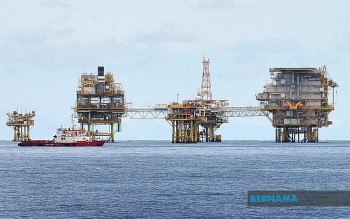
Southeast Asia's offshore energy sector is demonstrating remarkable resilience, with capital spending set to accelerate significantly even as geopolitical risks persist across the broader Asia Pacific region. According to Hong Leong Investment Bank, greenfield capital expenditure in Southeast Asia is anticipated to surge by 12 per cent, potentially exceeding US$100 billion, underscoring a pronounced shift toward new offshore development initiatives. This expansion comes at a critical juncture when regional players are reassessing their investment priorities following the volatility triggered by recent West Asian tensions, yet confidence appears to be strengthening among operators planning fresh ventures in the region's energy-rich waters.
The investment outlook extends beyond new projects into the maintenance and enhancement of existing infrastructure. South Asia is expected to lead brownfield capital expenditure growth at 23.0 per cent, while Southeast Asia contributes a more modest 3.0 per cent increase. This dual momentum—combining aggressive expansion in greenfield projects with steady investment in established assets—reflects operators' determination to bolster supply resilience across the near term. The emphasis on brownfield capex underscores the value placed on keeping producing assets competitive and operational, particularly as global energy security concerns reshape investment calculus across the region.
Geopolitical stability remains a critical variable shaping these investment decisions. The recent United States-Iran ceasefire agreement, formalised through a 14-point memorandum of understanding, has provided some breathing room for market participants cautiously optimistic about de-escalation in West Asian tensions. While analysts recognise the fragility of this arrangement, the signing itself has prompted a recalibration of risk assessments that had previously dampened confidence. Shipping activity through the Strait of Hormuz, one of the world's most strategically important maritime chokepoints, has begun recovering as operators gain greater clarity on transit safety and insurance costs. However, the incomplete picture painted by shipping data—satellite imagery suggests vessels are increasingly transiting with automatic identification systems disabled—hints that underlying anxiety persists, and normalisation may be gradual and uneven.
For Malaysia and the broader Southeast Asian region, these dynamics carry particular significance given the interconnection between regional oil and gas development and global market conditions. The International Energy Administration's assessment suggests that days of global commercial inventory supply will decline sharply to 50 days by late 2026, substantially below pre-conflict levels exceeding 60 days. This inventory drawdown is creating structural support for oil prices, which Hong Leong Investment Bank forecasts will stabilise around US$75 to US$80 per barrel over the medium term. The pressure on global inventories effectively elevates the premium placed on new supply sources and underscores why Southeast Asian offshore projects attract sustained investor interest despite cyclical headwinds.
The pricing environment carries direct implications for Malaysia's energy sector and broader economy. Brent crude's recent retreat from peaks to approximately US$69 per barrel represents a marked adjustment from earlier highs, yet still sits above production breakeven points for most conventional offshore developments in Southeast Asia. Hong Leong Investment Bank has adjusted its 2026 Brent forecast downward to US$80 per barrel from an earlier US$90 projection, while maintaining a US$75 floor for the following year. This revised outlook still provides sufficient margin for operators to justify capital deployment, particularly as depreciation benefits and contract mechanisms protect margins across cycles. IPPFA economist Mohd Sedek Jantan emphasises that sustained prices within the US$70-75 per barrel range would create a more favourable operating environment for regional businesses by reducing energy-related input costs and improving cost predictability for industrial operations.
Petronas, Malaysia's national oil company, stands positioned to benefit meaningfully from these trends. Hong Leong Investment Bank anticipates a potential Petronas capital expenditure upcycle beginning around 2027, which would support domestic oil and gas services and equipment providers substantially. Companies specialising in upstream development, hook-up and commissioning activities, maintenance operations, marine support services, fabrication, and pipeline-related works represent the primary beneficiaries of this projected cycle. This downstream multiplier effect extends the investment impulse beyond major operators into the intricate ecosystem of service providers that have become integral to Southeast Asia's offshore competitiveness. Malaysian firms with capabilities in these domains should anticipate enhanced demand visibility over the planning horizon.
The structural support for elevated oil prices reflects production constraints in key regions. Shut-in volumes across the Strait of Hormuz region escalated to 45 per cent by May 2026 from 35 per cent three months earlier, compressing available supply and lengthening recovery timelines. This supply tightness, combined with modest global inventory reserves, creates a more supportive environment for new project development economics. Even modest production delays or maintenance cycles command attention in this constrained market, reinforcing the value proposition for reliable offshore producers located outside geopolitical hotspots. Southeast Asia's geographic positioning as a politically stable production region increasingly attracts capital allocation decisions that might otherwise flow to higher-risk jurisdictions.
For Malaysian policymakers and investors, the convergence of factors supporting Southeast Asian offshore spending merits attention across multiple dimensions. The projected greenfield capex expansion signals that market fundamentals remain sound despite headline uncertainties, suggesting that long-term energy demand expectations remain robust among international operators. The emphasis on new development rather than mere maintenance indicates confidence that future supply will be required to meet global needs. At the time of reporting, Brent crude stood at US$69.17 per barrel, up 0.90 per cent, while West Texas Intermediate rose 0.94 per cent to US$72.67 per barrel, reflecting the complex dynamics between demand concerns and supply constraints.
Beyond immediate energy sector implications, the anticipated price environment and investment trajectory carry broader macroeconomic significance for the region. Sustained oil prices within moderate ranges support business investment by limiting energy-related cost volatility, strengthen consumer purchasing power through controlled inflation dynamics, and provide central banks with flexibility in monetary policy formulation. This supportive environment reinforces conditions for broader regional economic recovery while maintaining sufficient margins to incentivise continued capital deployment in energy infrastructure. The interplay between geopolitical stability improvements, inventory normalisation timelines, and Southeast Asia's structural attractiveness as a production destination suggests that offshore energy investment in the region has entered a potentially durable expansion phase, notwithstanding inevitable fluctuations around the medium-term price outlook.

