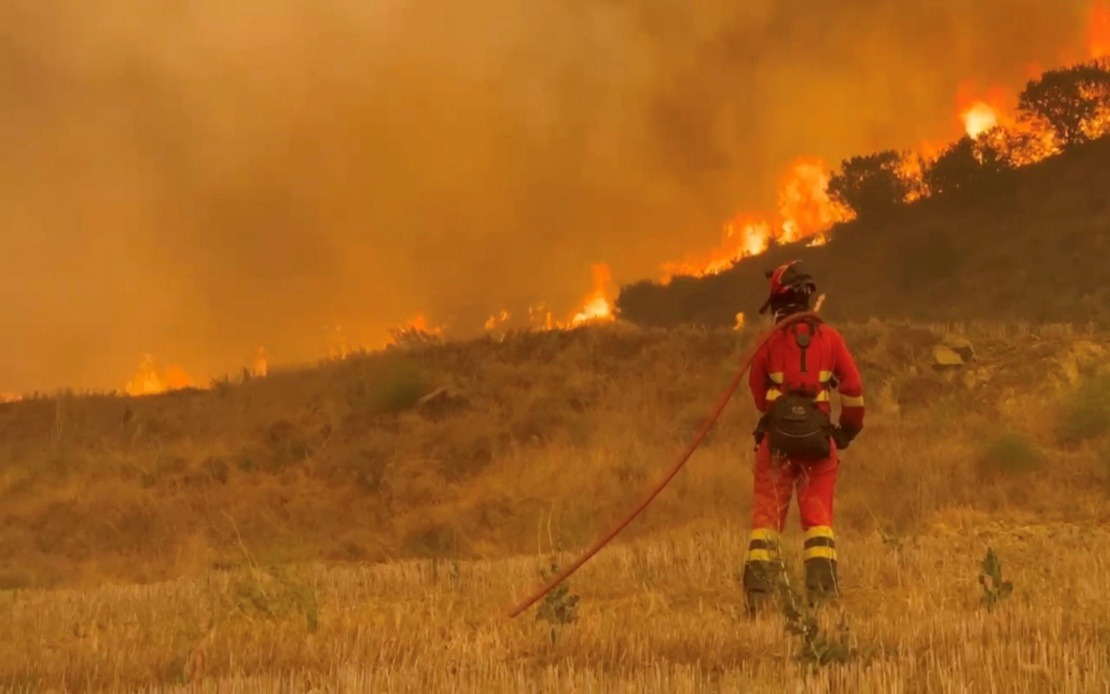
Spain is grappling with its most severe wildfire season of the year, with a massive blaze in the northeastern province of Zaragoza having destroyed approximately 12,000 hectares of land since igniting on Wednesday. The fire, which originated in the Cinco Villas region, has necessitated the displacement of more than 1,100 residents from five municipalities in Zaragoza and one adjacent municipality in Navarre, with authorities reporting the situation remains critically unstable and spreading rapidly overnight into Friday.
The sheer scale of the conflagration has stretched emergency response capabilities across Spain. By Thursday, authorities had mobilised approximately 400 ground personnel along with 19 aircraft to combat the advancing flames, with particular focus placed on defending residential areas in Uncastillo throughout the night. The fire's perimeter now extends roughly 60 kilometres across the landscape, creating a sprawling arc of destruction that has necessitated multiple road closures across the affected region. Despite the intensive response, descriptions from emergency services characterised the situation as "quite active" with "significant" advancement, indicating that containment remains elusive.
The crisis extends well beyond the primary Zaragoza fire. In Guadalajara province to the north, another substantial wildfire near La Mierla has consumed approximately 900 hectares, triggering evacuations and implementing lockdown protocols in neighbouring communities. A third fire near Lozoyuela, situated north of Madrid, continues to pose challenges despite showing more encouraging containment prospects, though emergency services maintain it remains neither controlled nor fully contained. These simultaneous blazes have stretched firefighting resources across a vast geographical area, prompting the regional government to petition for reinforcements from Spain's Military Emergency Unit, which dispatched around 100 personnel to supplement ongoing operations.
Criminal investigations have emerged from the incident, with the Civil Guard apprehending a suspect connected to the Madrid-region fire's origin. The regional government has indicated its intention to participate in legal proceedings as a civil party, signalling a serious response to potential arson or negligence allegations. This development underscores how wildfire crises often intersect with criminal liability and public accountability, issues that Spanish authorities are treating with appropriate gravity.
The cascading nature of the emergency has disrupted essential services across the impacted territories, though officials reported that electricity restoration to affected municipalities had been completed. However, substantial portions of the Cinco Villas region remain under lockdown conditions, with critical transportation arteries shuttered indefinitely. These operational disruptions have compounded the human and environmental costs of the disaster, creating secondary effects that ripple through affected communities' economic and social functioning.
Meteorological and environmental conditions have conspired to fuel the fires' intensity and spread. High ambient temperatures combined with vigorous wind conditions and exceptionally low humidity have created ideal combustion circumstances, whilst the abundance of dried vegetation following a wet spring provided abundant fuel load. This meteorological combination has essentially created a tinderbox across northeastern Spain, where any ignition source encounters conditions perfectly suited for rapid, uncontrolled propagation.
Examples like Spain's current crisis illuminate broader concerns that climate specialists and environmental analysts have been emphasising for years. Climate change is fundamentally altering temperature and precipitation patterns, whilst simultaneously the progressive abandonment of rural areas has eliminated traditional land management practices that once naturally suppressed hazardous fuel accumulation. As communities withdraw from countryside regions across Europe, vegetation management activities diminish correspondingly, allowing dried wood and undergrowth to accumulate to dangerous levels. This combination of climatic shifts and socioeconomic rural depopulation has essentially created structural conditions favouring catastrophic wildfire episodes.
For Southeast Asian observers, Spain's wildfire catastrophe carries instructive lessons regarding natural disaster preparedness and climate adaptation strategy. Malaysia and neighbouring nations equally confront seasonal fire hazards, particularly during extended dry periods affecting peatlands and forest regions. The Spanish experience demonstrates how rapidly wildfire situations can exceed conventional emergency management capacities, necessitating integrated approaches combining advanced detection systems, pre-positioned resources, cross-regional coordination frameworks, and civilian evacuation protocols refined through regular training exercises.
The incident also illustrates how climate change manifests through intensified natural hazards across diverse geographical regions. Spain's Mediterranean-influenced northeastern province and tropical Southeast Asia occupy different climatic zones, yet both face accelerating disaster frequency and magnitude. This convergence suggests that regional governments must embrace increasingly sophisticated risk assessment methodologies and invest substantially in protective infrastructure, trained personnel, and technological capabilities for early warning and rapid response mechanisms.
Meanwhile, the immediate humanitarian challenge remains acute, with thousands displaced and properties threatened by advancing flames. The ongoing mobilisation of military and civilian resources reflects the extraordinary demands such disasters impose upon state capacity. Spanish authorities continue implementing evacuation protocols and firefighting operations whilst simultaneously investigating potential causes and commencing damage assessment procedures that will ultimately determine reconstruction requirements and liability determinations.

