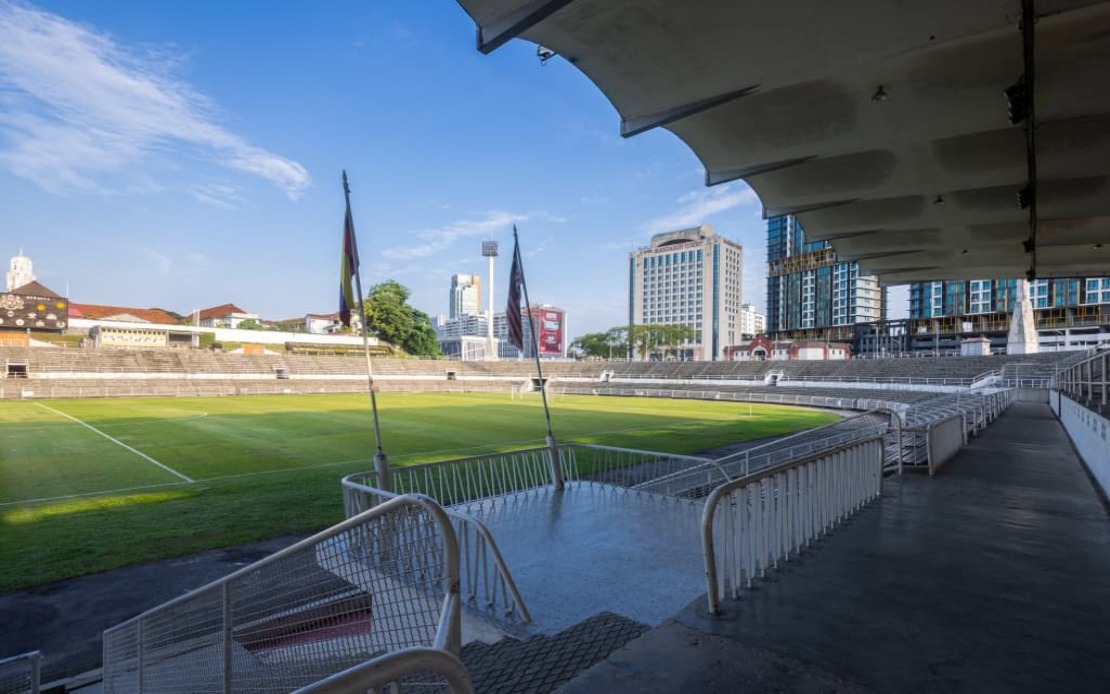
Nearly seven decades have passed since Stadium Merdeka echoed with the words that transformed a nation, yet the venue remains far more than a relic of history—it is an active bridge connecting modern Malaysia to the moment of its birth. When Tunku Abdul Rahman Putra Al-Haj proclaimed Malaya's independence on August 31, 1957, his seven resounding cries of "Merdeka!" reverberated through the stadium's walls, marking the end of colonial rule and the beginning of a sovereign nation. Today, despite being dwarfed by the gleaming Merdeka 118 and surrounded by Kuala Lumpur's contemporary architecture, the stadium continues to serve as a powerful symbol of the aspirations and determination that forged modern Malaysia.
The construction of Stadium Merdeka was itself a remarkable feat of national will. Built within a single year at a cost of approximately RM2.3 million, the venue was purpose-built to host the independence proclamation and has since become an architectural and symbolic anchor for the nation. Its very existence represents the confidence and momentum of a young nation stepping into independence. Professor Sarjit Singh Gill from Universiti Putra Malaysia, speaking from his position as Chairman of the National Council of Professors' National Unity Cluster, articulates the stadium's deeper significance beyond its sporting function. He emphasises that Stadium Merdeka embodies the nation's identity, dignity, and cultural heritage, serving as a tangible embodiment of the transition from colonial subjugation to self-determination.
The stadium's historical importance expanded in 1957 when it hosted the proclamation of the Malaysian Federation, a watershed moment that incorporated Sabah, Sarawak, and Singapore into the broader federation and formally concluded British colonial administration across these territories. This event underscored the stadium's role not merely as a venue for a single celebration, but as the stage for successive acts in Malaysia's emergence as a nation. The significance of these events being housed within the same walls cannot be overstated—it concentrates the symbolism of national transformation in one physical location that citizens can visit, touch, and experience directly.
The stadium faced an existential threat in the late 1990s when redevelopment pressures threatened to erase this crucial monument. Public opposition and government intervention proved decisive in protecting the site, demonstrating that Malaysians across the country recognised the irreplaceable value of this physical anchor to their collective history. In 2000, Permodalan Nasional Berhad (PNB) assumed stewardship of the venue with a mandate to preserve rather than merely exploit its potential commercial value. This decision reflected a deliberate choice to prioritise heritage conservation over immediate financial returns—a stance not always easy to maintain in a rapidly developing capital city.
Under PNB's management through PNB Merdeka Ventures Sdn Bhd, the stadium has undergone meticulous restoration work guided by original Public Works Department construction drawings. Rather than simply renovating the structure, conservation efforts deliberately removed later additions to restore the original 20,000-seat capacity and carefully rehabilitated defining features including the scoreboard, washrooms, mosaic tiling, and distinctive cantilevered roof. According to Datuk Dr Izwan Ibrahim, Chief Executive Officer of PNB Merdeka Ventures, this approach prioritises authenticity as paramount. The philosophy underpinning these efforts centres on preserving the stadium's stories and making them accessible to Malaysians, recognising that the venue represents far more than nostalgia—it embodies the aspirations and determination that shaped the nation.
The stadium's transformation into a living cultural space rather than a static museum demonstrates a sophisticated approach to heritage preservation. Rather than cordoning it off as an untouchable relic, the venue now serves the community directly through a refurbished running track open to public use and by hosting cultural events that draw large crowds. The Bazram Merdeka bazaar, a Ramadan marketplace held at the venue, attracted over 250,000 visitors earlier this year, demonstrating the stadium's capacity to remain vibrant and relevant to contemporary Malaysian life. This dual function—simultaneously preserving history while facilitating active community engagement—offers a model for heritage management that respects the past without imprisoning it in amber.
The challenge of connecting younger Malaysians to the independence story occupies a central position in PNB's strategy for the venue. For generations born decades after 1957, independence exists primarily as classroom content or family recollections rather than as lived experience. Dr Izwan Ibrahim recognises this generational distance and champions an experiential approach to historical education. By encouraging young people to visit Stadium Merdeka, participate in activities within its grounds, and create their own personal connections to the space, the management seeks to transform abstract historical knowledge into embodied understanding. Schools and universities increasingly bring students to the site, particularly during the national month, to develop their relationship with this foundational moment in the nation's story.
Recognition of the stadium's significance has come through formal channels as well. The venue received a UNESCO Asia-Pacific Heritage Award in 2008, acknowledging its importance within the broader Asian context, and was gazetted as a National Heritage site in 2009. These official designations provide legal and cultural protection while underscoring that Stadium Merdeka's significance transcends Malaysia's borders—it represents a crucial moment in twentieth-century Asian decolonisation and the emergence of post-imperial nation-states. The international recognition validates Malaysia's commitment to preserving this monument and signals to the world that the nation takes its history seriously.
The human dimension of the stadium's preservation emerges powerfully through the experiences of its caretakers. Alias Daud, who devoted the final decade of a thirty-five-year PNB career to maintaining the venue, embodies the deep personal attachment that grounds heritage preservation in genuine human commitment rather than bureaucratic obligation. For Daud, walking through Stadium Merdeka's gates each day evoked feelings of pride, gratitude, and nostalgia—emotions rooted in his conviction that the space transcended its function as a workplace. His observations of visitors from all walks of life passing through, each carrying their own stories and memories, attested to the stadium's role as a repository for collective national experience. Particularly during the national month, when government agencies, schools, and universities intensified their visits, the atmosphere became charged with the significance of national reflection and intergenerational transmission of historical memory.
Visitors to Stadium Merdeka frequently expressed surprise and deepened appreciation upon learning that this was where independence was proclaimed, revealing how easily such crucial historical locations can recede from public consciousness. The act of visiting, reading plaques, taking photographs, and absorbing the physical atmosphere of the site creates a different quality of understanding than encountering the same information through textbooks or screens. Younger visitors in particular demonstrated this transformation, moving from abstract knowledge to visceral comprehension through direct experience. The stadium thus functions as an educational instrument that supplements formal schooling while remaining accessible and welcoming to casual visitors.
As Kuala Lumpur's skyline transforms with contemporary architecture and development pressure continues to mount throughout the capital, Stadium Merdeka stands as an increasingly powerful counterweight—a reminder that progress must be measured not only in economic terms or architectural innovation but in the preservation of the monuments and memories that anchor national identity. The stadium's survival and flourishing despite surrounding modernisation demonstrates that heritage conservation and urban development need not be binary choices. The contrast between the historic stadium and the soaring Merdeka 118 creates a productive tension, with each structure lending meaning to the other—the old grounds the new in historical continuity, while modern achievements demonstrate the fruits of the independence the stadium commemorates.
Looking forward, Stadium Merdeka's continued significance will depend on sustained commitment to active preservation and community engagement. The management's emphasis on making the space accessible to younger generations, facilitating direct experience rather than mere passive learning, offers a sustainable model for keeping the site vital rather than allowing it to ossify into irrelevance. As Malaysia continues its development journey, Stadium Merdeka will remain the physical and spiritual touchstone where citizens can reconnect with the moment their nation chose freedom, where the echoes of "Merdeka!" continue to resonate across generations, inspiring reflection on how far the country has travelled and how its founding ideals might guide its future path.

