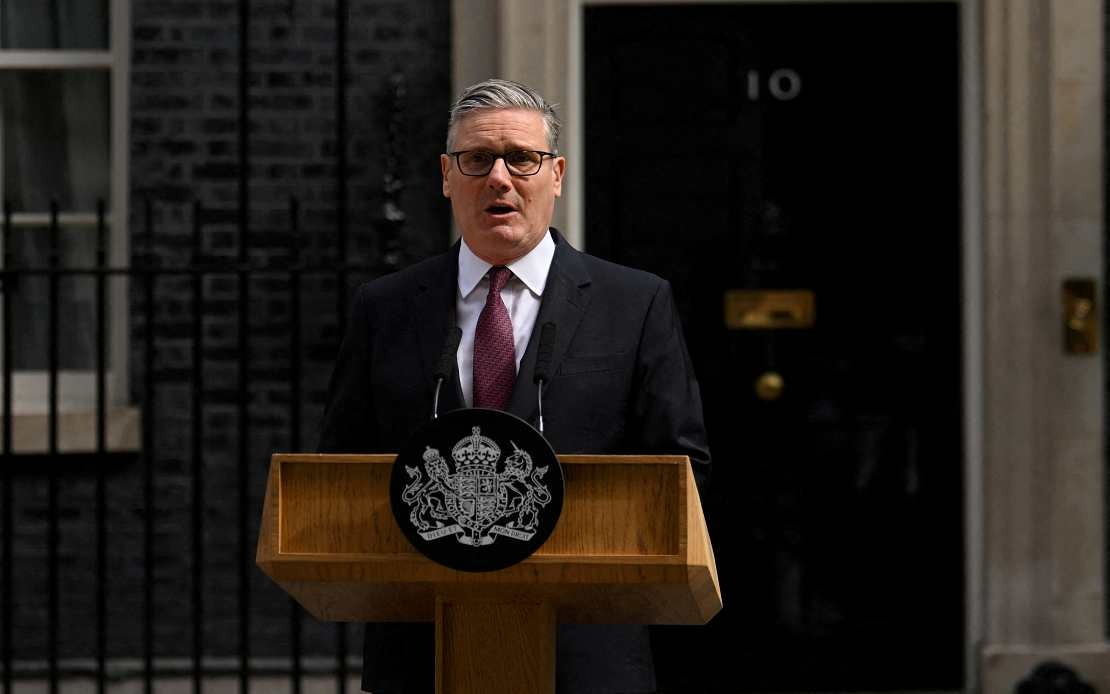
Keir Starmer has stepped down as British prime minister, delivering a final address at Downing Street on Monday before formally tendering his resignation to King Charles. In remarks made alongside his wife Victoria and close associates, Starmer reflected on his tenure and indicated that Andy Burnham will assume the top job. The departure marks a significant turning point in British politics and carries implications for regional affairs and trade relationships across Southeast Asia, where stability in Westminster traditionally carries weight in international negotiations.
Starmer's departure concludes a political journey that began with Labour's catastrophic election loss in 2019, when the party suffered historic defeats across the country. Over the subsequent years, the then-opposition leader embarked on an extensive restructuring programme designed to rebuild Labour's credibility and electoral appeal. By 2024, those efforts culminated in a decisive general election victory, handing Starmer a commanding mandate and allowing him to move into 10 Downing Street as prime minister. His two-year tenure followed, during which he implemented policies aimed at strengthening the nation's economic and social fabric.
In his remarks, Starmer characterised his time in office as fulfilling the objectives he had set upon taking power. He stated plainly that his "work is done" and that he departed "with a smile," suggesting a sense of completion rather than forced removal or political defeat. This framing carries psychological weight in British politics, as prime ministers who exit on their own terms typically maintain greater influence over their party's direction and legacy than those pushed out by internal pressure or electoral rejection. Starmer's voluntary departure thus preserves his standing within Labour circles and potentially positions him for continued influence in party affairs.
The prime minister's characterisation of Britain as "stronger and fairer" than when Labour assumed office represents a subjective assessment that will likely face scrutiny from political opponents and independent analysts. During his tenure, the government navigated economic challenges, international tensions, and domestic policy debates ranging from welfare reform to the cost-of-living crisis. Whether citizens genuinely feel the country has improved under Labour leadership remains contested, with polling data and regional variations suggesting mixed public sentiment. Nonetheless, Starmer's framing offers a narrative of purposeful governance and measurable progress, even as his departure suggests underlying dynamics may have prompted the decision to step aside.
Andy Burnham's emergence as the favoured successor represents continuity within Labour's leadership structure, though the Manchester-based politician brings a different political profile and regional identity compared to Starmer. Burnham's background as mayor of Greater Manchester and his focus on devolution and regional economic development signal potential shifts in how the party balances central authority with local governance. For Southeast Asian observers monitoring British political stability, the transition to a new Labour leader within the same party suggests institutional coherence and reduced likelihood of dramatic policy reversals, though specific approaches to trade, defence, and regional security remain subject to Burnham's particular priorities.
The symbolism of Starmer's journey to Buckingham Palace to formally resign to the monarch underscores the constitutional procedures that govern British power transitions. Rather than a sudden collapse of government or electoral earthquake, this represents an orderly transfer of authority within established parliamentary frameworks. The presence of family members and colleagues during his final Downing Street address emphasises the personal dimensions of high office and the weight of such transitions on individuals who have occupied Britain's most senior political position. This ceremonial dimension reflects British constitutional tradition and the formal processes that typically accompany changes in prime ministerial leadership.
For Malaysia and other Southeast Asian nations, developments in British politics carry tangible consequences for bilateral relationships and regional stability. The United Kingdom maintains significant diplomatic, defence, and trade interests across the region, and changes in Westminster leadership inevitably produce adjustments in foreign policy priorities and bilateral engagement. Burnham's assumption of the premiership will likely prompt reassessments of Britain's role in the Indo-Pacific, its participation in regional security arrangements, and the emphasis placed on trade partnerships with ASEAN nations. The transition period itself may create temporary uncertainties regarding decision-making timelines on matters affecting the region.
Labour's control of Parliament following the 2024 election provided Starmer with substantial legislative capacity to implement his agenda, though the duration of his premiership—approximately two years—represents a relatively brief tenure by modern standards. Prime ministers typically serve longer terms, suggesting that Starmer's decision to step aside while maintaining party control reflects deliberate choice rather than electoral loss or parliamentary defeat. This voluntary transition pattern differs markedly from scenarios where leaders are forced out by backbench rebellions or public rejection, allowing for more managed succession processes and clearer handovers of authority.
The timing and circumstances of Starmer's resignation merit consideration within broader British political contexts. His departure comes after a period during which Labour governed with substantial parliamentary majorities, allowing for implementation of policy objectives without requiring consensus-building across party lines. The decision to hand power to Burnham rather than trigger new leadership elections or general contests suggests internal Labour machinery functioned smoothly in determining succession. This contrasts with periods of fractious party politics when multiple candidates compete for leadership positions, potentially causing damage to party unity and public standing.
Burnham's positioning as successor potentially signals Labour's intent to emphasise regional development, devolution, and addressing geographical inequalities that have defined British political debate in recent years. As a figure associated with northern England and metropolitan governance, Burnham may prioritise policies affecting post-industrial regions and urban centres experiencing economic transition. These policy orientations could influence how Britain approaches development assistance in Southeast Asia, the emphasis placed on regional trade initiatives, and the priorities reflected in diplomatic engagement with nations in the region experiencing similar developmental challenges.
The broader context of Starmer's departure includes assessment of Labour's first two years governing after fourteen years of Conservative-led administrations. Labour inherited an economy facing multiple pressures, public services requiring substantial investment, and international relationships requiring recalibration following years of Brexit-related focus and political turbulence. Starmer's characterisation of progress in these areas provides Labour's preferred narrative for the government's record, though independent economists and policy analysts offer varied assessments of whether tangible improvements materialised or whether structural challenges persisted throughout the tenure.
Looking forward, Burnham's leadership will shape Labour's trajectory through potential electoral cycles and his government's engagement with Southeast Asian partners across trade, security, and development domains. The transition from Starmer to Burnham represents continuity in party control but potential evolution in policy emphasis and political style. For Malaysian policymakers and regional observers, tracking how British politics develops under new leadership remains important for understanding how this traditional Western power calibrates its interests and commitments across the Indo-Pacific and within ASEAN frameworks.

