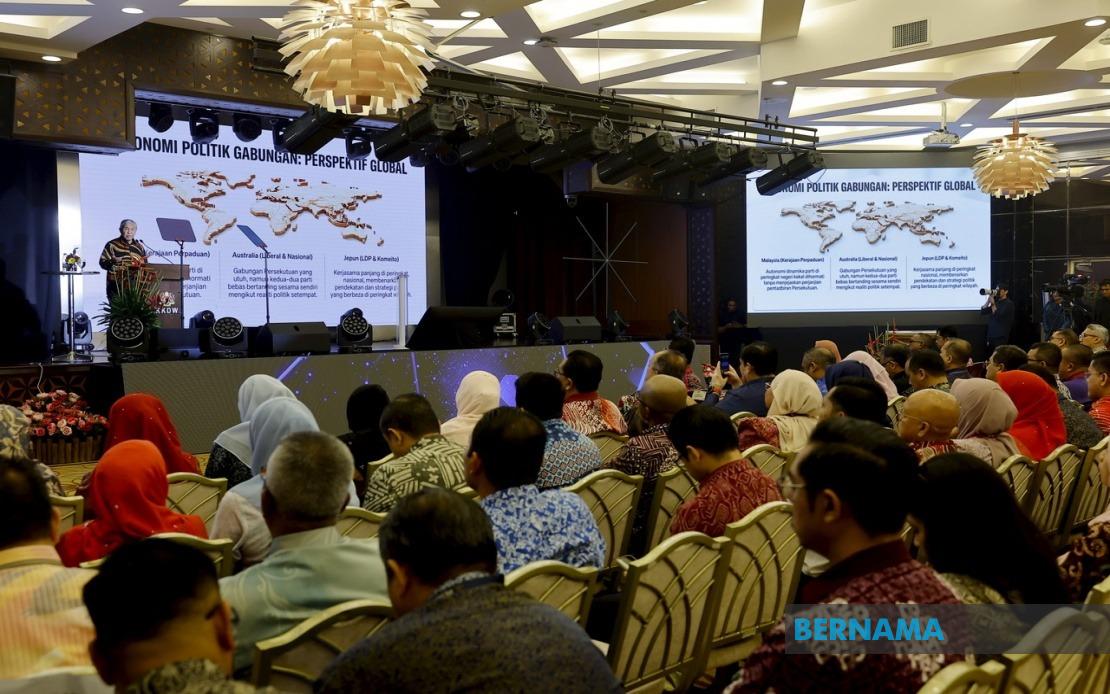
Deputy Prime Minister Datuk Seri Dr Ahmad Zahid Hamidi has reassured the public that political competition at the state level poses no threat to the stability of Malaysia's federal administration, even as electoral contests intensify in key regions. Speaking at a monthly assembly for the Rural and Regional Development Ministry in Putrajaya on August 6, Ahmad Zahid, who simultaneously heads Barisan Nasional, underscored that the Unity Government framework rests on foundational agreements designed to withstand such political shifts without disruption to core governance functions.
The Deputy Prime Minister's comments arrive amid a period of heightened political activity across Malaysian states, with recent electoral exercises in Johor and Negeri Sembilan generating considerable speculation about potential ripple effects on federal arrangements. Ahmad Zahid's statement appears calibrated to manage such uncertainties by drawing a clear distinction between state-level party competition and the institutional stability required to operate the federal machinery. His framing suggests that while component parties within the coalition may contest vigorously for state-level influence and electoral mandates, such rivalry operates within an understood framework that protects the broader government structure.
Central to Ahmad Zahid's argument is the concept that the federal administration will continue functioning normally as long as Parliament remains in session and has not been dissolved. This technical but significant point establishes that the government's operational mandate derives from parliamentary confidence rather than electoral outcomes in individual states. The assurance effectively communicates to investors, civil servants, and ordinary Malaysians that policy implementation and government services will proceed uninterrupted despite electoral turbulence at the subnational level. This is particularly important for maintaining public confidence in the delivery of infrastructure projects, social programmes, and economic initiatives that depend on sustained government attention and funding.
Ahmad Zahid introduced the concept of political autonomy within a coalition framework to explain how the Unity Government accommodates the competing interests of its constituent parties. Under this model, each party retains the freedom to formulate and pursue its own political strategies, campaign platforms, and electoral tactics without constraint from coalition management. However, this autonomy operates within boundaries defined by the underlying agreement that brought the government into being. The balance between party independence and coalition discipline represents a pragmatic accommodation that allows ideologically diverse or historically competing parties to govern together while maintaining their distinct identities and voter bases.
The implications of this arrangement extend beyond mere political theory. For Malaysian voters and observers, it signals that the government's policy direction and administrative priorities will not be subject to abrupt shifts resulting from state-level electoral victories or defeats. The MADANI Government's planned initiatives, budgeted programmes, and infrastructure projects will advance according to established timelines and allocations. This stability is particularly valuable in a context where major development projects and policy reforms require sustained commitment over multiple years. Sudden shifts in government priorities following electoral setbacks would undermine such long-term planning and implementation capacity.
The reference to recent state elections in Johor and Negeri Sembilan carries particular weight given the historical and political significance of these regions. Both states represent important constituencies within the federal framework, and electoral shifts within them could theoretically influence the balance of power within coalition arrangements. However, Ahmad Zahid's statement essentially argues that such shifts, while politically interesting, do not alter the structural stability of the federal government or its fundamental governing mandate. This messaging is designed to prevent short-term electoral anxiety from destabilizing longer-term governance arrangements.
Critical to understanding Ahmad Zahid's position is recognizing that the Unity Government's stability depends less on uniform electoral performance across all states and more on adherence to the foundational agreements that established it. These agreements represent negotiated outcomes between parties with different historical trajectories and electoral bases. Some component parties may perform better in certain states or regions, while others maintain stronger positions elsewhere. Such variation is natural within a diverse coalition and does not necessarily threaten federal cohesion as long as the underlying arrangement holds.
From a Malaysian governance perspective, this approach represents an evolution in how coalition governments manage internal tensions. Previous Malaysian coalition arrangements sometimes fractured due to state-level conflicts escalating to federal implications. By explicitly framing state-level autonomy as compatible with federal stability, Ahmad Zahid articulates a model that could provide greater durability. The key lies in whether all coalition partners genuinely accept this framework or whether state-level successes or failures lead component parties to recalibrate their commitment to the federal arrangement.
For Southeast Asian observers monitoring Malaysian political stability, Ahmad Zahid's statement offers insight into how the current governing coalition intends to manage the inherent tensions between electoral competition and governing continuity. The approach suggests confidence that procedural agreements and institutional mechanisms can contain partisan conflict within manageable bounds. However, the real test will come when state-level electoral outcomes produce results that significantly alter the regional balance of power within the coalition, potentially creating pressures that challenge the stated principle of federal insulation from state-level outcomes.
Looking ahead, the government's ability to maintain this separation between state and federal political dynamics will depend on several factors, including the magnitude of future state electoral swings, the relative importance of affected states to coalition partners, and whether state-level defeats create pressure for policy concessions at the federal level. Ahmad Zahid's statement essentially serves as a public commitment to maintaining institutional boundaries between these different levels of political competition, setting expectations about how the government intends to manage the inevitable tensions arising from coalition governance in a competitive electoral environment.

