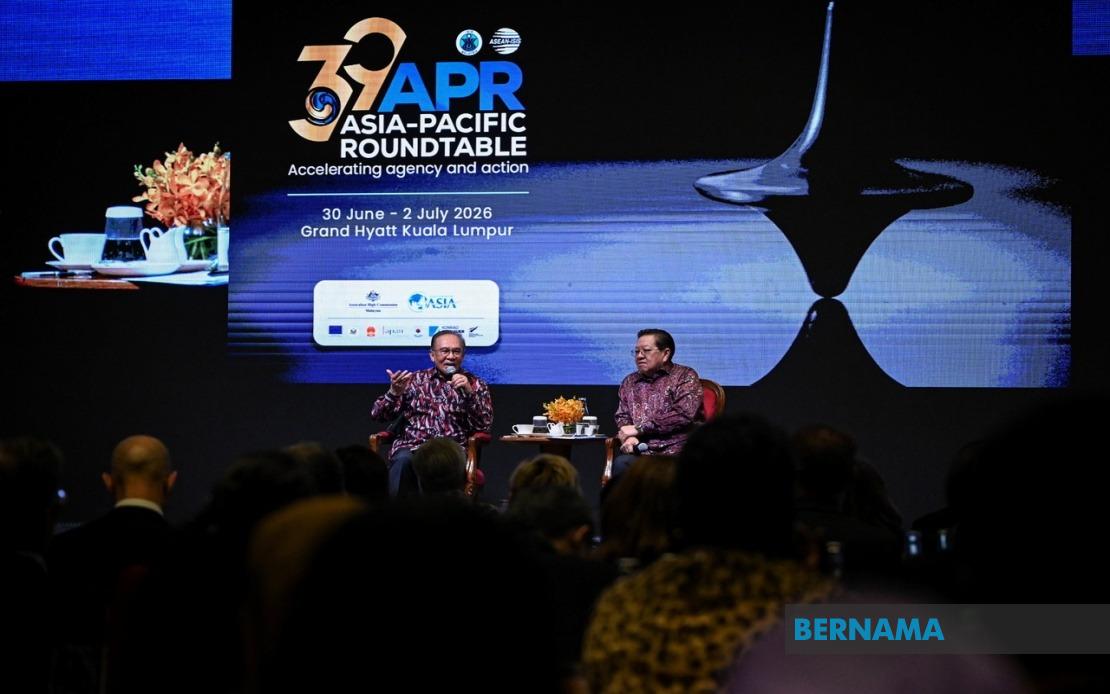
Prime Minister Datuk Seri Anwar Ibrahim has placed domestic governance reform at the centre of his administration's agenda, arguing that a nation can only contribute meaningfully to global affairs once it has set its own house in order. Speaking at the 39th Asia-Pacific Roundtable in Kuala Lumpur on July 2, Anwar outlined a vision in which Malaysia's immediate focus rests on building stronger institutions and demonstrating that principled democratic governance and Muslim-majority identity are not mutually exclusive.
The Prime Minister articulated a comprehensive reform agenda spanning multiple policy domains. His government has committed to improving governance structures, systematically addressing corruption, narrowing wealth disparities, and ensuring universal access to education and healthcare. These pillars form what Anwar characterizes as the foundation necessary before a nation can credibly engage with complex international issues. The framing reflects a calculated prioritization: rather than positioning Malaysia as a leading voice in every global debate, the administration is consolidating its legitimacy through domestic delivery and institutional strengthening.
Anwar's remarks carry particular significance within the broader context of Malaysian politics and regional dynamics. After a period of considerable political turbulence, the emphasis on governance reform and anti-corruption signals an attempt to rebuild public trust in state institutions. For Malaysian citizens, this translates to a government messaging that emphasizes competence and institutional integrity over rhetorical positioning on world stage issues. The approach also distinguishes Malaysia from other major economies in the region that pursue more prominent diplomatic roles despite domestic challenges.
The Prime Minister acknowledged that Malaysia would continue advocating for positions aligned with its values in international forums, but stressed that such engagement must be secondary to the work of national building. This reflects a matured understanding that soft power and diplomatic influence ultimately derive from domestic stability and institutional credibility rather than from pronouncements on every global flashpoint. Nations perceived as internally fractious or poorly governed struggle to command respect in international negotiations, regardless of their historical significance or geographic position.
Anwar devoted particular attention to countering simplistic narratives about global conflict, specifically rejecting the framing of international tensions as a "clash of civilisations." Drawing on the intellectual legacy of Palestinian-American scholar Edward Said, the Prime Minister recharacterized many tensions as a "clash of ignorance," emphasizing that misunderstanding and prejudice rather than fundamental incompatibilities drive many conflicts. This intellectual positioning allows Malaysia to critique inflammatory rhetoric and polarizing narratives while maintaining its own principled stance without appearing defensive about Islam or Muslim-majority governance.
Central to Anwar's vision is Malaysia's MADANI framework, a governance philosophy that seeks to balance technological progress with human values and social cohesion. The framework explicitly encourages intercommunal appreciation across ethnic, religious, and cultural lines. This approach addresses a persistent concern for Malaysia: maintaining unity and social stability within an ethnically and religiously diverse society while modernizing economically and technologically. The MADANI concept offers a counternarrative to those who argue that development and diversity are inherently in tension.
The Prime Minister invoked the Quranic concept of "li ta'arafu," which translates as mutual acquaintance or understanding, to ground his vision in Islamic teaching while simultaneously promoting pluralistic values. This rhetorical strategy is particularly effective in Malaysia's context, where religious legitimacy carries weight among significant portions of the electorate. By anchoring multiculturalism and interreligious harmony in Islamic sources rather than secular Western liberalism, Anwar positions these values as authentically rooted in Malaysian and Islamic tradition rather than imported ideologies. He emphasized that societies should aspire beyond mere tolerance of difference toward genuine understanding and appreciation.
For Malaysia and Southeast Asia more broadly, Anwar's emphasis on prioritizing governance reform carries important implications. The region faces mounting pressures from great power competition, climate change, migration, and economic volatility. Yet many Southeast Asian nations, Malaysia included, continue grappling with institutional weaknesses, corruption, and inequality. Anwar's argument that domestic consolidation must precede major international engagement offers a realistic assessment of resource constraints and political capital. It also implicitly critiques the tendency of some regional leaders to pursue ambitious foreign policy agendas while neglecting pressing domestic problems.
The Prime Minister's focus on eradicating corruption deserves particular attention given Malaysia's recent history. High-profile corruption cases involving previous administrations have damaged public confidence in governance institutions. Anwar's repeated emphasis on anti-corruption efforts signals that his government understands this erosion of institutional trust as a fundamental governance challenge requiring sustained attention. Successful anti-corruption campaigns require not merely prosecutions but also systemic reforms to procurement, oversight, and accountability mechanisms, a long-term undertaking that justifies placing it at the centre of policy priorities.
Anwar's vision of ensuring quality education and healthcare access for all citizens touches on issues that resonate deeply across Southeast Asia. The region contains significant disparities in educational attainment and health outcomes both between countries and within them. Malaysia's relative prosperity gives it greater capacity than some neighbours to achieve universal service provision, making this commitment both economically feasible and politically meaningful. Success in these domains would strengthen social cohesion while demonstrating the practical benefits of effective governance.
The Prime Minister's remarks at the Asia-Pacific Roundtable reflect a strategic recalibration of Malaysia's international posture. Rather than competing for regional leadership through assertive diplomacy or controversial stances on contentious international issues, Anwar is positioning Malaysia as a demonstration project for inclusive, democratic governance within a Muslim-majority context. This approach appeals to both domestic audiences seeking tangible improvements and international partners interested in models of pluralistic stability.
Looking forward, Anwar's governance-first agenda will be tested by implementation. Public perception will ultimately depend on whether promised reforms in institutional integrity, corruption control, and service delivery materialize in visible ways. The coming years will reveal whether this emphasis on domestic consolidation represents a sustainable strategy or whether pressure to engage more assertively in regional and global affairs will force adjustments to stated priorities.

