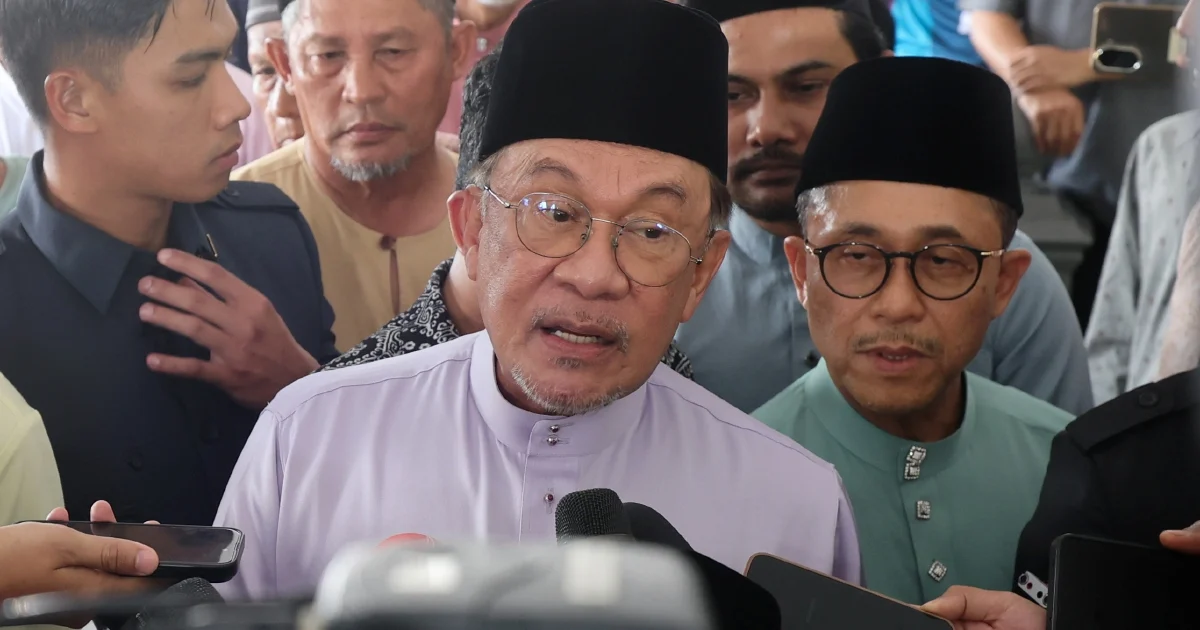
Prime Minister Datuk Seri Anwar Ibrahim has moved to allay anxieties within Malaysia's non-Muslim communities by publicly committing that proposed enhancements to the Syariah court infrastructure will pose no threat to their established religious freedoms. Speaking in Putrajaya, the Prime Minister emphasised that the government's intention to elevate the standing and operational capacity of Syariah courts remains compatible with the constitutional protections guaranteed to Malaysia's religious minorities.
The reassurance arrives at a politically delicate moment when Malaysia continues navigating the intricate balance between strengthening Islamic institutions and maintaining the constitutional architecture that safeguards pluralism. Since taking office, Anwar Ibrahim has positioned himself as an advocate for both deepening Malaysia's Islamic credentials whilst simultaneously reasserting the nation's secular constitutional foundations. This latest intervention suggests that the government recognises lingering unease among non-Muslim citizens regarding the scope and implications of judicial reforms centred on Islamic jurisprudence.
Malaysia's dual legal system—comprising civil courts operating under common law traditions alongside Syariah courts administering Islamic law—represents a distinctive feature of the nation's institutional framework. The Syariah courts exercise jurisdiction primarily over Muslims in matters encompassing family law, inheritance, and religious conduct. Any proposals to enhance their status or expand their remit necessarily trigger questions from non-Muslim communities, business interests, and constitutional scholars regarding potential jurisdictional creep or unintended consequences for the secular legal sphere.
Anwar's statement strategically emphasises categorical reassurance rather than technical legal exposition. By explicitly pledging that non-Muslims' religious practice rights will remain inviolate, the Prime Minister appears determined to prevent the initiative from becoming a flashpoint in Malaysia's delicate communal relations. The timing of the reassurance suggests government communications teams recognise that strengthening Syariah institutions, whilst legitimate within Malaysia's constitutional framework, requires proactive messaging to prevent misunderstandings from calcifying into political grievances.
Article 11 of the Malaysian Constitution explicitly guarantees every citizen the right to profess, practise, and propagate religion. This foundational provision has historically served as the constitutional shield protecting non-Muslims' freedoms, though its interpretation has occasionally generated legal disputes. The Prime Minister's statement, in effect, positions the Syariah court enhancement initiative as operating entirely within existing constitutional parameters rather than seeking to redraw the boundaries of permissible religious expression.
For the business community and investor class, clarity regarding the limits of Syariah court jurisdiction carries material significance. Foreign investors and multinational corporations operating in Malaysia require confidence that commercial contracts, property rights, and employment relationships will remain adjudicated within the established civil legal framework. Anwar's reassurance therefore serves a dual political function: calming communal anxieties whilst simultaneously signalling business stability to the international investment community.
The distinction between strengthening institutional capacity and altering substantive jurisdictional reach becomes critical in evaluating these proposals. The government's framing suggests investments in Syariah court infrastructure—judicial training, case management systems, court facilities, and administrative efficiency—rather than expansion of the categories of disputes falling within Islamic judicial authority. This characterisation, if accurate, implies that the initiative represents institutional modernisation rather than constitutional recalibration.
Regional context adds further dimension to Malaysia's approach. Neighbouring countries including Indonesia and Brunei operate considerably more expansive Syariah court systems with wider jurisdictional reach. Malaysia's government has demonstrated awareness that citizens and external observers increasingly compare national institutional arrangements across Southeast Asia. Anwar's government appears intent on demonstrating that Malaysia can strengthen Islamic institutions whilst maintaining the constitutional safeguards and institutional stability that have historically differentiated the country within the region.
The political calculus underlying these statements reflects deeper complexities within Anwar's governing coalition. The Pakatan Harapan government, despite controlling federal power, encompasses parties with divergent communal compositions and policy preferences regarding religious institution governance. Anwar must calibrate messaging to satisfy Islamist coalition partners advocating stronger Syariah institutions whilst simultaneously retaining electoral support from non-Muslim voters and minority-backed parties whose votes remain essential for parliamentary majorities.
Moving forward, implementation will prove more consequential than rhetorical reassurance. Citizens and observers will assess whether the Syariah court enhancement initiative truly remains bounded within existing jurisdictional parameters or whether operational expansion occurs incrementally through administrative decisions, subordinate legislation, or judicial interpretation. Transparent communication regarding specific reforms, consultation with affected communities, and respect for constitutional limits will determine whether these efforts successfully strengthen Islamic institutions whilst preserving the plural legal system Malaysians have inhabited for decades.
The Prime Minister's commitment ultimately reflects recognition that Malaysia's stability depends upon both strengthening component elements of its plural institutional system and maintaining the constitutional framework that provides all communities confidence in their protected status. Whether this delicate equilibrium proves sustainable through implementation will shape communal relations and investor confidence throughout the medium term.

