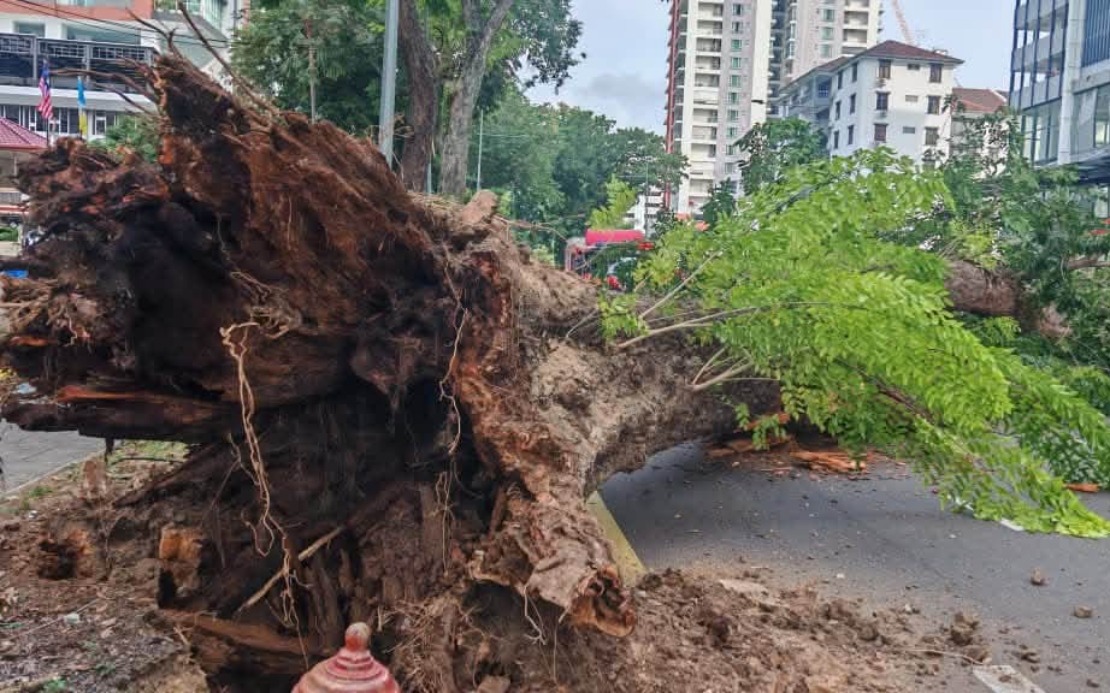
A towering 28-metre Angsana tree that stood for nine decades along Jalan Macalister in George Town unexpectedly collapsed on Friday morning, striking a passing vehicle and leaving three occupants with injuries. The incident has prompted Penang Municipal Council (MBPP) to release detailed findings on the structural failures that preceded the fall, revealing a complex interplay of internal tree deterioration and environmental stressors that officials say should serve as a cautionary tale for urban arboricultural management across the region.
According to MBPP Mayor Datuk A. Rajendran, the Pterocarpus indicus specimen—commonly known as Angsana—suffered from extensive internal degradation that severely compromised its structural integrity. The tree exhibited approximately 30 per cent root rot throughout its root system, while cavity decay accounted for roughly 40 per cent of the trunk's base. Together, these factors created a precarious situation where the tree's massive canopy could no longer be adequately supported by a weakened foundation, particularly given the tree's considerable height and weight distribution.
Beyond the visible signs of decay, however, MBPP identified several contributing environmental factors that collectively increased the likelihood of catastrophic failure. Chronic soil compaction around the tree's base had severely restricted the available rooting space, preventing the tree from establishing the deep, extensive root networks necessary for stability in mature specimens. Additionally, infrastructure upgrading works undertaken in the vicinity had further stressed the tree's already compromised condition, effectively tipping it past the point of no return. The accident occurred at approximately 9 am on a day characterized by normal weather conditions, with no reports of heavy rainfall or unusually strong winds that might otherwise explain the sudden collapse.
The impact of the falling tree proved dramatic and devastating. A Perodua Ativa sports utility vehicle travelling beneath the tree's canopy was crushed by the enormous trunk and branches, trapping an elderly couple and their grandchild inside the vehicle. Emergency responders and municipal workers arrived swiftly, with MBPP beginning tree removal operations at 9.41 am. Following nearly five hours of clearing and recovery work, the road was fully reopened to traffic at 2.20 pm, though questions about preventive measures and early warning systems continue to mount.
MBPP has presented a detailed account of its prior tree assessment activities, which may raise questions about the effectiveness of existing inspection protocols. The council conducted comprehensive assessments of mature and aged trees along Jalan Macalister during 2024, identifying 13 specimens as candidates for removal—all of which have since been felled. Notably, routine maintenance work on the stretch where the collapse occurred was last performed on January 29, 2024, and a remote sensing study undertaken in the previous year had concluded that trees along the road were in good condition with no obvious warning indicators. These findings suggest that the internal decay progressed more rapidly than detection systems anticipated, or that the structural weaknesses were not adequately flagged by available assessment methodologies.
The incident reflects broader challenges in urban tree management across Malaysian municipalities, which must balance heritage preservation, public safety, and infrastructure development. MBPP has disclosed that 179 high-risk trees have been approved for removal during 2024, with 148 already felled as of the time of the statement. Looking further back, the council removed 247 trees during the first nine months of the year, citing diverse reasons for removal including drainage obstruction, dead or leaning specimens, collapse risk factors, development projects, road and river expansion initiatives, and encroachment on water supply corporation pipeline routes. These statistics underscore the scale of the challenge facing urban planners in maintaining both liveable streetscapes and adequate safety margins.
A broader inventory conducted in 2023 identified 2,535 trees across MBPP's jurisdiction that required categorization and assessment. Among these, 45 cases involved drainage obstruction, 138 were confirmed dead trees, 2,242 were evaluated under risk or other categories, and 110 were flagged as linked to development or infrastructure works. This comprehensive data reveals a municipality grappling with the competing demands of heritage preservation and modernization, particularly in densely built areas where infrastructure upgrades frequently necessitate difficult decisions about tree retention or removal.
In response to the collapse on Jalan Macalister, MBPP has moved to accelerate preventive interventions. The council has instructed its appointed contractor to expedite ongoing work to reduce the height of vulnerable trees and to fell additional specimens demonstrating significant collapse risk based on assessments conducted by certified arborists. This reactive approach underscores a fundamental tension in municipal governance: the need to respond to public safety crises while simultaneously maintaining the green infrastructure that contributes to urban livability and environmental quality.
For Malaysian and regional observers, the Jalan Macalister incident highlights several interconnected concerns. The case demonstrates that even apparently healthy mature trees can harbour serious structural defects that escape standard visual inspections, suggesting that municipalities should invest in more sophisticated diagnostic tools including advanced imaging and core sampling. The episode also illustrates how incremental urban stressors—soil compaction, infrastructure works, restricted rooting space—can accumulate to create dangerous conditions. Furthermore, the incident raises questions about the adequacy of public liability frameworks and insurance arrangements when municipality-managed trees fail and cause property damage or personal injury. As Southeast Asian cities continue to densify and upgrade infrastructure, this incident provides valuable lessons about the importance of integrating comprehensive arboricultural science with urban planning processes rather than treating tree management as an afterthought to development priorities.

