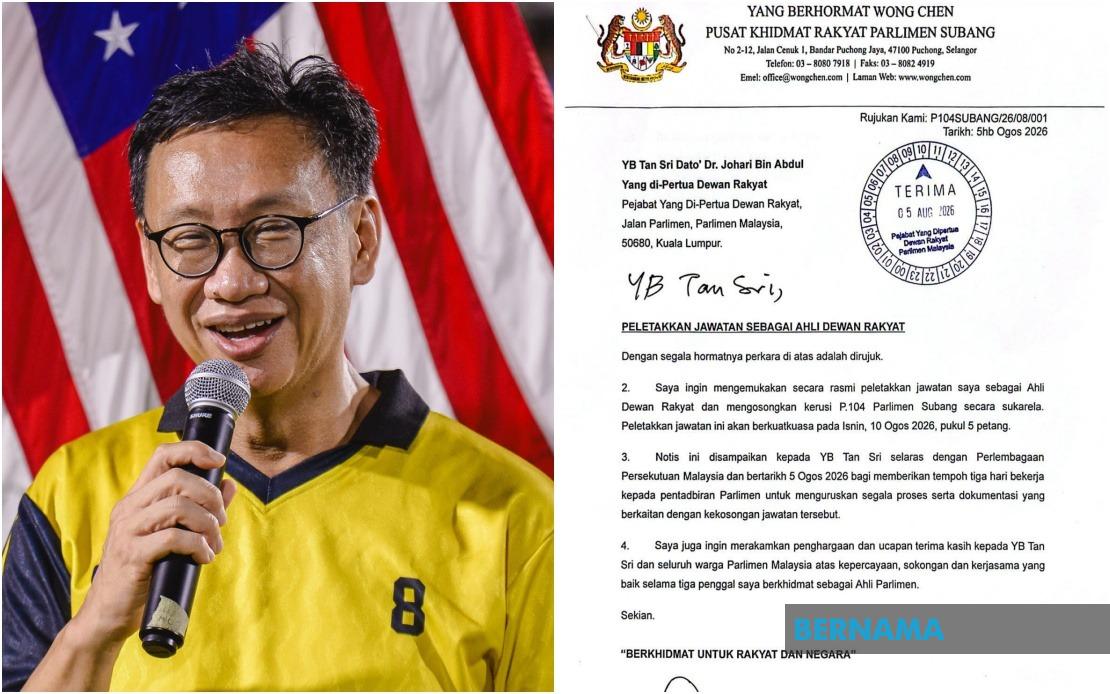
Wong Chen, the Member of Parliament for Subang, has formally stepped down from his position in the Dewan Rakyat, with his resignation taking effect at 5:00 pm today. The move concludes a parliamentary career spanning three consecutive terms representing one of Selangor's most closely watched constituencies. Wong submitted his official resignation letter to Dewan Rakyat Speaker Tan Sri Johari Abdul on August 5, providing advance notice to allow Parliament's administration adequate time to process the vacancy and prepare for the constitutional requirements that follow.
The Subang seat represents a significant political battleground in Malaysia's legislative landscape. Located in the Klang Valley region, the constituency has been a focal point for urban middle-class politics and has attracted considerable media attention in recent years. Wong's departure marks a notable shift in the representation of this demographically diverse area, which encompasses both established residential communities and growing commercial zones. The timing of his resignation, announced publicly via Facebook, reflects modern parliamentary practice where lawmakers increasingly communicate directly with constituents through social media platforms.
Wong's three-term tenure places him among Malaysia's more established opposition-aligned parliamentarians. His service across multiple parliamentary cycles indicates sustained electoral support from Subang voters, suggesting he maintained sufficient political capital to secure re-election in successive general elections. The decision to step down voluntarily, rather than await a general election or other circumstances, suggests a planned transition rather than a crisis-driven departure. His emphasis on submitting the resignation letter five days in advance demonstrates consideration for institutional procedures and administrative continuity.
The formal resignation letter, dated August 5, 2026, explicitly confirms that Wong's departure occurs voluntarily and in strict accordance with constitutional provisions governing parliamentary membership. This legal precision is significant in Malaysian parliamentary practice, where the mechanics of seat vacancies carry specific procedural implications. The invocation of Federal Constitution provisions underscores that the resignation follows established legal frameworks rather than representing any irregular departure from Parliament. Such attention to constitutional formality reflects professional parliamentary conduct and ensures clarity regarding the legitimacy of the vacancy.
In his communication to Parliament's leadership, Wong expressed gratitude to Speaker Tan Sri Johari Abdul and the institution's supporting staff, acknowledging the cooperation and institutional support he received throughout his legislative career. This courteous tone towards Parliament's administrative apparatus, despite potentially differing political perspectives, reflects the conventions of parliamentary decorum that persist even amid political disagreement. The appreciation extended to Parliament's personnel indicates a measured departure rather than one marked by recrimination or controversy, suggesting Wong's exit from the chamber occurs on amicable institutional terms.
Wong has scheduled a comprehensive press conference for 11:00 am tomorrow to elaborate on the circumstances and reasoning behind his resignation. This planned media engagement suggests he intends to provide constituents and the broader public with detailed explanation regarding his departure. The timing of this announcement, occurring after the resignation takes formal effect, allows Wong to address the parliamentary change as an accomplished fact rather than as a pending action. Such press conferences typically become important moments for politicians to shape the narrative surrounding significant career transitions and to clarify their future intentions.
The removal of the "Yang Berhormat" honorific from all official signage and correspondence represents a practical consequence of losing parliamentary status. This administrative adjustment, scheduled to commence next month, reflects the formal loss of the title that accompanies membership in the Dewan Rakyat. In Malaysian political culture, the removal of this honorific carries symbolic weight beyond mere administrative tidiness, marking the conclusion of Wong's legislative mandate and his transition to a non-parliamentary status. The month-long grace period for this transition allows for orderly updates to physical signage and official records across multiple office locations and channels.
The Subang by-election triggered by this vacancy will constitute a significant electoral test for the constituency's political alignment. By-elections in urban constituencies like Subang often attract intensive campaign activity and media scrutiny, serving as barometers for shifts in voter sentiment. The seat's status as a closely watched battleground means that various political parties will likely mobilize substantial resources to contest the vacancy, making the subsequent by-election a focal point for Malaysian political developments in the coming months.
Wong's departure from Parliament creates both a vacancy in representation and an opportunity for political realignment within Subang. The three-term incumbent's exit opens space for new voices and potentially different political orientations to emerge within the constituency's legislative representation. This transition reflects the natural evolution of parliamentary demographics, where experienced legislators eventually depart and make way for successive generations of elected representatives. For Malaysian observers tracking urban political dynamics in Selangor, Wong's resignation signals an important inflection point in the ongoing political development of the Klang Valley region.

