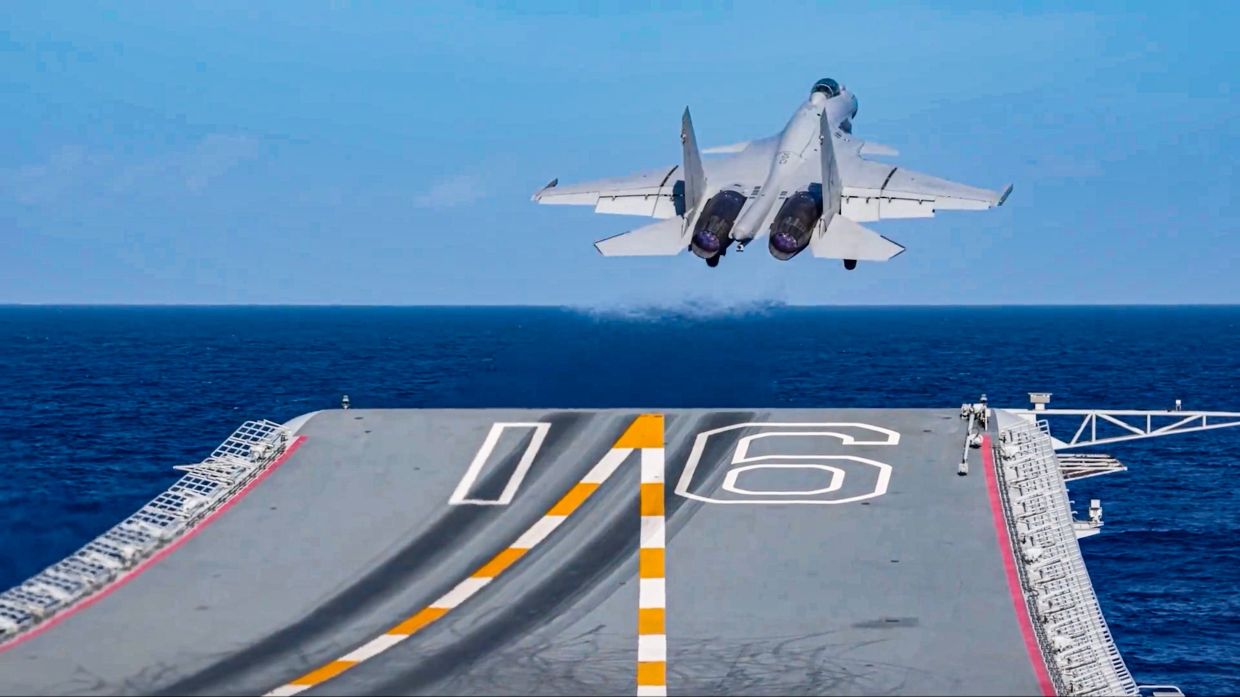
China's ambitious expansion of its aircraft carrier programme faces a significant strategic vulnerability in submarine warfare, according to defence analysts examining the balance of naval power in the western Pacific. As Beijing accelerates construction of new carrier vessels, researchers at the Centre for Strategic and International Studies have identified a coordinated "cost-imposition" strategy that could neutralise these high-value assets through multiple attack vectors. Among the proposed methods—including land-based strikes, cyber warfare, drone swarms, and electromagnetic attacks—submarine ambushes emerge as the domain where China's naval forces appear most exposed and least prepared to respond effectively.
The geographic positioning of Asia's maritime chokepoints creates natural advantages for submarine-based interdiction. Strategic waterways connecting the South China Sea to the Pacific Ocean represent narrow passages where carrier groups must transit predictably, making them susceptible to coordinated underwater attacks. The western Pacific environment, where these waterways converge, offers ideal conditions for submarine operations, particularly given the complexity of monitoring vast ocean depths across multiple strategic zones simultaneously. This geographical reality means that any confrontation involving Taiwan or broader regional stability would likely force Chinese carrier groups through precisely these areas of maximum vulnerability.
Christopher Sharman, director of the China Maritime Studies Institute at the US Naval War College, emphasises that China's fundamental weakness lies not in its carriers themselves but in the technological gap underpinning undersea detection and surveillance. Chinese naval forces currently lack comprehensive awareness systems that would enable them to reliably identify, track, and neutralise hostile submarines operating within their operational zones. This detection gap represents an asymmetric disadvantage, particularly when confronted with US attack submarines widely acknowledged as among the world's quietest and most advanced underwater vessels. The problem intensifies as carrier groups operate farther from shore, where shore-based detection systems become ineffective and reliance on onboard sensing capabilities increases proportionally.
A critical factor amplifying this vulnerability involves oceanographic knowledge. Sharman notes that China's meteorological and oceanographic capabilities, despite recent investments, continue to lag substantially behind those of the United States Navy. Understanding the undersea environment—water temperature gradients, salinity layers, acoustic properties, and current patterns—proves essential for effective anti-submarine operations. Without superior knowledge of these conditions, Chinese forces operate at a considerable disadvantage when attempting to locate submarines that exploit environmental factors to mask their presence. This technical gap extends beyond simple equipment limitations; it represents a fundamental difference in decades of accumulated expertise and real-world operational experience.
Recognising this weakness, Beijing has launched the Transparent Ocean programme to systematically improve oceanographic monitoring across strategically vital regions including the South China Sea, western Pacific, and Indian Ocean. This ambitious initiative incorporates satellites, research vessels, underwater buoys, autonomous gliders, and seabed sensor networks designed to create comprehensive maritime awareness across vast areas. The Ocean University of China, which spearheaded the programme, has already deployed hundreds of deep-sea observation systems and expanded monitoring networks significantly. Chinese officials have explicitly connected these investments to national security requirements, signalling recognition that current capabilities fall short of strategic needs.
Simultaneously, China has upgraded its anti-submarine warfare platforms and equipment. The People's Liberation Army Navy has expanded its fleet of fixed-wing maritime patrol aircraft and deployed advanced ocean-surveillance vessels equipped with towed-array sonar systems capable of detecting underwater targets across extended ranges. Sensor improvements to carrier-based helicopters and aircraft enhance the navy's ability to locate and engage submarines in operational areas. Despite these enhancements, defence analysts remain sceptical that incremental improvements will adequately address the underlying technological and knowledge gaps that continue to disadvantage Chinese undersea operations.
The strategic implications extend well beyond carrier protection. Timothy Heath, heading the defence research firm Perceptum, argues that submarine warfare constitutes a core component of China's broader naval strategy, particularly regarding aspirations to achieve sea control within the first island chain. Beyond that geographical boundary, into the Indian Ocean and Pacific expanses, Chinese strategists view effective undersea operations as essential to countering US naval superiority and complicating potential third-party intervention in any conflict scenario involving Taiwan. Military-affiliated Chinese authors have acknowledged that the depths near China's coast remain largely uncontrolled and unmonitored, describing these waters as a "wide-open door" through which adversaries can operate with relative impunity.
Japanese naval capabilities introduce additional complexity into this equation. Should Japan intervene in any Taiwan-related conflict, Japanese submarines and anti-shipping capabilities could target Chinese warships operating in adjacent waters, dramatically escalating the threat environment for Chinese carrier operations. This scenario constrains carrier deployment options, limiting their effective operational zones to areas where air cover and supporting forces can provide adequate protection. The result is a paradoxical situation where China's most advanced platforms become operationally restricted precisely when strategically deployed.
Howth, however, China faces difficult strategic trade-offs. Deploying carriers into the outer reaches of the western Pacific, where they might theoretically project power across wider areas, exposes them to multiple targeting vectors that Heath characterises as strategically unjustifiable. Land-based intermediate-range ballistic missiles remain China's most effective tool for threatening US naval forces extending to the second island chain. Committing valuable carrier assets to distant deployments where they become vulnerable to submarine attack, carrier-based aircraft strikes, and coordinated multi-domain operations represents an inefficient use of limited resources. The carriers' substantial monetary value and construction timelines argue for more conservative deployment strategies closer to shore, where protection becomes feasible.
The strategic implications for allied nations, particularly Japan and Australia, merit attention. US defence analysts argue that allied nations should increase procurement of anti-submarine warfare technologies, including advanced torpedoes, undersea drones, and missile systems. Building these capabilities alongside American forces would improve collective capacity to pressure Chinese carrier groups and potentially deter aggressive regional actions. For Southeast Asian nations, this underwater vulnerability in China's naval expansion suggests that the regional balance may prove more contestable than surface-level assessments might indicate. Submarines operated by regional powers or allies could theoretically complicate Chinese operational freedom even without matching overall fleet size.
The broader strategic picture reveals a military modernisation programme that, despite impressive quantitative advances, contains significant qualitative limitations. China's carrier expansion projects power and signals technological progress, yet the platform's actual operational utility remains constrained by undersea vulnerabilities. As regional tensions persist regarding Taiwan and maritime disputes, these underwater asymmetries could prove decisive in determining actual strategic outcomes rather than nominal force comparisons. The next decade will reveal whether Chinese investments in oceanographic monitoring and anti-submarine capabilities can meaningfully reduce this vulnerability or whether submarine warfare remains the Achilles' heel constraining China's naval ambitions.

