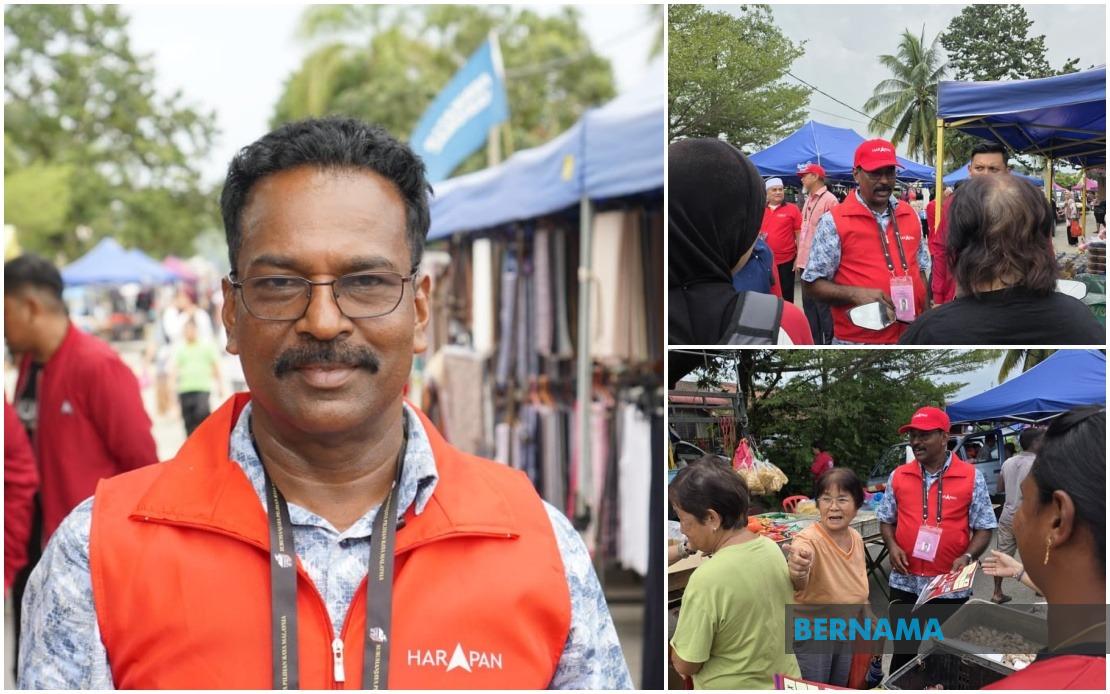
C. Subramani's campaign for the Bukit Kepong seat in the 16th Johor state election reflects a broader narrative unfolding across the state's 56 assembly constituencies: voter appetite for change is reshaping political calculations even in seats traditionally held by other coalitions. The Pakatan Harapan candidate, speaking ahead of Saturday's polls, exudes confidence about overturning expectations in a three-cornered contest that also features Barisan Nasional and Perikatan Nasional candidates.
Subramani's optimism rests on tangible feedback gathered during extensive ground campaigns throughout the Pagoh-based constituency. His repeated field visits, particularly to Orang Asli settlements nestled within Bukit Kepong, have yielded what he characterises as encouraging receptiveness from voters weary of stagnant development and unresolved community grievances. This grassroots engagement has proven instructive, allowing the candidate to catalogue specific infrastructure deficits and socioeconomic pressures that dominate local conversations—insights that inform his campaign messaging and policy priorities.
A pivotal element of Subramani's strategy hinges on operational synergy between Johor's state administration and Malaysia's federal government. He argues that misalignment between these tiers has historically impeded resolution of issues requiring federal agency intervention, from education policy implementation to water management and drainage systems. Were a PH state government to govern in tandem with the current federal administration, he contends, efficiency gains would materialise as bureaucratic friction diminishes and direct ministerial engagement becomes feasible. This argument holds particular resonance among constituents frustrated by protracted delays in pursuing remedies for problems that technically fall within federal purview.
The Pagoh PKR chief's vision extends beyond administrative coordination to encompass tangible economic rejuvenation. Transforming the Bukit Kepong Gallery into a heritage tourism destination represents his flagship developmental initiative, designed to catalyse local economic activity and create employment opportunities within a historically significant locality. Alongside this anchor project, Subramani identifies a constellation of immediate concerns that have accumulated through years of apparent neglect: inadequate street illumination in several neighbourhoods, structurally compromised bridges requiring urgent remediation, and an acute shortage of affordable housing stock accessible to lower-income families comprising the B40 income bracket.
Subramani's political trajectory lends credibility to claims of substantive engagement with Bukit Kepong's electorate. His previous candidacy in Buloh Kasap during the 2022 Johor state election provided him experience navigating state-level electoral competition, while his position as Pagoh PKR chief reflects sustained involvement in local party machinery and community organising. These credentials, he maintains, distinguish him from candidates parachuted into constituencies with minimal prior connection to constituent interests and local networks.
The electoral contest itself mirrors patterns observable across the broader Johor state election landscape. The state's 172 candidates are contending for 56 assembly seats before an electorate comprising approximately 2.7 million registered voters, a turnout that underscores the electoral stakes and potential for constituency-level surprises where local campaigns successfully mobilise dissatisfaction. The Bukit Kepong three-way battle reflects this fragmentation of the political terrain, wherein traditional two-coalition frameworks have fractured into multipolar contests where strategic messaging and localised campaign intensity can substantially influence outcomes.
Historical context adds nuance to assessing Subramani's aspirations. The preceding 2022 state election saw Perikatan Nasional retain the seat through Datuk Dr Sahruddin Jamal, who secured a relatively slender majority of 710 votes—a margin sufficiently narrow to suggest considerable voter mobility and vulnerability to a well-executed opposition campaign. This slim incumbent advantage indicates that neither Bukit Kepong nor similar constituencies possess commanding demographic or historical loyalties that automatically predetermine electoral outcomes, provided opposition candidates successfully translate grassroots discontent into ballots.
Subramani's emphasis on Orang Asli concerns reflects awareness that indigenous communities within Johor constitute a demographic segment often marginalised in mainstream campaign discourse and policy implementation. By explicitly identifying four separate Orang Asli settlements and engaging their representatives regarding specific challenges, Subramani signals attentiveness to a constituency within Bukit Kepong whose votes could prove decisive in a tight three-way race. Indigenous voters in Peninsular Malaysian constituencies have demonstrated capacity to swing elections when candidates demonstrate sustained interest in their material welfare rather than parachuting in at election time.
The broader implications of Subramani's challenge extend beyond Bukit Kepong's boundaries into Johor's political calculus more broadly. Should PH succeed in surprising victories across multiple constituencies—particularly in seats previously assumed secure for PN or BN—momentum would shift toward state-level political reconfiguration. Conversely, if traditional coalitions hold their ground despite professed voter restlessness, such outcomes might indicate limits to apparent dissatisfaction or effectiveness of incumbent defensive strategies. The Bukit Kepong contest therefore functions as a microcosm illuminating whether contemporary voter sentiment for change translates into altered electoral results.
For Malaysian readers monitoring Johor's trajectory, Subramani's campaign encapsulates broader themes reshaping peninsular politics: the search for competent local administration, frustration with bureaucratic inefficiency spanning government tiers, and recognition that historical voting patterns no longer guarantee electoral dominance absent continued responsiveness to constituent concerns. Whether voters ultimately endorse his candidacy Saturday will illuminate the durability of such sentiment when exercised within the polling booth.

