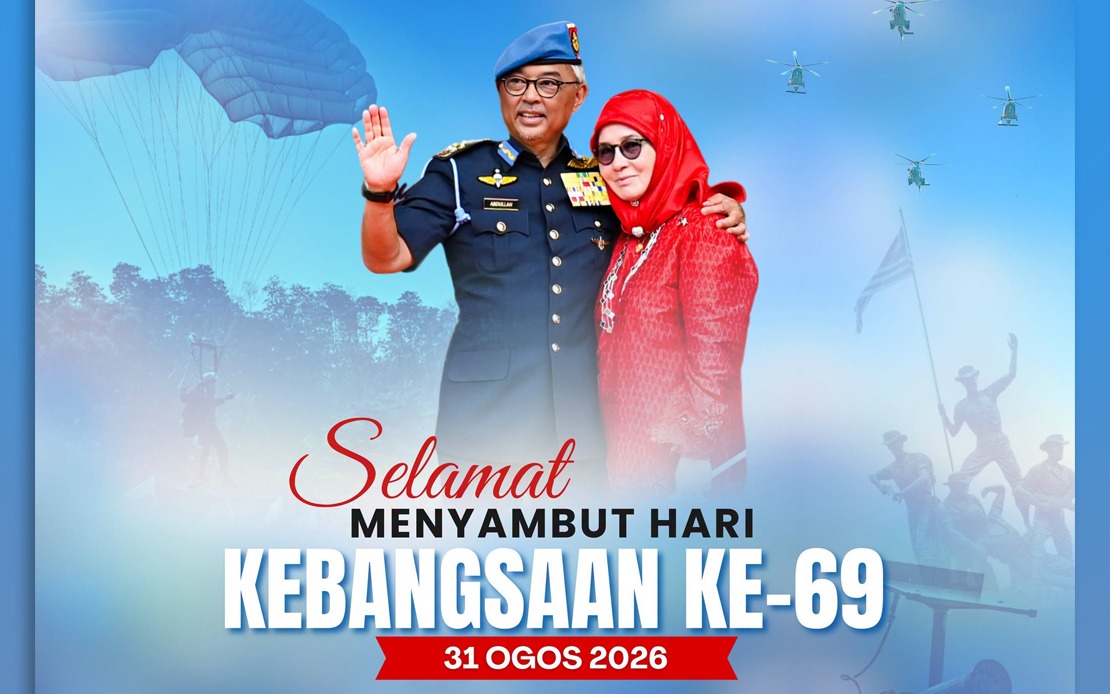
The Sultan of Pahang Al-Sultan Abdullah Ri'ayatuddin Al-Mustafa Billah Shah and Tengku Ampuan Pahang Tunku Azizah Aminah Maimunah Iskandariah have conveyed heartfelt congratulations to the people of Pahang on Malaysia's 69th National Day, emphasising the importance of preserving the nation's hard-won independence and sovereignty. The royal couple's message, disseminated through official channels in Kuantan on August 30, struck a reflective tone as the nation commemorated nearly seven decades of self-governance and collective progress since Merdeka.
Central to Their Royal Highnesses' statement was a profound sense of gratitude for the blessings Malaysia has enjoyed throughout its independent existence. They acknowledged that the peace, prosperity and social harmony experienced across the country represent considerable achievements worthy of appreciation and safeguarding. This messaging resonates particularly in the Malaysian context, where the interplay of multiple ethnicities, religions and cultures has required constant negotiation and mutual forbearance since 1957.
The royal couple underscored that maintaining national independence and sovereignty is not merely a historical accomplishment but an ongoing responsibility shared collectively by all citizens. By framing these foundational elements as "great trusts," they placed emphasis on the idea that preserving Malaysia's standing as a sovereign nation depends on active commitment from every generation. This framing carries particular weight in contemporary discourse, where questions about national identity and unity periodically resurface in public conversation.
Throughout their address, Al-Sultan Abdullah and Tunku Azizah identified unity, mutual respect and tolerance as the cornerstones upon which national harmony and long-term stability must rest. These principles have served as working guidelines for Malaysian governance since independence, even as their practical implementation has sometimes proved challenging. The deliberate reiteration of these values suggests an understanding that their regular reinforcement remains necessary to counter centrifugal pressures that periodically test national cohesion.
The Sultan and Tengku Ampuan made a direct appeal to all residents of Pahang to cultivate and maintain patriotic sentiment in their daily lives and interactions. They specifically encouraged citizens to embody and practise the Rukun Negara—the five national principles that form Malaysia's constitutional foundation: belief in God, loyalty to the monarchy, upholding the Constitution, rule of law, and goodwill and morality. For many Malaysians, the Rukun Negara remains familiar primarily through recitation in schools rather than through substantive integration into civic behaviour, making its periodic restatement by senior leadership rhetorically significant.
A notable dimension of the royal message focused on the nation's younger generation, whom Al-Sultan Abdullah and Tunku Azizah encouraged to develop deeper appreciation for Malaysia's independence struggle and the sacrifices that preceded Merdeka. This intergenerational appeal reflects wider concerns across Southeast Asia about whether historical consciousness remains sufficiently robust among youth increasingly engaged with global digital culture. The royal couple positioned heritage preservation and cultural continuity as responsibilities incumbent upon the young, framing these as integral to broader national stability.
The message also contained an explicit invocation that Pahang would remain under divine protection and blessing, praying for the state to experience continued peace, prosperity and collective well-being. This spiritual framing is customary in Malaysian royal communications and reflects the constitutional role of Malay rulers as custodians of Islam in their respective states. Such language carries cultural resonance for the predominantly Malay-Muslim population of Pahang whilst maintaining inclusive national sentiment.
For Pahang specifically, the royal message holds particular relevance given the state's role within Malaysia's broader political landscape. As one of the larger peninsular states with significant economic importance, particularly in agriculture, mining and increasingly in renewable energy initiatives, Pahang's continued stability and internal cohesion contribute materially to national economic performance. The Sultan's emphasis on unity and harmony therefore extends beyond symbolic rhetoric into domains affecting tangible developmental outcomes.
The timing of such messages immediately before or during Merdeka celebrations provides Malaysian leadership with a platform to recalibrate national conversation around foundational values. In recent years, public discourse has occasionally fractured along communal or political lines, making the periodic emphasis on shared principles and collective identity a strategic imperative for maintaining the social consensus upon which Malaysian stability depends. The royal communication effectively uses the National Day occasion as a moment for resetting those parameters.
The choice to disseminate this message via social media, specifically the Pahang Sultanate's Facebook page, reflects contemporary adaptation in how royal communications reach constituents. This approach democratises access to official messaging whilst maintaining the formal authority that such communications carry within Malaysian constitutional tradition. It demonstrates how traditional institutions navigate contemporary information environments without compromising their institutional dignity or relevance.
Within the broader Southeast Asian context, Malaysia's ongoing emphasis on national unity and patriotic sentiment mirrors approaches adopted by regional neighbours facing their own pluralist challenges. Thailand, Indonesia and the Philippines have similarly deployed official messaging around national occasions to reinforce civic consciousness and discourage sectarian or political polarisation. The consistency of these approaches across the region suggests shared recognition that maintaining multi-ethnic or religiously diverse societies requires persistent, institutionally-anchored reinforcement of inclusive national values.
Moving forward, the effectiveness of such royal interventions depends substantially on whether ordinary citizens translate ceremonial adherence to Rukun Negara principles into genuine interpersonal respect and institutional fairness. The royal couple's invocation of these principles represents the leadership's side of an implicit social contract, whilst implementation ultimately depends on millions of individual decisions and interactions occurring daily across Malaysian society. The 69th National Day thus functions as both celebration of achievements and reminder of ongoing obligations.

