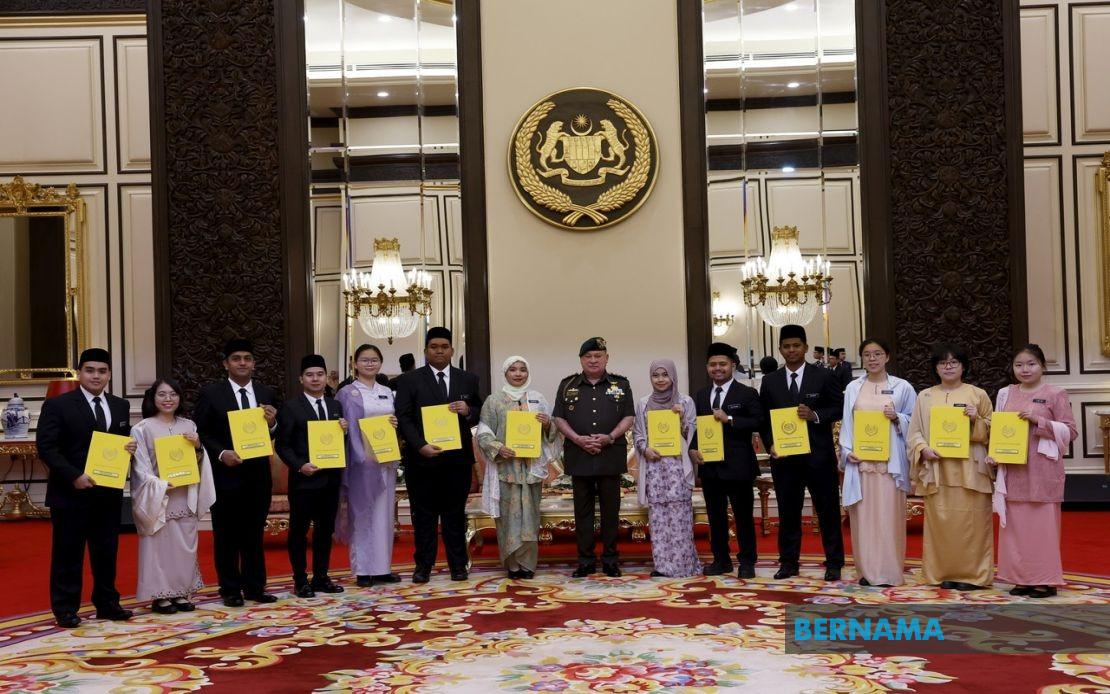
His Majesty Sultan Ibrahim, King of Malaysia, conferred the 2026 Yang di-Pertuan Agong Scholarships upon 14 deserving scholars during a formal presentation ceremony held at Istana Negara in Kuala Lumpur on June 24. The occasion highlighted the monarchy's commitment to nurturing Malaysia's research and academic talent pipeline at the postgraduate level, recognising the critical importance of advanced scholarship in driving the nation's intellectual and economic advancement.
The cohort comprises two distinct groups pursuing different levels of advanced qualification. Exactly half of the recipients—seven in total—have been selected to pursue doctoral degrees, positioning them to conduct original research and contribute to frontier knowledge across their respective disciplines. The remaining seven scholars have received support to undertake Master's programmes with a research focus, enabling them to develop sophisticated research capabilities and transition toward doctoral work or specialised professional roles. This split reflects a deliberate strategy to build research capacity at both the master's and doctoral levels.
The geographic distribution of these opportunities underscores Malaysia's dual engagement with both its domestic research ecosystem and the global academic landscape. Ten of the 14 recipients will conduct their postgraduate studies at Malaysia's leading research-intensive universities, strengthening capacity within local institutions and retaining intellectual resources domestically. Meanwhile, four scholars have been awarded funding to pursue their degrees at prestigious universities abroad, facilitating international research networks and exposure to world-class academic environments. This balance acknowledges that some fields and research directions benefit from exposure to specific international centres of excellence whilst maintaining investment in homegrown research capability.
Senior government officials attended the awards ceremony, underscoring its significance within Malaysia's public administration and scholarship infrastructure. Tan Sri Wan Ahmad Dahlan Abdul Aziz, the Director-General of the Public Service, and Tan Sri Dr Azmi Rohani, Comptroller of the Royal Household at Istana Negara, were both present, reflecting the intersection of royal patronage, civil service leadership, and education policy. Their attendance emphasised that these scholarships represent not merely charitable disbursement but rather strategic investment in human capital aligned with public service objectives and national development priorities.
The BYDPA scholarship programme occupies a distinctive place within Malaysia's constellation of government-funded awards for advanced study. According to Tan Sri Wan Ahmad Dahlan's remarks to journalists following the ceremony, the BYDPA represents the most prestigious scholarship available domestically and offers the most substantial funding envelope among all government scholarship initiatives. This pre-eminence reflects both the competitive selection process and the commitment of Malaysia's public administration to supporting the nation's most capable researchers and scholars. The ranking of BYDPA at the apex of government scholarship provision signals that recipients have undergone rigorous vetting and represent exceptional promise in their fields.
The funding levels associated with BYDPA scholarships carry significant implications for recipient scholars' capacity to focus on their research without financial distraction. By offering the highest funding among government programmes, BYDPA enables scholars to engage fully in their postgraduate work, access necessary research resources, and participate in international conferences and collaborative research networks. This financial support proves particularly valuable for doctoral candidates, whose research often extends across three to four years and may involve fieldwork, laboratory expenses, or access to specialised facilities. The generosity of BYDPA funding thus removes structural barriers that might otherwise constrain research productivity or force scholars toward employment during critical study phases.
Malaysia's investment in postgraduate research scholarships reflects broader regional and global trends recognising that advanced human capital drives economic competitiveness and innovation capacity. Southeast Asian nations increasingly compete for research talent and seek to develop domestic research excellence across STEM fields, social sciences, and humanities. By maintaining robust scholarship programmes at the doctoral level, Malaysia positions itself to retain talented scholars who might otherwise migrate to higher-income jurisdictions or pursue advanced training entirely abroad. The BYDPA programme thus serves strategic national interests beyond individual educational opportunity, contributing to the development of a knowledge-based economy and research-intensive industrial ecosystem.
The selection of recipients for these scholarships likely reflects consideration of multiple criteria extending beyond academic merit to include research proposal quality, potential for contributing to national priorities, and disciplinary diversity. The distribution across 14 scholars pursuing different fields and at different postgraduate levels suggests deliberate portfolio management aimed at building research strength across multiple domains rather than concentrating resources narrowly. This approach acknowledges that national development requires advances across diverse fields—from biomedical research to social policy analysis to engineering innovation—and that research talent must be cultivated broadly.
The 2026 cohort represents the latest iteration of a scholarship programme that has historically served as a mechanism for identifying and supporting Malaysia's research leadership pipeline. Recipients of BYDPA scholarships often go on to prominent academic careers, establish research groups, mentor subsequent generations of scholars, and contribute significantly to knowledge production within Malaysian universities. The long-term impact of awards like these extends well beyond the immediate scholarship period, as scholars develop expertise, secure research funding, and build international collaborations that enhance Malaysia's research profile and institutional capabilities.
For Malaysian readers and regional observers, the BYDPA awards ceremony exemplifies how governments can strategically invest in human capital development and research capacity. The programme demonstrates commitment to merit-based selection, adequate funding provision, and integration of both domestic and international study opportunities. As Malaysia and other Southeast Asian nations seek to transition toward knowledge-based economies and establish themselves as research hubs, such scholarship initiatives prove essential in developing the talent and institutional capacity necessary for sustained competitive advantage.