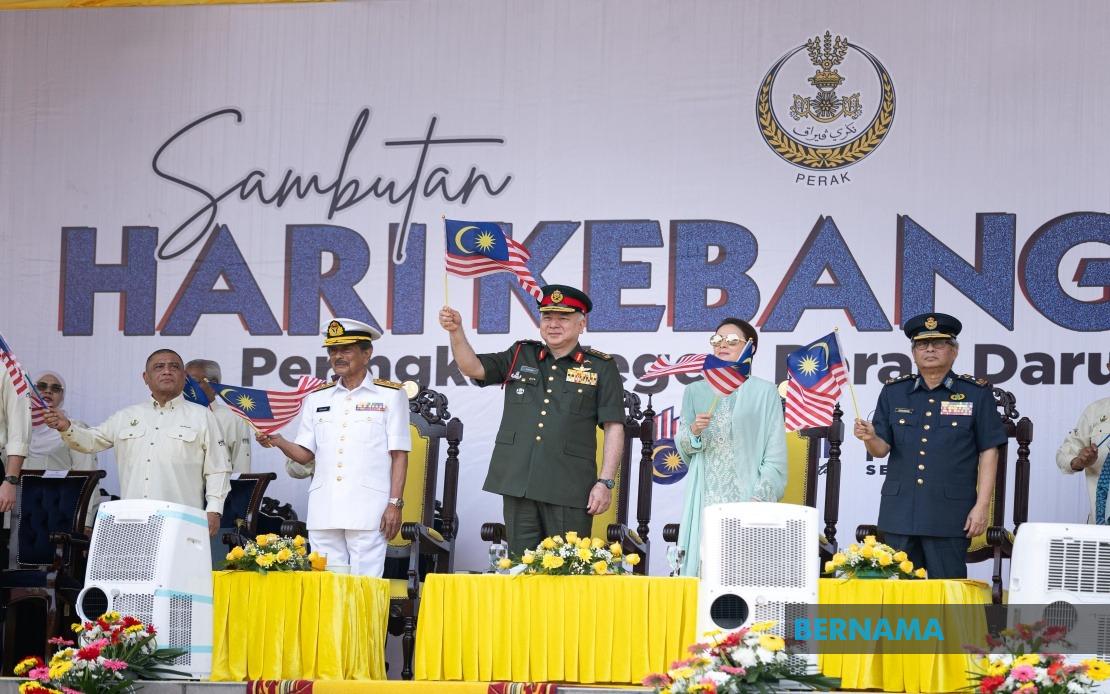
Sultan of Perak Sultan Nazrin Shah and Raja Permaisuri of Perak Tuanku Zara Salim presided over the Perak-level National Day 2026 Awards Presentation Ceremony at Dewan Bandaran Ipoh on August 31, officially recognizing the contributions of 11 individuals who have dedicated themselves to protecting Malaysia's security and sovereignty. The event drew attendance from Perak Menteri Besar Datuk Seri Saarani Mohamad, the State Secretary and members of the State Executive Council, alongside other members of the royal household including Raja Muda of Perak Raja Jaafar Raja Muda Musa and Raja DiHilir of Perak Raja Iskandar Dzurkarnain Sultan Idris Shah.
The recipients of Sultan Nazrin's recognition comprised a diverse cross-section of Malaysia's security services. Six personnel from the Malaysian Armed Forces were honoured alongside two members of the Royal Malaysia Police and three retired naval officers from the Royal Malaysia Navy. Each honouree received RM1,000 in financial recognition and a certificate of appreciation, formal acknowledgement of contributions that frequently involve personal sacrifice and risk to life and limb in service of the nation.
Among the most poignant recognitions was that of Warrant Officer 2 Mohamad Razali Din, whose service came at considerable personal cost. During Operation Naga in Banding, Razali stepped on a landmine, an encounter that resulted in the amputation of his left leg below the knee. His continued recognition decades after the incident underscores Malaysia's commitment to honouring those who bear permanent physical reminders of their duty to the nation.
Another distinguished recipient was Warrant Officer 2 Megat Abdullah Megat Othman, whose operational record during Operation Batu Kawah in Sri Aman included the successful elimination of three communist terrorists. Megat Abdullah received special commendation alongside his certificate of appreciation, recognition of active engagement in direct combat against armed threats to national security.
The roster of Malaysian Armed Forces personnel extended beyond these two senior non-commissioned officers. Staff Sergeant Idris Ismail, Corporal Mokhtar Sulaiman, Lance Corporal Khairul Anuar Abdul Hamid and Lance Corporal Alias Abd Wahab rounded out the military contingent. Their inclusion reflects the depth of commitment across all ranks, from senior warrant officers to junior corporals, demonstrating that sacrifice and service in defence of Malaysia transcends hierarchical boundaries.
From the police establishment, retired Sub-Inspector Omar Jayus and retired Sergeant Major Abdul Malek Nordin were recognized for their contributions to law enforcement and public safety. Their retirement status highlights an important dimension of national recognition—honouring those who have completed their service tenures and moved into civilian life following years of dedication to maintaining civil order and protecting citizens from criminal and security threats.
The naval complement included three retired senior officers: retired First Admiral Mohamad Imran Abd Hamid, retired Commander Mohd Akhbar Mohd Yusof and retired Warrant Officer 2 Ahmad Safwi Shaari. The inclusion of these three naval personnel underscores Malaysia's multi-dimensional security architecture and the critical role played by maritime forces in protecting national sovereignty across the country's extensive coastlines and maritime boundaries.
Beyond the individual honours, Sultan Nazrin also presented awards recognizing excellence in celebration of National Day itself, including recognition for the National Month parade and beautification competition. This dual focus—simultaneously honouring those who have sacrificed for the nation whilst celebrating civic participation and community beautification—reflects a comprehensive approach to national identity that encompasses both security and social cohesion.
Menuti Besar Saarani used the occasion to articulate a vision of Malaysian nationhood grounded in diversity and unity. In his address, he emphasized that Malaysia has never been constructed from a homogenous society but rather from one deliberately choosing to coexist across lines of difference. This framing is particularly significant in the contemporary Southeast Asian context, where regional neighbours continue to grapple with ethnic and religious tensions.
Saarani articulated three pillars binding the diverse Malaysian polity: the Jalur Gemilang as a common symbol, the Federal Constitution as shared legal framework, and the Malay language as a unifying linguistic medium. He additionally emphasized the constitutional role of the Malay Rulers in serving as institutional custodians protecting all Malaysians regardless of their ethnic or religious background. These elements, he suggested, constitute the foundational architecture maintaining Malaysia's plural democracy.
Crucially, Saarani identified a critical vulnerability in this architecture—the risk that communal solidarity erodes when citizens begin categorizing one another through demographic lenses rather than recognizing shared humanity. His observation that erosion occurs "when a neighbour is no longer seen as a neighbour, and a friend is no longer seen as a friend, but everything begins to be judged based on race, religion or group" speaks to contemporary Malaysian discourse where identity-based polarization threatens the social compact.
The Menteri Besar's analysis suggested that distance originating from such categorization progressively obscures the "things that have united us all this while." This metaphor of widening distance and blurred vision captures a genuine concern within Malaysian governance—that incremental drift along communal lines, unchecked, can fundamentally transform a functional multiethnic democracy into a fractured one. The ceremony thus functioned simultaneously as celebration of national service and cautionary reminder about the fragility of pluralistic cohesion.
The Perak ceremony reflects broader national patterns in how Malaysia memorializes sacrifice and citizenship. By recognizing military and police personnel who have literally risked life and limb alongside civic exhortations toward unity, state authorities attempt to embed security service within a larger narrative of national purpose transcending narrow communal interest. Whether such ceremonial recognition effectively counters contemporary centrifugal forces driving Malaysian society remains an open question for regional observers assessing stability across Southeast Asia's most established democracy.

