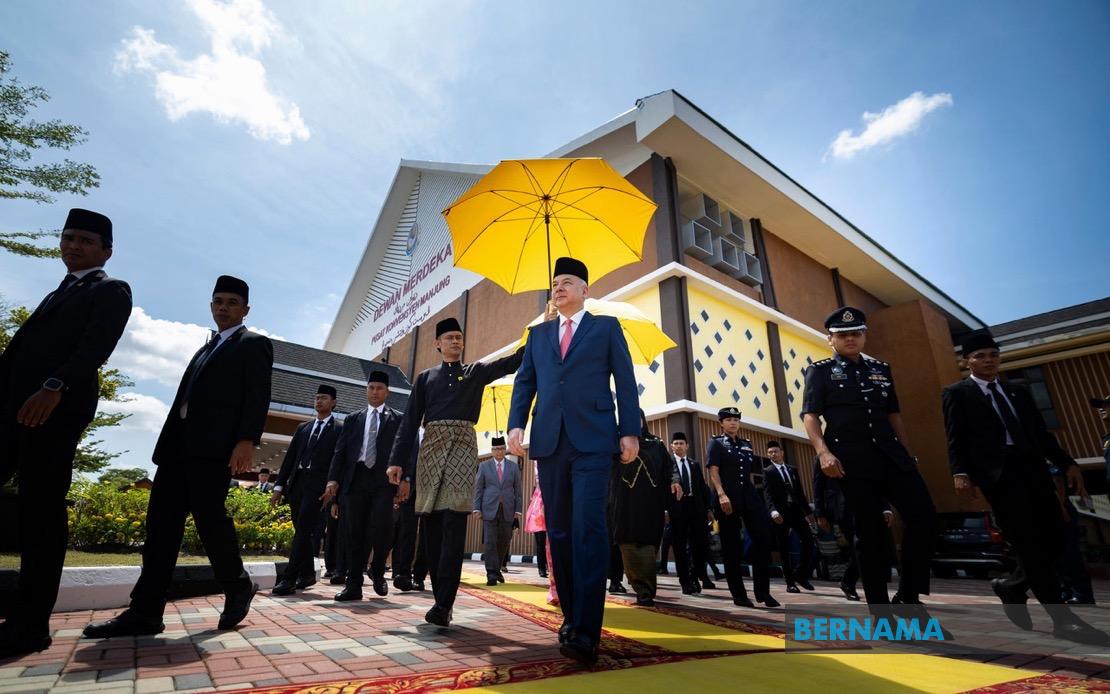
Sultan Nazrin Shah, the reigning monarch of Perak, officially inaugurated the newly constructed Merdeka Hall at the Manjung Municipal Council headquarters in Lumut on Monday, marking a significant infrastructure milestone for the coastal district. The ceremonial opening was attended by several high-ranking dignitaries, including Tuanku Zara Salim, the Raja Permaisuri of Perak, and Raja Iskandar Dzurkarnain Sultan Idris Shah, the Raja Di Hilir. The event also drew participation from Perak Menteri Besar Datuk Seri Saarani Mohamad and Higher Education Minister Datuk Seri Dr Zambry Abd Kadir, underscoring the event's importance to both state and federal authorities.
The RM12.7 million facility represents far more than a simple addition to Manjung's civic infrastructure. Designed to accommodate up to 2,500 people, the Merdeka Hall has been conceived as a multipurpose venue intended to host official government functions, large-scale conferences, and community gatherings. According to Menteri Besar Saarani's remarks at the opening ceremony, the hall functions as an anchor facility for the district's broader development aspirations, particularly its planned transformation into a recognised Tourism and Maritime City by 2030. For Malaysian readers familiar with coastal economic development strategies across Peninsular Malaysia, such flagship facilities frequently serve as catalysts for attracting investment and visitors to secondary cities competing for regional prominence.
The journey to realise this project stretched across nearly a decade. Planning commenced in 2016 when the then-sitting Menteri Besar championed the necessity of constructing a modern municipal hall to replace or significantly upgrade existing civic facilities. This extended timeline, ultimately culminating in Federal Government approval of the required allocation, reflects the bureaucratic and budgetary deliberations typically involved in major infrastructure commitments at the state level. The Menteri Besar highlighted that the project's completion demonstrates continuity in governance between successive administrations and, perhaps more significantly for observers of Malaysian politics, the functional cooperation maintained between the Perak state administration and the Federal Government in resource allocation and development priorities.
The symbolic dimensions of naming the facility Merdeka Hall carry weight beyond mere nomenclature. Saarani interpreted the choice as a deliberate reminder that national independence constitutes an ongoing responsibility rather than a historical achievement alone. This framing aligns with Malaysia's recurring emphasis on preserving the constitutional foundations and social values underpinning the nation since 1957. By attaching the independence narrative to a modern municipal facility in a district focused on economic modernisation, state leaders signal that development and heritage preservation operate as complementary rather than competing objectives within Perak's strategic vision.
The opening ceremony's timing proved particularly fortuitous, coinciding with the Manjung Municipal Council's 25th anniversary since its municipal status elevation. The council itself traces its institutional lineage further back to 1980, when it functioned as a district council before being elevated to municipal status on 1 August 2001. For administrative geographies in Malaysia, such a milestone anniversary represents a moment to assess institutional effectiveness and project future ambitions. The coincidence of the hall's inauguration with this silver jubilee celebration allowed state officials to frame the infrastructure investment as recognition of two and a half decades of municipal administration and as acknowledgement of the council's evolving responsibilities in managing a developing coastal district.
Manjung's strategic positioning within Perak's economic geography lends particular significance to infrastructure investments targeting tourism and maritime sectors. The district encompasses Lumut, home to Malaysia's naval base and a growing maritime tourism hub, alongside industrial zones and fishing communities. The aspiration to achieve Tourism and Maritime City status by 2030 reflects a deliberate economic diversification strategy common among Malaysian local authorities seeking to reduce dependency on traditional extractive or agricultural sectors. The Merdeka Hall, as a venue capable of hosting international conferences, trade exhibitions, and cultural events, directly supports this repositioning effort by providing the physical infrastructure necessary to attract regional business gatherings and tourism-related activities.
The Menteri Besar's remarks about the hall becoming a space where knowledge is nurtured and consensus flourishes suggest an understanding of modern municipal facilities transcending their functional purpose as event venues. Within Malaysian governance discourse, emphasis on fostering dialogue, understanding, and community consensus reflects broader themes of social cohesion and inclusive development prioritised in national and state strategic plans. The characterisation of the Merdeka Hall as a potential incubator for initiatives benefiting both community and state positioning the facility within a holistic vision of development where infrastructure serves not merely physical convenience but also social and institutional objectives.
For Perak specifically, and for comparable secondary cities across Malaysia's western seaboard, the Manjung example offers insight into how state and local authorities mobilise physical infrastructure toward broader repositioning objectives. Many Malaysian municipalities face the challenge of transitioning from primary commodity dependence toward knowledge-based, tourism-oriented, or value-added service economies. The investment in modern civic facilities signals commitment to such transitions and provides the tangible backdrop necessary for attracting conferences, exhibitions, and business delegations essential to economic transformation narratives. The RM12.7 million investment should therefore be interpreted not as isolated capital expenditure but as one component within a larger strategy to elevate Manjung's regional standing and competitive positioning.
The participation of the Higher Education Minister at the opening ceremony, while not elaborated upon in the available remarks, potentially signals alignment between educational and economic development initiatives. Malaysian state governments increasingly recognise that tourism and maritime sector growth depend upon workforce development and skills training in hospitality, port operations, and related fields. The minister's attendance may thus reflect coordination between skills development and infrastructure readiness, though the specific educational dimensions of this cooperation remain unstated in the available record.
Looking forward, the Merdeka Hall's success in supporting Manjung's tourism and maritime ambitions will depend substantially upon marketing effectiveness and capacity building within the municipal council's institutional structures. Modern facilities alone prove insufficient without complementary tourism promotion, skilled event management, and alignment with broader Southeast Asian travel and business trends. The next phase of Manjung's development trajectory will likely involve testing whether the physical infrastructure translates into tangible increases in visitor arrivals, business events, and economic activity. The benchmark of achieving Tourism and Maritime City status by 2030 provides a measurable framework against which progress can be assessed, offering a useful comparison point for Malaysian readers tracking how similar initiatives perform across other states and municipalities.

