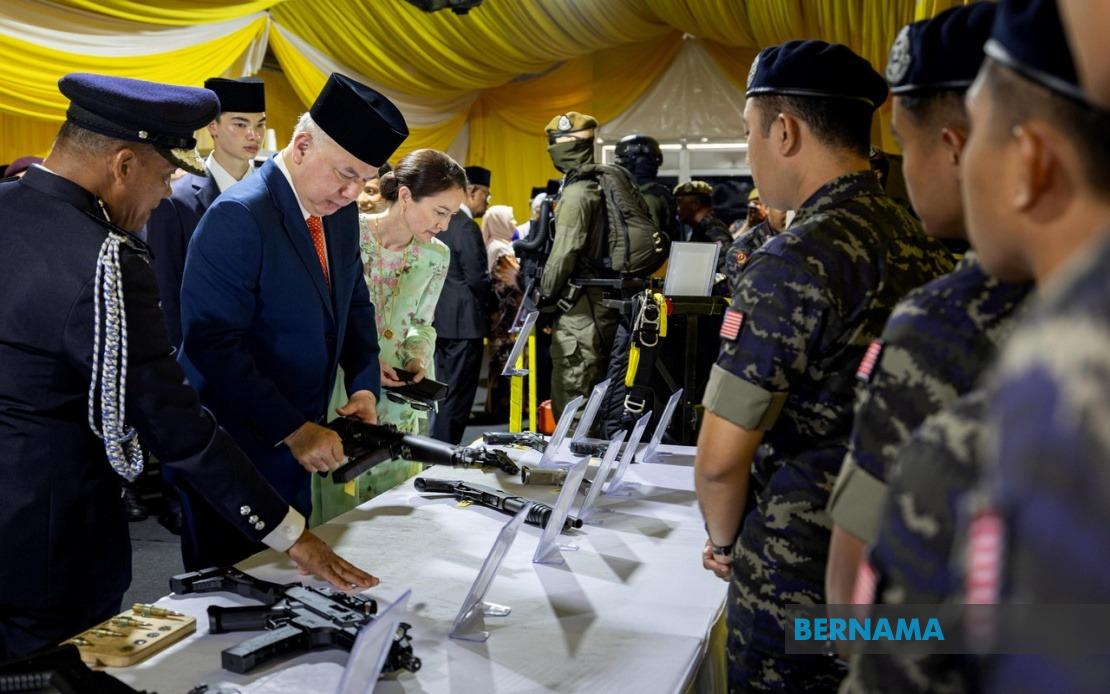
Sultan Nazrin Shah, the reigning monarch of Perak, formally dedicated the new Sultan Nazrin Shah 69 Commando Camp in Ulu Kinta on July 7, marking a significant milestone in the nation's defence infrastructure. The ceremony was attended by senior members of the Perak royal household, including the Raja Permaisuri, Raja Muda, and Raja DiHilir, alongside key government figures and security officials, underscoring the national importance of the facility.
Home Minister Datuk Seri Saifuddin Nasution Ismail used the occasion to articulate the government's broader security vision, describing the camp's opening as emblematic of MADANI's dedication to fortifying the capabilities of Malaysia's security apparatus in response to the mounting complexity of modern threats. He emphasised that the government recognises the critical need to provide world-class training facilities and infrastructure that would enable the force to operate at peak effectiveness and maintain constant vigilance over the nation's territorial integrity and civilian safety.
Malaysia's standing in global security metrics reflects positively on the country's track record. The Home Minister highlighted that Malaysia ranks 12th among 163 countries in the most recent Global Peace Index, a distinction that speaks to the professional standards and operational effectiveness of the nation's security institutions. This ranking places Malaysia well above most regional and many developed counterparts, demonstrating the foundation upon which further improvements can be built.
The 69 Commando unit itself carries a storied operational history spanning more than half a century since its establishment in 1969. Throughout its five decades of service, the unit has responded to some of the nation's most challenging security situations, from the protracted counter-insurgency campaign against communist forces to more recent high-profile operations. The unit's involvement in the 2000 Al-Maunah incident, the 2013 Ops Daulat response in Lahad Datu, Sabah, and the 2014 deployment related to the MH17 tragedy demonstrates its role as a rapid-response asset for complex and sensitive missions.
Beyond combat operations, the unit has developed substantial expertise in counter-terrorism initiatives, precision hostage rescue operations, and the management of volatile security scenarios that demand both tactical proficiency and strategic judgement. The unit's consistent deployment at critical junctures in the nation's security challenges underscores its status as one of the country's most capable and trusted operational assets. Government recognition of this track record informed the decision to develop a purpose-built facility worthy of the unit's standing and future requirements.
The new facility represents an investment of more than RM206 million and encompasses 338 hectares of carefully selected terrain in Perak. The site was developed with meticulous attention to the specific operational requirements of a modern special operations unit, incorporating training grounds, administrative facilities, and living quarters designed to support sustained high-intensity operations and professional development. The facility was handed over to the Royal Malaysia Police in 2024, establishing it as a dedicated operations, training and administrative hub for the commando unit.
The scale and comprehensiveness of the Sultan Nazrin Shah Camp reflect strategic thinking about Malaysia's long-term security posture. Rather than merely addressing immediate capacity constraints, the facility was conceived as a generational investment intended to serve the 69 Commando and the broader security ecosystem for decades to come. This approach acknowledges that security challenges evolve continuously, requiring institutional infrastructure capable of supporting sustained excellence and adaptation.
The naming of the facility after Sultan Nazrin Shah carries symbolic weight beyond administrative designation. It represents formal state recognition of the commando unit's contributions and the sacrifices made by generations of personnel who have served in the unit since its inception. For officers and enlisted personnel of the 69 Commando, the designation signals institutional appreciation for their professionalism and commitment, particularly important given the inherent risks associated with special operations deployment.
The camp is intended to function as an incubator for developing the next generation of commando personnel who will inherit and advance the unit's operational legacy. Beyond basic training and skill development, the facility is designed to serve as a centre for cultivating expert knowledge, maintaining combat readiness, and fostering the kind of institutional excellence that has characterised the unit's historical performance. The comprehensive infrastructure allows for sustained professional development and specialisation in the diverse skill sets required for contemporary security operations.
For Southeast Asian observers, the Sultan Nazrin Shah Camp represents Malaysia's strategic commitment to maintaining robust domestic security capabilities at a time when regional security dynamics face increasing complexity. The investment signals confidence in the professionalism of Malaysian security forces and commitment to equipping them with modern facilities comparable to international standards. This capability enhancement contributes to broader regional stability by ensuring Malaysia can effectively address internal security challenges without destabilising effects.
The facility also demonstrates how Malaysia approaches the intersection of tradition and modernity in its governance structures. The involvement of the Perak royal household in the inauguration ceremony reflects the constitutional role of the sultans in matters of state security and defence, while the MADANI Government's articulation of security policy reflects contemporary administrative imperatives. This complementary relationship between traditional institutions and modern governance frameworks characterises Malaysia's distinctive constitutional monarchy system.
Looking forward, the Sultan Nazrin Shah Camp is positioned as a catalyst for operational innovation within the 69 Commando and, potentially, across Malaysia's broader security establishment. Modern facilities with appropriate training infrastructure often catalyse improvements in operational doctrine, inter-agency coordination, and the adoption of emerging security technologies. The camp's existence provides a platform for ongoing institutional evolution that can keep pace with evolving security challenges in the region and globally.

