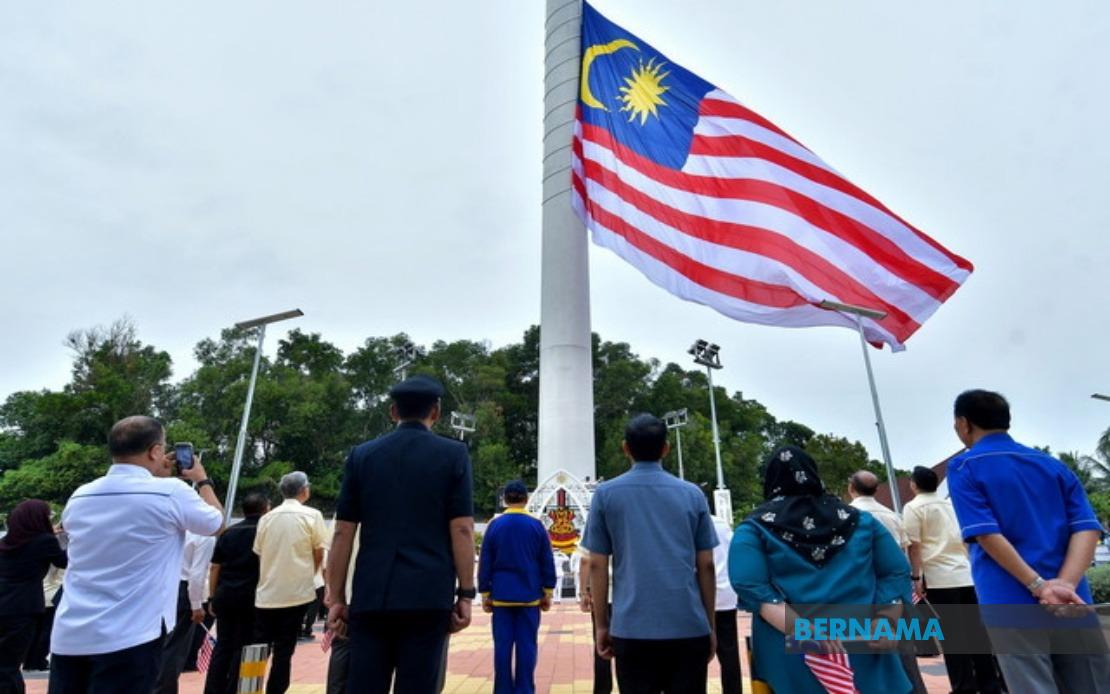
Sultan Sharafuddin Idris Shah, the Sultan of Selangor, has delivered a measured call for Malaysians to view their national flag as far more than ceremonial decoration, framing the Jalur Gemilang instead as a unifying emblem that supersedes the divisions of ethnicity, faith and political affiliation that characterise the nation's diverse population. In remarks released during the National Month build-up, the Ruler emphasised that despite profound differences among Malaysian citizens—spanning linguistic, religious, racial and ideological lines—the flag serves as a tangible reminder of shared citizenship and collective identity. His intervention arrives as the nation moves toward Independence Day and Malaysia Day observances, with the Selangor state flagpole at Dataran Selangor displaying the Jalur Gemilang from August 26 through September 17.
The Sultan's statement carries particular resonance in Malaysia's contemporary political context, where communal tensions and polarisation along ethnic and religious lines have periodically threatened social cohesion. By explicitly positioning the national flag as belonging equally to all citizens regardless of background, Sultan Sharafuddin addressed a persistent challenge facing multiethnic democracies: the question of whether national symbols can genuinely represent populations that experience vastly different relationships to state power and historical narratives. His framing rejects the notion that any single community holds privileged ownership of Malaysian national identity, instead casting the flag as fundamentally neutral territory where all communities possess equal claim.
The formal flag-hoisting ceremony at Dataran Selangor this morning functioned as both symbolic gesture and practical demonstration of this philosophy. Rather than positioning the ceremony as merely commemorative, the Sultan presented it as an opportunity to cultivate patriotic sentiment grounded in authentic respect for national diversity. This approach distinguishes between surface-level patriotic expression—the physical act of raising flags—and the deeper, more demanding work of building genuine intercommunal respect. The ceremony thus became a launching point for broader national reflection rather than an endpoint in itself.
Sultan Sharafuddin articulated a sophisticated critique of how national celebrations often remain disconnected from substantive progress on unity. Flying thousands of flags throughout the National Month requires minimal effort and carries no inherent political cost, he suggested. The far more taxing challenge involves creating the institutional, social and political conditions whereby citizens from different communities genuinely perceive themselves as respected, valued members of a shared polity. This distinction matters considerably for policymakers and community leaders, as it reframes National Day observances as accountability moments rather than opportunities for symbolic gestures devoid of meaningful follow-through.
The Sultan's comments implicitly critique leadership across multiple domains—political, religious and community-based—for sometimes exploiting ethnic and religious identities as mobilising tools rather than fostering genuine tolerance. By calling on leaders and politicians to model moderation, tolerance and compassion while explicitly avoiding divisive rhetoric, Sultan Sharafuddin positioned ethical leadership as prerequisite to national unity. He cautioned against treating political, racial or religious differences as justifications for polarising rhetoric and policy, suggesting that such framing represents a fundamental betrayal of the nation's foundational compact.
Education emerged as a critical vector in Sultan Sharafuddin's vision for strengthened unity. His emphasis that younger generations require explicit instruction in respecting diverse religions, races and cultures acknowledges that such respect cannot be assumed or inherited automatically. This reflects recognition that without deliberate pedagogical intervention, generational transmission of divisive attitudes becomes default outcome. The statement thus implicitly challenges Malaysia's educational establishment to examine whether current curricula adequately prepare students for genuine intercommunal coexistence or instead reinforce communal silos through selective historical narratives and limited exposure to different worldviews.
The Sultan's reiteration that the Jalur Gemilang makes no distinctions between ethnic groups—whether Malays, Chinese, Indians, Kadazan-Dusuns or Ibans—or religious communities carries particular weight given recurring debates about whose interests national institutions prioritise. By emphasising the flag's essential neutrality, Sultan Sharafuddin addressed anxieties held by both majority and minority populations: majority communities concerned about perceived erosion of their historical role, and minority communities questioning whether national symbols genuinely represent them. His formulation offered a both-and resolution rather than zero-sum framwork.
The timing of these remarks during the National Month amplifies their significance. Independence anniversary celebrations traditionally provide platforms for political speeches emphasising national achievements and future direction. Sultan Sharafuddin's intervention directed public discourse toward internal social dynamics rather than external accomplishments, implicitly suggesting that Malaysia's most consequential challenges relate less to economic performance or international standing than to the fundamental question of whether ethnically and religiously diverse citizens can build genuinely shared national life. This reorientation of focus reflects awareness that institutional stability requires deeper legitimacy grounded in perceived fairness and respect across communal lines.
For regional observers, the Sultan's statement offers insight into how Malaysia's constitutional monarchy functions as institutional check on purely majoritarian impulses. Unlike elected politicians whose constituencies reward polarising rhetoric, monarchs occupy positions enabling them to articulate transcommunal visions without immediate electoral consequences. Sultan Sharafuddin's invocation of this platform to emphasise unity rather than supremacy demonstrates deliberate choice to deploy royal authority toward integration rather than sectional advantage. This role has historically distinguished Malaysia's approach to managing diversity from alternative models elsewhere in Southeast Asia.
The practical implications of Sultan Sharafuddin's statement extend to local governance and community leadership structures. If flag-flying without corresponding attention to substantive equality proves insufficient, then government agencies, civil society organisations and private institutions must examine whether their policies and practices genuinely reflect the inclusive vision the Sultan articulated. This creates potential accountability framework whereby National Month observances can be evaluated not merely on ceremonial magnificence but on demonstrated progress toward the Ruler's stated vision of a nation where all citizens feel respected and accepted.
Looking forward, Sultan Sharafuddin's formulation of national identity as transcending rather than erasing difference offers potentially productive direction for ongoing national dialogue about constitutional purpose and social contract. By insisting that true independence means enabling diverse populations to live together in peace and mutual respect, the Sultan positioned unity not as suppression of difference but as deliberate choice to navigate difference constructively. This framework matters particularly as Malaysia confronts generational transitions in political leadership and evolving demographic dynamics that will test the nation's capacity for inclusive governance.

