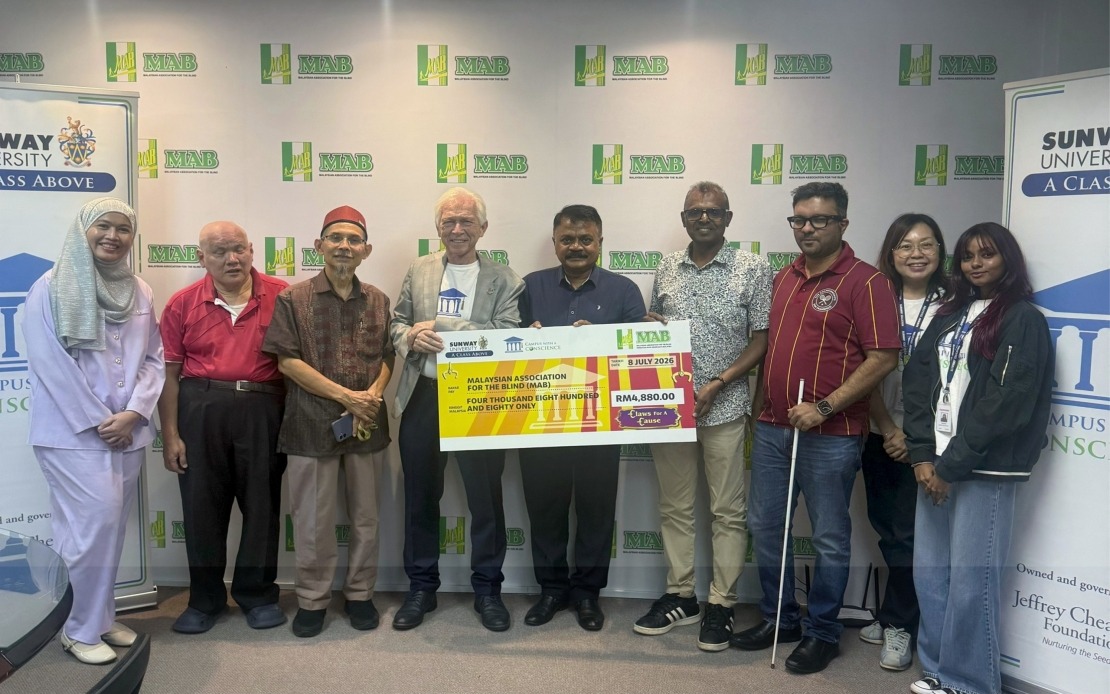
Sunway University has generated RM4,880 in donations for the Malaysian Association for the Blind (MAB) through an imaginative campus-wide fundraising scheme that transformed a familiar arcade experience into a vehicle for charitable giving. The project, termed Claws For A Cause, operated throughout a full week on the university's Kuala Lumpur campus and formed part of the broader Campus With A Conscience programme. The collaboration between the academic institution and entertainment partner Space Panda demonstrates how traditional entertainment mechanisms can be repurposed to address social needs within higher education environments.
The fundraising concept centered on a claw machine—a simple, accessible gaming device found in entertainment venues across Malaysia—which became the focal point for student and staff engagement. Rather than playing for typical arcade prizes, participants contributed funds that directly supported MAB's work with visually impaired individuals. This approach proved effective in encouraging widespread participation, as the familiar nature of the activity lowered barriers to engagement while the charitable element provided meaningful purpose. The week-long duration allowed multiple opportunities for campus members to take part, building momentum and community awareness around the cause.
Professor Sibrandes Poppema, who serves as President and Vice-Chancellor of Sunway University, framed the initiative within the institution's broader educational philosophy and social responsibility framework. He emphasized that the university's mission transcends conventional academic teaching and research, extending instead into measurable community benefit. Poppema characterized such programs as expressions of the university's identity as a mission-driven institution operating at what he described as the fifth-generation level of higher education development. This positioning reflects global trends in university governance, where institutions increasingly define themselves through community partnerships and social impact metrics alongside traditional educational outcomes.
The university president highlighted several dimensions of the fundraising success. Beyond the monetary target achieved, he pointed to the demonstration of collective action and compassion as outcomes equally worthy of recognition. His statement underscored how organized initiatives can mobilize institutional resources—both physical infrastructure and human participation—toward externally focused goals. This framing matters for Malaysian higher education contexts, where universities face increasing expectations to contribute visibly to national development priorities and social cohesion. Sunway's approach suggests one model for balancing commercial entertainment partnerships with genuine philanthropic outcomes.
Space Panda's participation, led by Director Marcus, extended beyond merely providing the gaming equipment. The company's involvement represented a conscious business decision to align commercial operations with social welfare objectives. Marcus articulated the view that incremental charitable acts collectively generate substantial impact, a philosophy that resonates with grassroots fundraising models throughout Southeast Asia. His emphasis on supporting an organization dedicated to empowering persons with visual impairments carried particular weight, suggesting Space Panda's leadership considers disability inclusion a priority area worthy of corporate resource allocation.
The Malaysian Association for the Blind operates within Malaysia's broader disability support ecosystem, providing services that range from vocational training to independent living assistance for individuals experiencing vision loss. The organization's work addresses both practical challenges faced by visually impaired Malaysians and broader social inclusion objectives. The RM4,880 raised through Sunway's initiative, while modest in absolute terms, contributes incrementally to operational capacity. For specialized organizations like MAB, such donations frequently support specific program components—perhaps training modules, equipment purchases, or client service expansion—that would otherwise face funding constraints.
The partnership between Sunway University and Space Panda exemplifies a model increasingly common in Malaysian philanthropy: structured collaboration between educational institutions, commercial enterprises, and charitable organizations. Each partner contributes distinct assets—Sunway provided the campus venue, engaged student body, and institutional credibility; Space Panda supplied entertainment infrastructure and corporate participation; MAB benefited as the charitable recipient. This tripartite arrangement distributes both effort and benefit, creating sustainability advantages over models dependent on single institutional actors.
From a higher education perspective, Sunway's Campus With A Conscience programme reflects institutional recognition that student formation encompasses values beyond disciplinary knowledge and technical skill. Participation in organized charitable activities provides experiential learning in prosocial behavior, organizational collaboration, and social awareness. Malaysian universities increasingly incorporate such components into their educational missions, responding to employer demand for graduates demonstrating not merely technical competence but also ethical judgment and community orientation. The Claws For A Cause initiative thus served educational functions alongside its charitable outcomes.
The fundraising mechanism itself warrants consideration within Malaysian consumer culture contexts. Claw machines represent accessible entry points for participation—most campus members have encountered such devices and understand their operation. By converting a recreational activity into a charitable donation vehicle, Sunway removed psychological barriers to giving that sometimes inhibit smaller donations. This approach acknowledges that many individuals prefer structured giving opportunities over unmediated charitable solicitation, a reality reflected in the strong participation rates throughout the campaign week.
Looking beyond the specific fundraising outcome, the initiative signals broader institutional positioning regarding corporate social responsibility and educational purpose. Malaysian universities, as community anchors and trusted institutions, increasingly leverage their convening power to mobilize resources toward recognized social needs. Disability support remains an underfunded area within Malaysia's social services landscape, where government capacity faces constraints and civil society organizations like MAB operate with limited resources. University-driven fundraising initiatives help address this resource gap while simultaneously engaging student communities in empathy-building and civic participation.
The success of Claws For A Cause also suggests replicability potential for other Malaysian higher education institutions seeking to strengthen community engagement portfolios. The initiative required minimal specialized resources—a claw machine and charitable cause—while generating meaningful outcomes. Other universities might adapt this model to support different causes, creating a form of distributed institutional fundraising that strengthens multiple nonprofit sectors simultaneously. The template demonstrates how creativity in program design can amplify impact relative to conventional fundraising approaches.
Finally, the recognition accorded to Space Panda's participation reflects evolving corporate expectations within Malaysian business environments. Companies increasingly face pressure from consumers, employees, and communities to demonstrate authentic commitment to social welfare beyond symbolic gestures. Space Panda's involvement in the Claws For A Cause initiative positioned the entertainment company as genuinely invested in disability support, potentially strengthening brand reputation among socially conscious consumers and employees. This alignment of business interests with charitable outcomes creates mutual benefit that sustainability researchers recognize as essential for long-term partnership viability.
Sunway University's fundraising success ultimately represents a confluence of institutional commitment, corporate partnership, community need, and creative program design. The RM4,880 raised for the Malaysian Association for the Blind addresses immediate funding requirements for disability support services. Simultaneously, the initiative modeled for campus participants how collective action generates social benefit, reinforced institutional values through tangible community engagement, and demonstrated corporate responsibility through meaningful partnership. As Malaysian higher education institutions increasingly position themselves as social actors beyond classroom boundaries, initiatives such as this establish practical templates for translating mission statements into measurable community outcomes.

