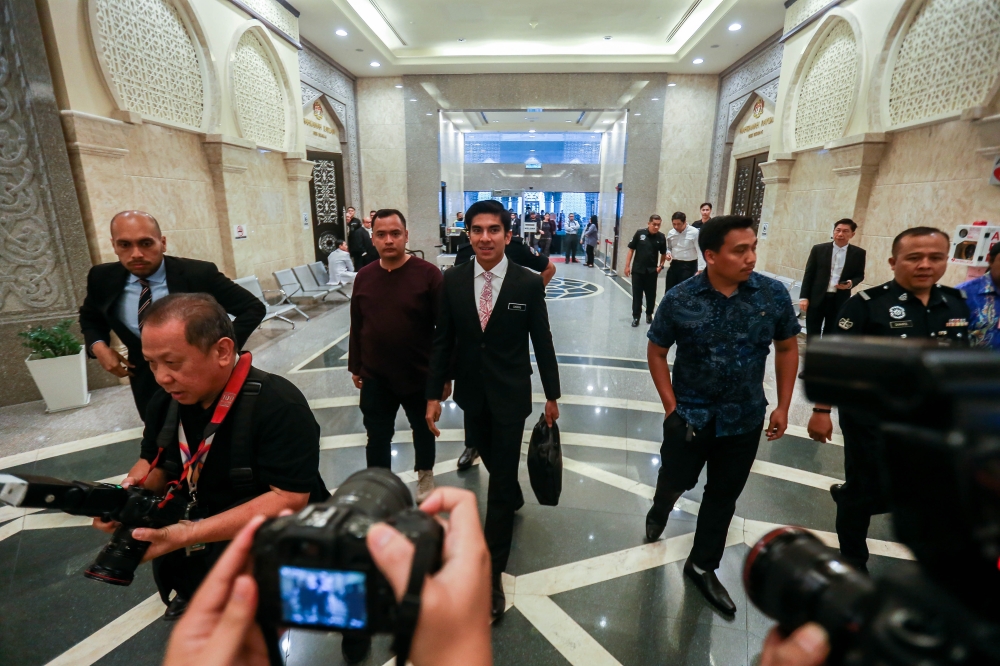
Putrajaya witnessed an early convergence of political sympathisers and onlookers on July 13 as Muar Member of Parliament Syed Saddiq Syed Abdul Rahman made his way to the Palace of Justice for a decision that could reshape his political future. The appearance of large crowds outside the courthouse underscored the significance of the matter before the nation's highest court, drawing attention from observers across the political spectrum who recognised the stakes involved in the adjudication.
Syed Saddiq's arrival at the venue was notably accompanied by his family members and his fiancée, a visible show of familial solidarity during what constituted a pivotal moment for the 35-year-old politician. The presence of his immediate family at his side symbolised personal support during proceedings that extend beyond the purely legal dimensions into the realm of public perception and political consequence. Such displays of family backing often carry symbolic weight in Malaysian political culture, signalling resilience and continued confidence in the individual's character and prospects.
The Muar representative has occupied a notable position within Malaysia's political landscape, having served previously in ministerial roles that brought him into prominence within his party and broader governmental circles. His parliamentary tenure and earlier executive experience have established him as a recognisable figure in national politics, which explains the substantial public interest surrounding the Federal Court's deliberation. The jurisdiction of Malaysia's apex court typically signals cases of constitutional importance or those with far-reaching implications for the individuals involved.
The gathering of considerable numbers at the Palace of Justice reflected the broader political resonance of the case, extending beyond mere curiosity to encompass genuine concern from his political supporters and allies. Such courtroom vigils have become increasingly common features of Malaysia's contemporary political landscape, where high-profile legal proceedings often generate significant public attention and become flashpoints for political discussion and speculation.
The composition of those assembled outside the courthouse appeared to encompass both organised political supporters and individual citizens interested in observing the proceedings, creating an atmosphere charged with anticipation regarding the court's pronouncement. The early hour of the gathering suggested coordinated efforts by supporters to ensure prominent visibility and demonstrate their backing during this consequential moment.
For Malaysian observers following contemporary political developments, the case represents another instance of the intertwining of legal processes with political trajectories, a phenomenon that has characterised recent years within the nation's governance structures. The outcome of such Federal Court decisions frequently carries implications not only for the individuals directly involved but also for the broader political configurations and factional alignments within Malaysian parliamentary and party structures.
The presence of Syed Saddiq's fiancée alongside family members at the Palace of Justice underscored the personal dimensions of legal proceedings that, while conducted in formal courtroom settings, inevitably affect the lives and futures of those directly involved and their closest associates. This dual aspect—simultaneously legal and profoundly personal—characterises many high-stakes cases that attract sustained public attention in Malaysia's political environment.
As Southeast Asia continues to observe Malaysia's political developments with considerable interest, cases such as this one serve as barometers of the region's democratic maturity and the functioning of its judicial institutions under circumstances of high political pressure and public scrutiny. The capacity of courts to deliver decisions perceived as fair and principled, even in politically sensitive contexts, remains essential for the integrity of Malaysia's constitutional framework.
The gathering at Putrajaya reflected broader patterns within Malaysian political culture where courtroom moments become occasions for public demonstration of support or opposition, transforming legal venues into spaces of political expression. The scale of attendance on July 13 indicated widespread recognition that Syed Saddiq's case possessed significance extending beyond the technical legal questions before the Federal Court.
For Malaysian legal observers and political analysts, the proceedings represented an opportunity to assess how the judicial system navigates the complex intersection of political consequence and legal principle, an equilibrium that Malaysian courts must continually maintain to preserve public confidence in institutional independence and impartiality.

