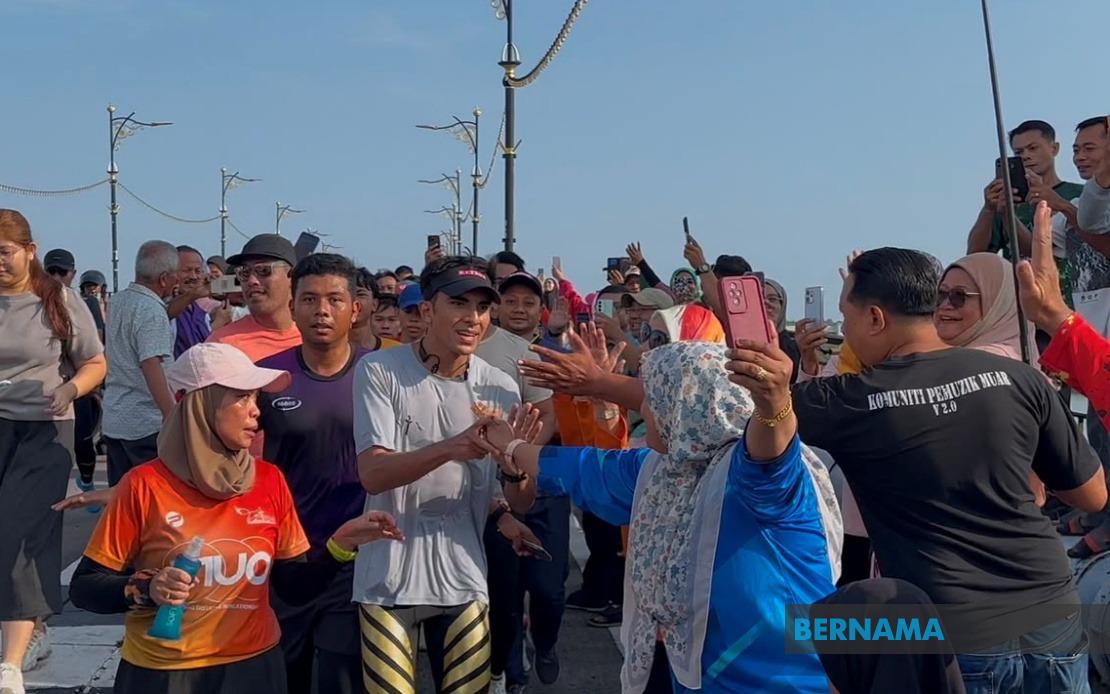
Muar Member of Parliament Syed Saddiq Syed Abd Rahman crossed the finishing line at Laman Maharani here on July 19, concluding a remarkable four-day endurance run that galvanised community support across multiple parliamentary constituencies. The 170-kilometre 'Larian Kesyukuran' (Gratitude Run), which commenced from the Palace of Justice in Putrajaya on July 16, culminated in a triumphant reception with approximately 2,000 local residents gathering since early morning to witness the MP's arrival at 9.15 am.
The final leg of the odyssey saw Syed Saddiq cover 17 kilometres from Simpang Sungai Rambai in Melaka, crossing the Sultan Ismail Bridge alongside members of the 'Muo Runner' group before arriving at the designated finishing point. This extended grassroots engagement reflects a growing trend among Malaysian politicians of leveraging physical endurance events to mobilise charitable giving whilst maintaining direct contact with voters. The format—combining personal physical sacrifice with transparent fundraising objectives—appears to resonate particularly well in constituencies seeking tangible evidence of representative commitment to constituent welfare.
The financial outcome substantially exceeded initial projections, with the four-day initiative accumulating RM650,959.2 against an original target of RM200,000. This threefold overperformance underscores both the appeal of the charity's framing and the capacity for sustained community participation when political leaders demonstrate willingness to undertake demanding physical challenges. Syed Saddiq committed that all funds collected will be allocated exclusively to welfare assistance programmes benefiting Muar parliamentary residents, establishing a direct line between the fundraising effort and its intended beneficiaries.
The allocation framework encompasses several key priority areas within the constituency. Food assistance baskets will be distributed to families experiencing economic hardship, whilst tablet devices will be provided to academically promising students from disadvantaged backgrounds, addressing both immediate welfare needs and educational opportunity gaps. This dual-pronged approach acknowledges that effective constituency support requires attention to both survival-level needs and medium-term developmental investments in young constituents' educational prospects.
Syed Saddiq expressed appreciation for the overwhelming community response, particularly highlighting contributions from unexpected sources. He specifically recalled receiving donations as modest as 50 sen from a child, framing such gestures as emblematic of the grassroots support animating the initiative. This reflection suggests an understanding that charitable participation transcends monetary value, incorporating elements of civic engagement and symbolic community solidarity. The willingness to acknowledge and valorise small-scale contributions may reflect broader recognition that sustainable welfare systems depend upon cultivating widespread participatory culture rather than relying solely on major donors.
The geographical reach of supporters extended substantially beyond the Muar parliamentary boundary, with residents from adjacent constituencies including Batu Pahat travelling specifically to the finishing point to offer moral support and financial contributions. This spillover effect reveals the capacity for local political initiatives to generate inter-constituency cooperation and suggests that welfare-focused activities can transcend the typical parochialism of parliamentary representation. The presence of supporters from surrounding areas indicates that causes framed in terms of community welfare possess mobilising capacity that transcends narrow constituency divisions.
Among the participants who journeyed across district boundaries were Aminah Abd Rahman, aged 64, and her daughter Syarifah Fatimah Syed Ali, 26, who travelled from Batu Pahat specifically to contribute and demonstrate solidarity. Their decision to monitor the run's progress through social media over four consecutive days before attending the finale indicates how contemporary digital platforms enable remote participation in locally-focused initiatives. Aminah articulated a perspective that differentiates Syed Saddiq's approach from conventional political engagement, noting that not all elected representatives demonstrate equivalent willingness to undertake physically demanding endeavours on behalf of constituent welfare.
This observation touches upon a significant dimension of contemporary Malaysian politics: the expanding expectation that elected representatives demonstrate commitment through personal sacrifice and physical endurance rather than through conventional administrative mechanisms. The success of such initiatives may reflect constituent recognition that traditional governance channels often produce limited tangible outcomes, rendering visible personal exertion an alternative currency for demonstrating political seriousness. For younger or more reform-oriented politicians, such high-visibility endurance activities offer mechanisms for differentiation from established political figures and for building direct constituent relationships that circumvent traditional party machinery.
The social media documentation of the run's progression across four days created a form of distributed civic participation, permitting geographically distant supporters to track the endeavour's trajectory and contribute remotely before attending the conclusion. This integration of digital engagement platforms with physical charitable activities represents an evolving model of political mobilisation in Southeast Asia, where social media amplification of on-ground initiatives can substantially expand their reach and impact. The approach demonstrates sophisticated understanding of how contemporary communication patterns can be leveraged to sustain constituent interest and participation across extended timeframes.
Beyond the immediate fundraising objective, the Larian Kesyukuran initiative functions as a political branding exercise, positioning Syed Saddiq within a framework of constituency-first prioritisation and personal accountability. The scale of the undertaking—170 kilometres across four days—establishes a distinctive public narrative that may influence voter perceptions during subsequent election cycles. For Malaysian constituencies experiencing political volatility and shifting representative loyalty, such highly visible welfare commitments can serve as differentiation mechanisms in increasingly competitive electoral environments.
The initiative's resonance also reflects broader patterns within Malaysian civil society, where informal welfare networks and community-based fundraising continue to supplement or compensate for perceived gaps in government service provision. The overwhelming public participation suggests constituent recognition that supplementary welfare mechanisms remain necessary components of the social safety net, and that political representatives responsive to such needs merit public affirmation through direct participation and contribution. The success of this model may inspire replication by other elected representatives seeking to strengthen constituent relationships whilst simultaneously addressing documented welfare deficits.

