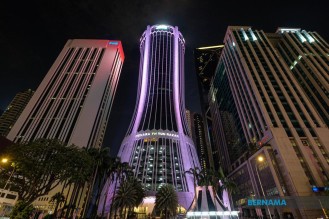
Parliament heard damaging details this week about Lembaga Tabung Haji's troubled investment in construction company Putrajaya Perdana, with Finance Minister II Datuk Seri Amir Hamzah Azizan revealing that the entire approval process unfolded while the target company remained under the alleged control of fugitive financier Low Taek Jho through his vehicle Utama Banking Group Bhd. The disclosure emerged during a special parliamentary sitting examining a Royal Commission of Inquiry report into TH's management and operational practices, drawing sharp questions from MPs concerned about how depositors' funds were deployed.
According to sworn court testimony recorded during proceedings against SRC International, the sequence of events in 2014 reveals troubling governance lapses. Putrajaya Perdana director Datuk Rosman Abdullah testified that SRC International—itself an alleged front for Jho Low's interests—channelled RM170 million into the company's construction subsidiary between July and August 2014. Critically, this occurred before UBG completed its sale of Putrajaya Perdana on April 13, 2015, meaning Jho Low's apparatus maintained control throughout the entire TH decision-making process. While the court has not formally determined Jho Low's beneficial ownership, the timeline of events painted by sworn testimony raises serious questions about regulatory oversight during a period when Malaysia was already grappling with the unfolding 1Malaysia Development Bhd scandal.
The chronology itself deserves closer examination. TH's Investment Panel approved the purchase on July 24, 2014, followed by board approval on August 25 and ministerial blessing on August 27. The actual share purchase agreement came much later, on December 3, 2014, and TH paid RM193.5 million in December 2014 for its 30% stake. Every major decision point occurred within the window when testimony suggests Jho Low retained control, yet there is no evidence that decision-makers at TH were informed of this concerning backdrop. Most troubling is that when the Investment Panel requested management identify the ultimate shareholder of the seller on July 24, no recorded response materialised, and approval proceeded anyway based on incomplete information.
The valuation process itself warrants scrutiny, as it appears to have lacked rigorous grounding in objective assessment. TH's own Research Division initially valued the 30% stake at between RM124 million and RM155 million, but approval was granted for RM193.5 million without documented justification for the dramatic upward revision. The stake size itself expanded from an originally proposed 25% to 30%, another shift lacking written explanation. What makes this particularly egregious is that due diligence was conducted only after all approvals had already been secured and final agreements signed—inverting the normal sequence of prudent investment practice. The Investment Panel and board never reviewed due diligence findings before committing TH's money. This pattern repeated across multiple other TH investments examined in the 2023 fact-finding assessment, with four separate deals lacking required due diligence and risk management recommendations going unaddressed.
A critical piece of information was never disclosed to decision-makers: the seller, Cendana Destini Sdn Bhd, had itself acquired the entire company from Jho Low-linked interests for only RM260 million in 2012, meaning a 30% stake should have been worth approximately RM78 million at acquisition cost. Yet TH paid nearly RM194 million for the same stake less than two years later—an increase of roughly 150%, or nearly triple the cost basis. This enormous premium appears utterly unjustifiable and raises questions about whether TH's management fully understood the underlying asset's true value or was subject to external pressure to proceed.
The two fundamental promises upon which the entire transaction rested both failed to materialise. The seller promised that Putrajaya Perdana would be relisted on the stock exchange within one year and would generate profits of RM86 million in 2015. Neither happened. When these core commitments evaporated, TH exercised a put option in March 2018 demanding that the seller repurchase the shares for RM210.7 million, but payment never arrived. The company collapsed in value, and by the 2024 financial year TH took full impairment of the RM193.5 million investment, effectively writing off a substantial portion of its capital. The debacle represents not merely a poor investment decision but a comprehensive breakdown of TH's governance, due diligence, and fiduciary responsibility to millions of Malaysian depositors who entrust their hajj savings to the institution.
TH has now escalated to litigation, having filed a writ and obtaining a Mareva injunction to freeze the seller's assets. Court-directed mediation was scheduled for the day Amir Hamzah made his parliamentary statement, with trial currently set for June 23, 2027—suggesting the legal process will consume years despite the straightforward nature of the underlying facts. The lengthy court timeline underscores how TH's initial failures have cascaded into expensive and protracted remedial action, further consuming institutional resources that could otherwise benefit depositors.
The Putrajaya Perdana case exemplifies how Jho Low's tentacles extended into institutions beyond 1MDB and SRC International, and how his associates exploited regulatory gaps and weak corporate governance to extract value. For TH specifically, the episode raises fundamental questions about board independence, management accountability, and the adequacy of internal controls that supposedly protect one of Malaysia's most important financial institutions serving the Muslim community. That a RM193.5 million transaction could be approved based on incomplete information, inflated valuations, and deferred due diligence suggests systemic weaknesses that extended beyond individual poor decisions.
The implications extend beyond TH itself. The case demonstrates how government-linked investment vehicles can become vulnerable to external actors when governance safeguards deteriorate. It illustrates why independent board oversight and mandatory due diligence sequencing exist—not as bureaucratic obstacles, but as essential protections against predatory actors. For depositors across Malaysia's pilgrim savings system, the Putrajaya Perdana saga serves as a stark reminder that institutional reputation and regulatory assurances provide no guarantee against mismanagement or external infiltration when internal controls fail.
MPs from constituencies including Muar, Putrajaya, and Port Dickson raised concerns about Jho Low's broader role in the transaction and his alleged influence over the decision-making apparatus. Their questions reflected legitimate depositor anxiety about whether TH's leadership was captured by interests contrary to the institution's core mission. While the court has not formally ruled on Jho Low's beneficial ownership at the time of approval, the sworn testimony connecting SRC International's involvement to Putrajaya Perdana's capitalisation during the period when Jho Low allegedly controlled the company through UBG creates a damning narrative that TH failed to investigate adequately. The timing, the funding flows, and the subsequent asset impairment all point toward a transaction that enriched connected parties while depleting capital belonging to working-class Malaysian Muslims saving for hajj.

