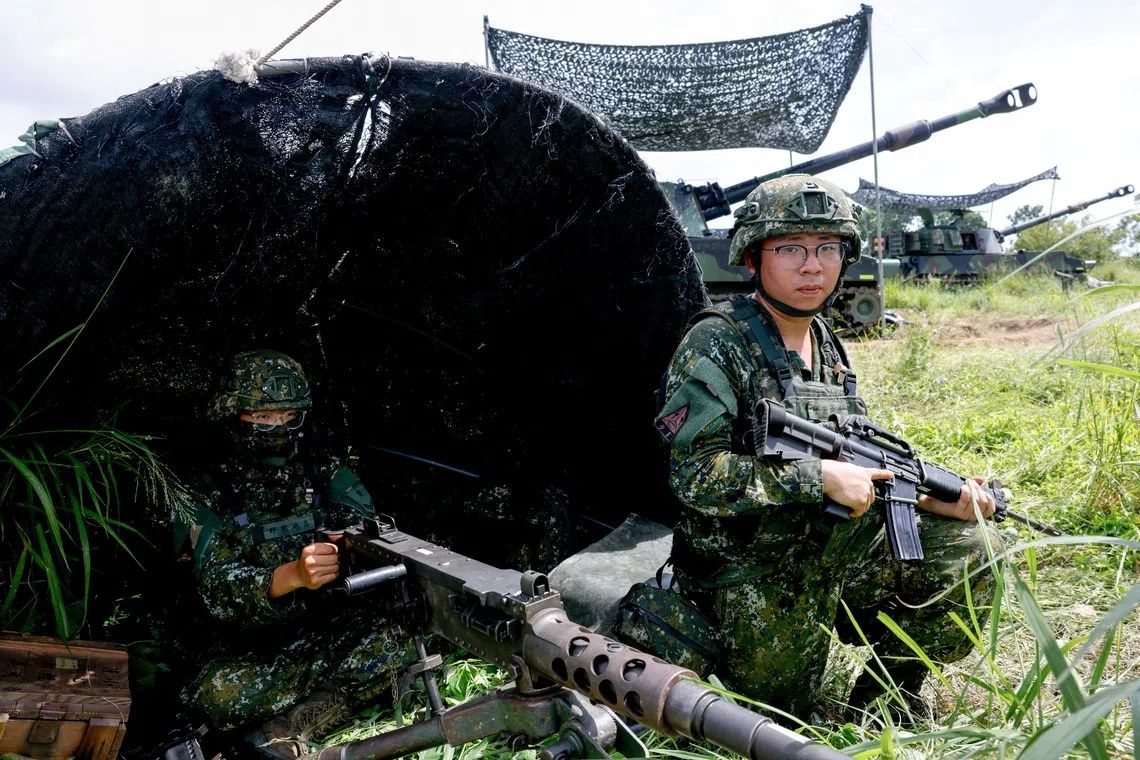
Taiwan's military commenced its most ambitious annual defence exercise this week, signalling a significant shift toward war-gaming that mirrors actual combat conditions rather than controlled laboratory-style simulations. The Han Kuang drills, which kicked off on Wednesday and will run through mid-August, represent a watershed moment in Taiwan's approach to national defence preparation, incorporating unprecedented elements such as deliberate internet speed reductions and protocols borrowed from advanced military establishments like the United States armed forces.
The 10-day exercise began with an underground command centre in Taipei activating the formal drill order, immediately cascading combat-readiness procedures throughout the island's military apparatus. These operational movements encompass the dispersal of fighter jets to alternative airfields, emergency naval mobilisations, and the simulation of critical infrastructure relocation. The scope extends beyond traditional military units, incorporating over 20,000 troops including approximately 5,000 reservists who will participate in scenarios designed to stress-test Taiwan's entire defensive posture during periods of heightened tension.
Among the most notable innovations is Taiwan's adoption of a "backbrief" methodology, a communication protocol where junior officers receiving operational orders must restate mission parameters and objectives back to their commanding officers before execution. This technique, established practice within US military structures, addresses a persistent vulnerability in military operations: the gap between intent and understanding. By requiring subordinates to articulate their comprehension of orders, Taiwan's defence establishment aims to eliminate coordination failures that could prove catastrophic in actual conflict, particularly in scenarios where rapid adaptation becomes necessary.
The drills deliberately introduce what military planners term "friction"—the unexpected and chaotic elements that characterise real warfare rather than scripted exercises. Defence officials emphasised that commanders will face scenarios deliberately deviating from initial threat assessments, forcing them to reassess situations, adjust tactics, and issue new orders under pressure. This represents a deliberate rejection of the predictable, controlled environment that has historically characterised Taiwan's defence preparations, with officials acknowledging that previous exercises sometimes suffered from excessive stagecraft that failed to prepare personnel for genuine operational complexity.
A particularly striking development is Taiwan's introduction of controlled internet throttling during the Han Kuang exercises. For the first time in the drills' four-decade history, authorities will intentionally reduce mobile internet speeds island-wide, creating conditions that simulate potential bandwidth constraints during wartime. This innovation recognises how modern civilian populations depend on digital connectivity for everything from emergency alerts to supply chain coordination, and it tests whether Taiwan's population and administrative apparatus can function effectively when this critical infrastructure degrades. The move reflects sophisticated understanding that contemporary warfare extends far beyond military installations to encompass the entire societal infrastructure that sustains a nation's defence effort.
Central to the exercise design is the assumption that China, which continues to assert claims over Taiwan despite the island's firm opposition, would attempt to paralyse critical nodes early in any military campaign. Taiwan's defence planners are focusing specifically on command centres, port facilities, logistics networks, and defence industry sites. The exercises therefore include mobilisation of civilian manufacturing capacity and simulated relocation of major military arsenals, recognising that Taiwan's defence depends not merely on standing military forces but on the capacity to sustain operations through civilian industrial mobilisation. Additionally, escort drills conducted off Taiwan's Pacific coast address rising strategic concerns that Beijing might attempt to sever the island's supply lines from regional allies, constraining Taiwan's ability to sustain a prolonged conflict.
Taiwan's evolving exercise design reflects an underlying anxiety about the sustainability of supply lines, particularly from partners across the Pacific. As Chinese military capabilities expand and Beijing's willingness to conduct increasingly assertive operations around Taiwan becomes evident, Taiwanese planners must account for scenarios in which established supply routes become contested or severed. The drills therefore place considerable emphasis on testing alternative logistics arrangements and ensuring that civilian infrastructure can be rapidly repurposed for military supply functions.
A noteworthy institutional innovation involves the integration of an "embedded reporter" mechanism specifically designed to assess how Taiwan would manage wartime communications and counter hostile information operations. This acknowledges that modern conflicts extend into the information space, where narrative control and the ability to counter disinformation become as strategically significant as military operations. The mechanism tests Taiwan's capacity to maintain accurate, timely communication with its population while simultaneously countering false narratives that an adversary might disseminate.
Taiwan's defence establishment has explicitly rejected the characterisation of these exercises as laboratory-style operations conducted in isolation from real-world conditions. Officials contend that the drills now incorporate "real bottom-line conditions" and stress-test the system against authentic constraints. This philosophical shift reflects lessons learned from historical military exercises that failed to prepare forces for operational realities, combined with growing recognition that Taiwan faces an increasingly capable and assertive military challenger across the Taiwan Strait.
The exercises extend beyond purely military dimensions to encompass how Taiwan's civilian government would maintain continuity during cascading crises ranging from natural disasters to military invasion. Resilience drills test whether local officials possess the training and systems to sustain governance functions during conditions of severe stress. This whole-of-society approach acknowledges that Taiwan's defence depends not on military capacity alone but on the willingness and capacity of the broader population to endure hardship and maintain social cohesion during crisis.
For Malaysia and other Southeast Asian observers, Taiwan's evolving defence posture carries significant implications. A Taiwan that successfully develops realistic military preparedness and civilian resilience becomes a more credible deterrent to forceful action, potentially reducing the likelihood of conflict that could disrupt regional stability and international commerce. Conversely, if Taiwan's defence preparations prove inadequate, the consequences could extend far beyond the island itself, potentially reshaping regional power dynamics and creating security dilemmas that affect neighbouring states.
Taiwan's emphasis on testing commanders' capacity for adaptive decision-making under uncertainty reflects broader military theorists' recognition that conflicts rarely unfold according to preconceived plans. By deliberately introducing unpredictability into exercises and requiring officers to demonstrate genuine problem-solving rather than executing predetermined responses, Taiwan positions itself to navigate the inherent chaos of actual warfare. This represents maturation in military thinking that extends beyond hardware acquisition to encompass the human and organisational dimensions of defence capability.

