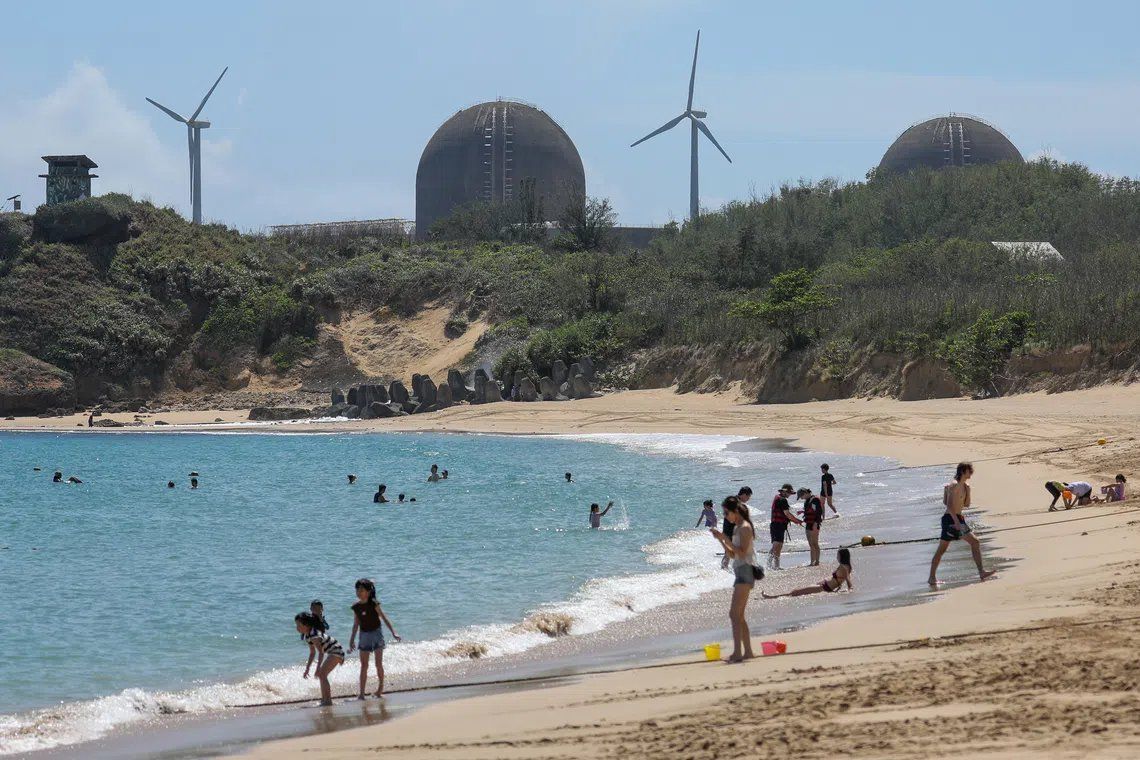
Taiwan will vote on nuclear energy policy in November as part of its "nine-in-one" local elections, marking yet another chapter in the island's intensifying love-hate relationship with direct democracy referendums. The nuclear referendum, coupled with simultaneous elections for county magistrates and other officials across Taiwan, has drawn scrutiny from political analysts who contend that the primary motivation behind holding these polls is electoral strategy rather than substantive policy deliberation. The vote asks whether the government should abandon its "Nuclear-Free Homeland" policy to address energy security, electricity affordability, national defence resilience, and artificial intelligence industry development. However, closer examination reveals that the true calculus driving this referendum proposal involves far more mundane partisan considerations than the lofty language suggests.
The November nuclear poll represents the fourth referendum on Taiwan's atomic energy future within just eight years, with the previous vote occurring merely a year ago in August 2023. This extraordinary frequency of revisiting the same policy question raises fundamental questions about whether referendums in Taiwan serve as genuine instruments of popular governance or have instead devolved into routine partisan weapons. The Central Election Commission approved only this single nuclear referendum from three proposals submitted this year, rejecting a contentious proposal to legalise caning for serious crimes on human rights grounds, as well as another referendum concerning traffic fine revenue allocation. The selective approval process itself underscores how referendums have become entangled in Taiwan's broader political competition, with institutional gatekeepers making judgements about which policy questions warrant direct democratic consideration.
Political scientists studying Taiwanese politics argue persuasively that the nuclear referendum's timing and design serve primarily to mobilise specific voter constituencies aligned with the opposition Kuomintang (KMT) and Taiwan People's Party (TPP). These parties apparently believe that issues like nuclear power, combined with the rejected crime referendum's underlying law-and-order messaging, can energise their more conservative-leaning supporters to turn out for November's local elections. The historical precedent is compelling: in 2018, when ten national referendums were held alongside local elections, the KMT performed exceptionally well, suggesting a correlation between conservative referendum content and strong opposition election performance. The higher turnout among voters motivated by such issues could prove decisive in competitive local races where margins are typically narrow, making the electoral calculus transparent even if unspoken in official rhetoric.
Singapore, paradoxically, plays a role in this Taiwanese political drama. The KMT seeks to position itself as the party capable of implementing law-and-order approaches and economic prosperity comparable to Singapore's governance model, arguing that they would pursue such policies if the ruling Democratic Progressive Party (DPP) did not obstruct them through current legal frameworks. This positioning allows opposition politicians to frame referendums as tools for circumventing what they characterise as obstructionist governance, when in reality the referendums function as mechanisms to energise their voter base and generate campaign narratives. The strategy transforms referendums from mechanisms for resolving substantive policy disagreements into instruments for amplifying partisan messaging during electoral seasons.
Whole legitimacy questions surrounding energy policy have arguably shifted since the previous nuclear referendum in August 2023, providing some genuine policy rationale for revisiting the question. Global oil supply disruptions resulting from instability in the Strait of Hormuz have created tangible energy security concerns, while the artificial intelligence boom has sparked legitimate anxiety about Taiwan's electrical capacity and grid stability. These material changes in Taiwan's energy environment could justify seeking updated voter guidance on nuclear policy, particularly given that public opinion on energy matters genuinely moves with global circumstances and technological advancement. However, experts emphasise that these legitimate policy considerations pale in significance compared to the electoral motivations driving opposition parties to initiate the referendum at this particular historical moment.
The transformation of Taiwan's referendum culture reflects a dramatic institutional shift that occurred in 2017, when the government lowered the threshold for holding and passing referendums. Previously, a referendum required 50 per cent turnout to be valid, a bar that proved so high that even former president Chen Shui-bian's cross-strait relations referendums in 2004 failed despite commanding overwhelming support among actual voters. The revised system permits referendums to pass if "Yes" votes outnumber "No" votes and affirmative votes equal at least 25 per cent of the total electorate, a substantially lower barrier that fundamentally opened the floodgates. This institutional change coincided with sharply increased referendum frequency, as political parties discovered a new tool for mobilising supporters and capturing public attention during electoral cycles. What was originally envisioned as a mechanism for resolving truly consequential national questions has instead become weaponised as standard-issue electoral apparatus.
Taiwan's experience with referendum proliferation contrasts starkly with comparative democracies, as observers have noted. Switzerland, despite its celebrated referendum tradition, implements a rigorous deliberative process requiring three to five years from initial proposal to final vote, ensuring that government agencies and the public have adequate opportunity to understand complex policy tradeoffs before deciding. Taiwan's nuclear referendum compressed the timeline from August announcement to November vote—merely three months—a period manifestly insufficient for serious public deliberation about the "rigorous, complex and diverse" technical questions involving energy policy and grid management. This compressed timeline reveals the referendum's underlying function: mobilising voters for November elections rather than facilitating genuine policy deliberation. The absence of extended discussion periods prevents voters from meaningfully engaging with competing technical evidence or policy analyses that might inform sophisticated decision-making.
Political scientist Chong Ja Ian from the National University of Singapore observes that the opposition's referendum strategy involves creating issues that can galvanise voter mobilisation while allowing opposition politicians to publicly position themselves as being thwarted by DPP intransigence on matters of governance, law and order, and economic management. This narrative construction—portraying the opposition as forward-thinking but hamstrung—appeals powerfully to conservative voters concerned about crime, national security, and economic competitiveness. The caning proposal, which was rejected by election authorities, exemplified this strategy: KMT politicians explicitly discussed its mobilisation potential for November elections, revealing how openly referendums have been integrated into electoral strategy. The approach transforms direct democracy from a mechanism for resolving genuine disagreements into a vehicle for partisan branding and voter mobilisation.
Research fellow Qi Dongtao from NUS's East Asian Institute emphasises that "this electoral consideration is probably at least as important as the policy substance of the referendums themselves," highlighting how contemporary Taiwanese politics has subordinated genuine deliberative democracy to partisan electoral competition. The proliferation of high-turnout electoral events incorporating referendums creates structural incentives for political parties to propose contentious issues specifically designed to energise ideologically aligned voters, transforming referendums into perpetual battlegrounds. This development threatens to hollow out the institution's original purpose, which was presumably to enable citizens to authorise major policy directions through direct democratic input when representative institutions proved inadequate. Instead, referendums increasingly function as supplementary weapons in partisan arsenal, deployed during elections to activate voter bases rather than to resolve substantive governance questions.
Public scepticism toward Taiwan's referendum culture has grown visibly as voters recognise how political parties manipulate direct democracy for electoral purposes. Sean Chang, a 39-year-old public relations professional, acknowledged that referendums began with good intentions but deteriorated into partisan tools. "It made me feel like I had to think about every issue from multiple perspectives, and after a while, I just stopped paying attention," he recalled, noting that he participated in the 2018 referendum elections but has since become alienated from the process. This citizen disengagement represents a troubling trajectory: as referendums become transparently instrumental tools for electoral manipulation, voters reasonably conclude that their ostensible decision-making power functions primarily to legitimise predetermined partisan strategies rather than to exercise genuine authority over government policy. The credibility damage extends beyond referendums themselves, potentially eroding public confidence in democratic institutions generally.
The November "nine-in-one" elections will determine 11,051 local public officials across Taiwan, with campaign attention primarily focused on domestic governance issues spanning crime, development, infrastructure, and economic management. The nuclear referendum, though presented in technical policy language, functions as one component of this broader electoral competition. Political strategists recognise that local election outcomes often serve as bellwethers for subsequent national elections, with Taiwan's next presidential and legislative ballots scheduled by 2028. The opposition parties' nuclear referendum strategy therefore carries implications extending far beyond November's local contests, establishing thematic frameworks and voter mobilisation networks that will likely persist through the 2028 national elections. The November outcome will provide valuable data on whether conservative voters continue responding to law-and-order and energy security messaging, information that will shape opposition campaign strategies across the coming years.
The nuclear referendum ultimately exemplifies how Taiwan's political system has integrated direct democracy into routine partisan competition rather than reserving it for genuinely consequential national questions. As Qi Dongtao suggests, referendums should ideally be deployed sparingly for major policy decisions where clear justification exists for seeking direct popular authorisation, rather than functioning as permanent fixtures in electoral competition. Taiwan's trajectory has followed the opposite path, with lowered institutional thresholds enabling parties to weaponise referendums as mobilisation tools. The November vote will almost certainly pass, not because public opinion has fundamentally shifted on nuclear energy since August 2023, but because the opposition's voter mobilisation advantage will generate sufficient "Yes" votes. This outcome will reinforce the lesson that referendums function as partisan instruments, further corroding public confidence in direct democracy as a governance mechanism and potentially diminishing their future utility for addressing genuinely consequential national questions.

