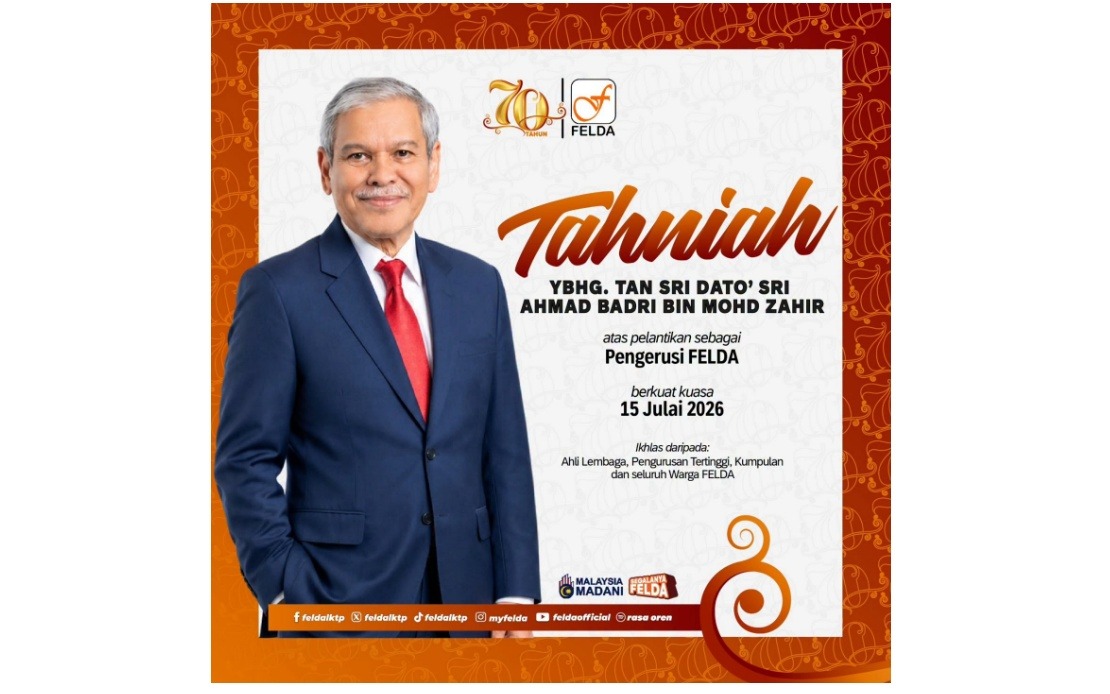
Tan Sri Ahmad Badri Mohd Zahir has been named the new chairman of the Federal Land Development Authority (FELDA), marking a significant leadership transition for one of Malaysia's most important land development institutions. The appointment was announced by FELDA on July 15, with the organisation emphasising that the decision reflects governmental confidence in Ahmad Badri's proven track record of steering major national institutions through periods of strategic transformation.
The FELDA board's selection of Ahmad Badri underscores a deliberate strategy to inject seasoned financial and institutional management expertise into an organisation that oversees the livelihoods of more than three million settlers across the country. His appointment comes at a critical juncture as FELDA navigates broader questions about agricultural modernisation, land utilisation efficiency, and the economic viability of settlement schemes in an increasingly competitive global commodity market.
Ahmad Badri brings an unusually comprehensive resume spanning both government and private sector roles accumulated over more than three decades. His career trajectory began in 1989 when he joined the Ministry of Finance, providing him with foundational experience in public finance management. Most notably, he served as Treasury Secretary-General from 2018 to 2020, a position that required managing Malaysia's fiscal operations during a period of significant economic and political transition, offering direct exposure to macro-level economic policymaking and institutional reform.
Beyond his Treasury tenure, Ahmad Badri has accumulated extensive boardroom experience across Malaysia's financial and corporate landscape. He previously chaired the Employees Provident Fund, Asia's largest pension fund by membership, where he would have overseen investment strategies and retirement security frameworks affecting millions of Malaysian workers. His involvement with Bank Negara Malaysia in a board capacity indicates exposure to monetary policy considerations and financial system stability, while his association with Permodalan Nasional Berhad—Malaysia's sovereign wealth management vehicle—suggests familiarity with long-term value creation and national asset stewardship.
Currently, Ahmad Badri maintains an active portfolio of executive responsibilities that reflect continued confidence from both government and corporate sectors. He chairs RHB Bank Bhd, one of Malaysia's major financial institutions, positioning him within the commercial banking ecosystem. His chairmanship of the Malaysian Rubber Board places him at the intersection of agricultural commodity management and export policy, an experience directly relevant to FELDA's plantation-based operations. Additionally, his board seat at Sime Darby Bhd connects him to one of Malaysia's oldest and largest diversified conglomerates with substantial agricultural and plantation interests.
The educational credentials Ahmad Badri presents align with international best practices in institutional leadership. His Master of Business Administration from the University of Hull represents advanced management training from a respected British institution, while his bachelor's degree in Estate Management from Universiti Teknologi MARA indicates specialised knowledge of land administration and property development—fields that directly underpin FELDA's core mandate of developing and managing federal land settlements.
FELDA's formal statement articulated an explicit expectation that Ahmad Badri's stewardship will catalyse governance improvements and elevate management standards across the organisation. The framing emphasises alignment with Malaysia's broader development philosophy, positioning FELDA's transformation within the context of national sustainability objectives and inclusive growth principles. This suggests that Ahmad Badri's appointment represents more than a routine leadership succession; rather, it signals an institutional commitment to recalibrating FELDA's operations in response to evolving economic, environmental, and social expectations.
For FELDA's extensive settler population, the appointment carries tangible implications. The organisation announced that Ahmad Badri's leadership will focus on safeguarding settler welfare while simultaneously driving economic sustainability improvements. This dual mandate reflects a fundamental tension within FELDA's institutional design: balancing the immediate income security needs of individual settlers with the long-term financial health and competitive positioning of the FELDA Group as a commercial enterprise. Ahmad Badri's experience managing large institutional funds and complex stakeholder relationships suggests he has previously navigated comparable balancing acts.
The timing of this appointment intersects with broader conversations about agricultural transformation across Southeast Asia. Malaysian agricultural sectors face mounting pressures from climate variability, global commodity price volatility, labour scarcity, and rising input costs. FELDA settlements, which have historically concentrated on rubber and palm oil production, must increasingly contend with market dynamics and sustainability pressures that differ markedly from the operating environment when these schemes were originally established. Ahmad Badri's mandate to drive transformation agenda suggests FELDA leadership recognises the necessity of operational evolution rather than incremental adjustment.
Regionally, FELDA's trajectory carries relevance for other Southeast Asian nations pursuing agricultural development models. As an established institution managing multiple settlement schemes, FELDA's experiences—both successes and challenges—inform broader development policy discussions across the region. Ahmad Badri's appointment, bringing contemporary corporate governance standards and financial management discipline to the organisation, may influence how neighbouring countries structure their own agricultural development authorities and land settlement programmes.
The appointment reflects confidence that Ahmad Badri can synthesise institutional reform with stakeholder protection, a capacity that FELDA requires as it operates within political, economic, and social dimensions simultaneously. His track record suggests he understands that modern institutional leadership demands simultaneous attention to fiduciary responsibility, regulatory compliance, organisational efficiency, and stakeholder welfare—a multifaceted challenge that FELDA's operational complexity certainly presents.

