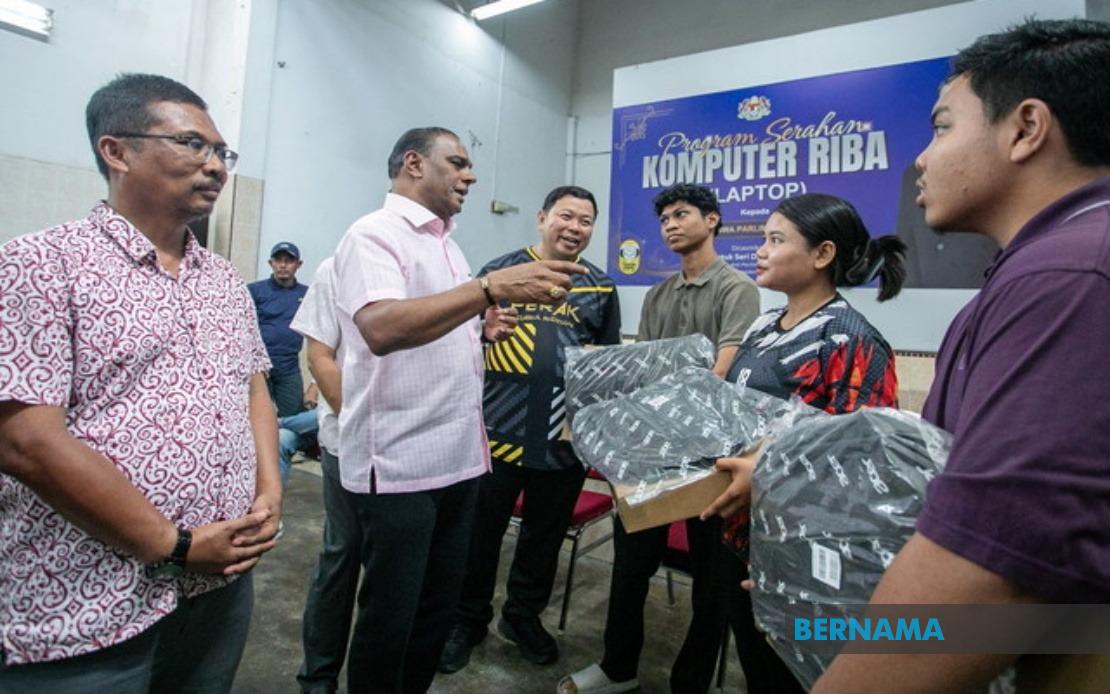
In a move underscoring the growing centrality of digital tools to tertiary education, Tapah Member of Parliament Datuk Seri M. Saravanan distributed laptops to 45 students from B40 households, part of an ongoing initiative that has emerged as a lifeline for disadvantaged learners across the constituency. The handover ceremony took place at Mahatma Gandhi Hall, bringing to more than 1,000 the total number of students who have benefited from the programme since its establishment in 2008.
The cohort receiving devices this year reflects the diversity of Malaysia's higher education pathways. Among the recipients were 30 diploma students, five at certificate level, four pursuing matriculation qualifications, and three working towards degrees. The remainder—one each—were students at the SPM, STPM, and foundation programme levels. This distribution across multiple educational tiers demonstrates how financial barriers to technology access cut across different academic trajectories, affecting learners whether they are on university-track routes or pursuing vocational qualifications.
Saravanan framed the initiative within the broader transformation of learning in Malaysia, noting that laptops have ceased to be luxury items and have become educational essentials. Modern university coursework increasingly depends on digital platforms for assignments, research, collaborative projects, and access to online learning materials. For students from economically struggling families, the absence of a personal computer can create a significant handicap, forcing them to share devices, travel to cybercafés, or fall behind in coursework. The programme directly addresses this structural inequity by placing technology directly into the hands of those most likely to be excluded by cost alone.
The selection process for recipients incorporated robust verification mechanisms designed to ensure fairness and prevent misallocation of resources. A dedicated committee evaluated each application, cross-referencing information obtained from the District Education Office and consulting with community leaders who possess intimate knowledge of local family circumstances. This layered approach reflects recognition that means-testing for assistance programmes requires local intelligence; official income records alone often fail to capture the full picture of household hardship, particularly in rural areas where informal employment predominates.
Beyond the immediate practical benefit of device provision, Saravanan highlighted a broader success story within his constituency: the rising participation of Orang Asli youth in higher education and professional fields. Over the past two decades, indigenous students from Tapah have progressed into careers as doctors, lawyers, and other professions. This upward mobility, though still limited by systemic barriers, represents a significant shift in educational outcomes within a community historically marginalised from Malaysia's knowledge economy. The laptop programme contributes to sustaining this momentum by removing one obstacle—financial access to technology—that might otherwise derail promising students just as they enter university.
Aidil Iskandar Ramlan, 18, exemplifies the programme's target beneficiary profile. The former student of SMK Syeikh Abdul Ghani, Bidor, is preparing to enter a Diploma in Public Administration at Universiti Teknologi MARA (UiTM) Raub, Pahang. His family's economic circumstances illustrate the constraints facing many B40 households: his father works as a school security guard while his mother remains a homemaker. For such families, the expense of purchasing a laptop—whether a basic unit costing several hundred ringgit or a more capable machine—represents a significant financial decision that can strain household budgets already stretched thin by rent, utilities, and food costs. The provided device eliminates this burden, freeing family resources for other pressing needs while equipping Aidil with the tools necessary to complete assignments and engage with university-level coursework.
Another recipient, Ea Endry Iana Aslan, 19, will use her laptop to pursue studies in Early Childhood Education at FELCRA College. She articulated the programme's significance in terms that many beneficiaries would recognise: the relief of financial pressure on her family combined with her own increased capacity to function effectively as a student. Without access to a personal device, she would have faced the familiar struggles of queuing at computer labs, depending on borrowed equipment, or investing scarce family money in a purchase that might have forced trade-offs elsewhere. The laptop removes this bind, allowing her to study on her own schedule and work independently.
The longevity of the Tapah programme—now operating for 16 years—suggests both sustained political commitment and demonstrated value. Unlike ad-hoc handouts, a programme that persists across multiple election cycles and has reached over 1,000 students indicates that the initiative has become embedded within the constituency's support infrastructure. For policymakers examining how to narrow Malaysia's digital divide, particularly the gap separating low-income students from their better-resourced peers, such constituency-level programmes offer a tested model. They complement national initiatives like the SASTI laptop scheme and demonstrate how localised efforts, grounded in understanding specific community needs, can effectively target assistance.
The emphasis on B40 families also reflects evolving understanding of education equity in Malaysia. The Bottom 40 percent income classification has become a focal point for poverty-reduction initiatives, acknowledging that family income remains a powerful determinant of educational opportunity. Students whose parents earn minimal incomes often attend under-resourced schools, have less access to private tuition, and live in homes where educational investment is constrained by subsistence concerns. By targeting this group specifically for technology access, the programme recognises that equality in education requires not identical treatment but rather differential support calibrated to actual disadvantage.
The implications of such programmes extend beyond individual beneficiaries. When B40 students enter university equipped with necessary tools, they are more likely to complete coursework on schedule, engage fully with learning platforms, and perform at their potential. This reduces attrition rates among disadvantaged cohorts and generates long-term returns through higher graduation rates and improved career prospects. Over time, this contributes to broader social mobility and reduces the intergenerational transmission of poverty—precisely the outcomes that justify public and political investment in education access for low-income students.

