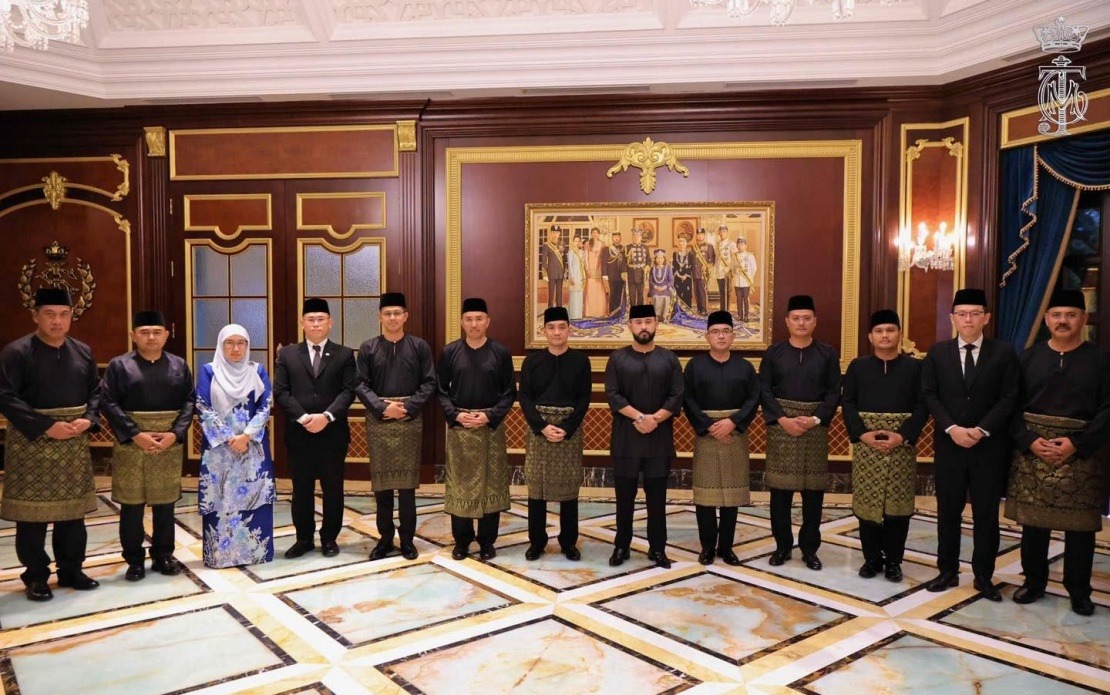
Ten elected representatives from Johor took their oaths as members of the state's Executive Council in a formal ceremony held before Tunku Mahkota Ismail at Istana Bukit Serene, marking the final stage of Barisan Nasional's transition to government control in Malaysia's southern state. The swearing-in, which took place in mid-July, represents the completion of the political reshuffle that began when Menteri Besar Datuk Onn Hafiz Ghazi assumed office for his second consecutive term just days earlier.
The composition of the new Exco reflects a mixture of experienced administrators and fresh political talent. Mohd Hairi Mad Shah from Larkin, Datuk Mohd Jafni Md Shukor representing Bukit Permai, Mohd Fared Mohd Khalid from Semerah, Ling Tian Soon from Yong Peng, Lee Ting Han from Paloh, and Mohamad Fazli Mohamad Salleh from Bukit Pasir bring established legislative experience to their roles. Their inclusion ensures continuity in administrative experience at the executive level, a critical consideration for managing a state government's diverse portfolio of responsibilities spanning economic development, infrastructure, and social services.
Four members represent new entrants to the state executive structure, signalling an injection of fresh perspectives into Johor's governance. Md Israk Abdullah from Kukup, P. Pannir Selvam representing Perling, Hasrunizah Hassan from Pulai Sebatang, and Muhammad Naqib Md Ghazali from Panti complete the ten-member council. These appointments demonstrate the party's confidence in emerging political figures and reflect a deliberate strategy to balance institutional knowledge with new ideas in the state cabinet.
The formal ceremony was attended by Menteri Besar Onn Hafiz alongside other senior officials, including Royal Court Council Yang Dipertua Datuk Dr Abdul Rahim Ramli and State Secretary Datuk Mohammed Ridha Abd Kadir. This presence of high-ranking figures underscored the significance of the occasion, as the swearing-in ceremonies formally established the operational government structure that would implement Barisan Nasional's policy agenda for the next five years.
Onn Hafiz's reappointment as Menteri Besar occurred merely days before the Exco members took their oaths, completing a rapid consolidation of power. His re-election to the position followed a decisive mandate at the ballot box, providing him with a strong political foundation for his second term. The timing of both events—the Menteri Besar's swearing-in followed immediately by the Exco ceremony—reflects standard constitutional procedures in Malaysian state governance, where executive authority flows from the sovereign to the chief minister and subsequently distributes across the executive council.
The underlying electoral context gives particular weight to these appointments. Barisan Nasional's performance in the 16th Johor state election produced a commanding majority that transformed the political landscape. The coalition secured 48 out of the state's 56 legislative seats, providing the governing coalition with substantial working room in the state assembly. This supermajority position means the government can advance its legislative agenda without requiring support from opposition representatives, a luxury that few state governments in Malaysia currently enjoy.
Onn Hafiz's personal performance in the Machap constituency demonstrated the broader coalition victory's strength. He won his seat with a margin of 15,375 votes, a commanding victory that validated both his personal standing and Barisan Nasional's electoral position in Johor. This majority gave the Menteri Besar a clear mandate not only for his re-election but also for the policy direction he would chart during his second term.
For Malaysian political observers, particularly those tracking developments in Johor, the composition and appointment of this ten-member council carries significance beyond administrative routine. Johor represents the most populous and economically significant state in peninsular Malaysia outside the Klang Valley, with substantial manufacturing capacity, port infrastructure, and agricultural interests. The quality and capability of the Exco members directly influences how effectively these economic engines operate and how competitive the state remains in attracting regional investment.
The expansion of the Exco to include new faces also suggests Onn Hafiz's approach to governance embraces both continuity and renewal. Retaining experienced administrators while introducing newcomers indicates a balanced leadership style that respects institutional memory while remaining open to innovation. This composition strategy matters in a state government setting, where Exco members typically oversee specific portfolios such as education, economic development, agriculture, health, and local government, among others.
The swearing-in of these ten representatives concludes the formal institutional arrangements necessary for Barisan Nasional's governance of Johor to function. With both the Menteri Besar and his council now in place, the administration can proceed with implementing its electoral promises and managing the state's diverse economic and social challenges. The next test of this government's effectiveness will come through its budgetary allocations, policy implementations, and administrative responsiveness to Johor's constituencies across the next eighteen months leading to the mid-term assessment of its performance.

