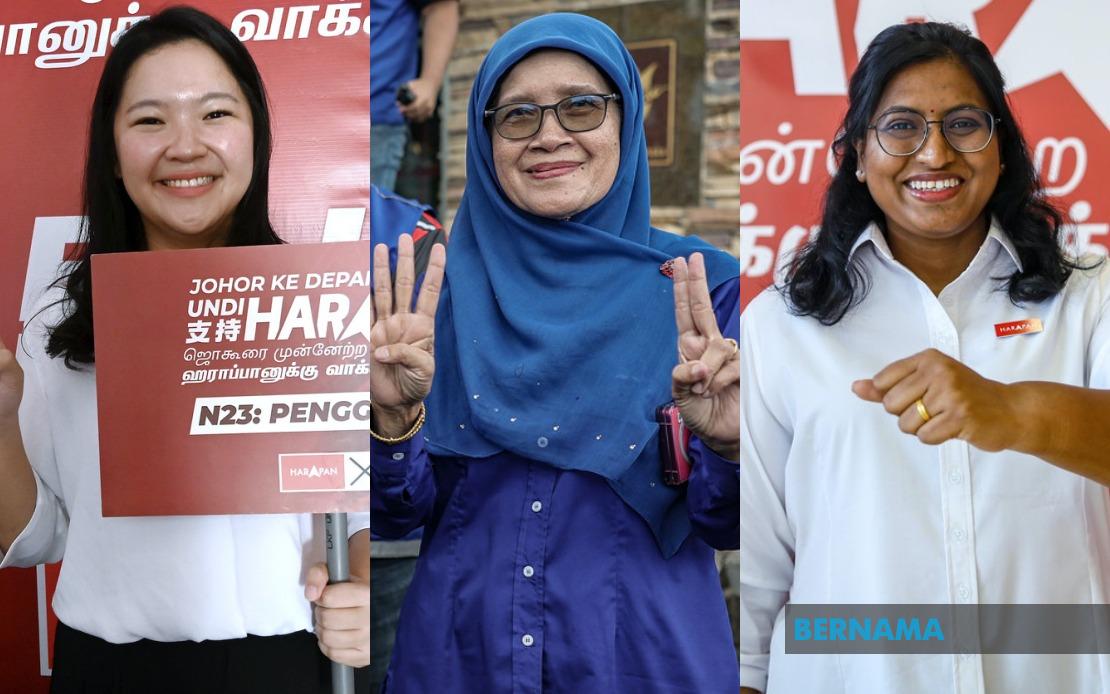
The 16th Johor State Election has delivered a symbolic but modest victory for women's political representation, with ten female candidates successfully capturing seats in the 56-member State Legislative Assembly. The successful contenders comprised seven from Barisan Nasional and three from Pakatan Harapan, reflecting the governing coalition's significant edge in the state's political landscape. Though the absolute numbers underscore the persistence of gender imbalance in elected office, the outcomes suggest that voters continue to place confidence in female leadership across different ideological lines.
Women represented approximately one-fifth of the total candidate pool, with 34 women competing against 138 male aspirants across the state. This near-20 per cent participation rate indicates that political parties are gradually expanding opportunities for female candidates, though the disparity in numbers remains substantial. The election outcome—with women capturing roughly 18 per cent of contested seats—suggests that female candidates performed at rates broadly comparable to their male counterparts, a development that could signal shifting voter attitudes toward gender representation in legislative chambers.
Barisan Nasional's seven successful women candidates demonstrated considerable electoral strength across their respective constituencies. Nadhirah Afiqah Abdull Rahim, contesting for the first time as Ledang Puteri UMNO chief, won the Serom seat with a commanding majority of 9,406 votes in a three-way contest. Nor Rashidah Ramli's victory in Parit Raja proved particularly significant, as her 13,576-vote majority represented substantial improvement over the coalition's 2022 performance in that seat, suggesting BN's female candidates generated meaningful electoral momentum. Alwiyah Talib's retention of the Endau seat for a third consecutive term underscored the durability of her personal political brand within the constituency.
The remaining BN women winners secured their positions through varying margins of victory. Norlizah Noh's commanding 16,344-vote majority in Johor Lama demonstrated substantial electoral consolidation, while Fauziah Misri achieved a landslide result in Penawar with 15,776 votes separating her from the nearest challenger. Chan San San's capture of Johor Jaya—historically regarded as a difficult seat for the governing coalition due to strong opposition presence—represented an unexpected upset, with her 35,971 votes defeating multiple challengers including a candidate from the DAP-affiliated Pakatan Harapan coalition. Hasrunizah Hassan's successful defence of Pulai Sebatang in a direct contest against Pakatan Harapan included a notably enlarged majority compared with the preceding 2022 election, suggesting growth in her personal electoral appeal.
Packatan Harapan's female victors demonstrated resilience in defending constituencies against determined challenges from both the governing coalition and other opposition parties. Felicia Poh Rui Ling, at 28 years old, captured her maiden electoral victory in Penggaram by defeating a Barisan Nasional opponent with a majority of 4,137 votes. Chu Poh Yee successfully retained Mengkibol with a 4,213-vote majority, demonstrating the stability of opposition support in urban constituencies. Kartiyaini Jeyapalan, a lawyer representing Skudai, navigated a four-way contest to preserve Pakatan Harapan's traditional hold on the seat, securing a substantial 15,280-vote majority that reflected the coalition's continuing appeal among the electorate in that locality.
The performance of female candidates carries implications extending beyond immediate electoral mathematics. The success of women representatives from both major coalitions suggests that state politics in Johor has evolved beyond simplistic gender-based voting patterns, with constituency-specific factors, personal political brands, and issue-based considerations appearing to outweigh gender as determining factors in many contests. This development contrasts with historical patterns in Malaysian electoral politics, where women candidates sometimes faced implicit voter resistance rooted in traditional attitudes toward female political participation.
The distribution of successful women candidates across different types of constituencies offers further insight into evolving political dynamics. While opposition-leaning urban seats like Johor Jaya registered a breakthrough victory for the governing coalition's female candidate, traditional strongholds for both coalitions continued electing women representatives at competitive rates. This geographic distribution suggests that female candidates have achieved sufficient political integration within party structures to contest competitive seats across diverse demographic and geographic contexts, rather than being concentrated primarily in safe constituencies designated for parties seeking to advance representation.
The absolute numbers, however, warrant contextualisation within broader Malaysian political trends. With only ten women occupying seats in a 56-member assembly, female representation in the Johor legislature remains substantially below the global average and below levels achieved in several Southeast Asian democracies. International perspectives on legislative representation suggest that meaningful shifts in gender balance typically require either sustained organic growth in candidate recruitment and voter support or deliberate institutional measures such as quota systems. Johor's current trajectory, while positive, would require acceleration to reach parity benchmarks that some regional neighbours have begun establishing.
The electoral performance of these ten women representatives may influence internal party dynamics and candidate selection processes for future elections. When female candidates demonstrate competitive or superior vote-gathering abilities compared with male counterparts in similar contests, party organisational structures face pressure—whether institutional or from grassroots mobilisation—to expand female participation in subsequent nomination processes. The success of women from both Barisan Nasional and Pakatan Harapan suggests that such advantages could accumulate across both coalition camps, potentially creating virtuous cycles of increased female candidacy and representation.
For Malaysian political observers and gender equality advocates, the Johor results present simultaneously encouraging and cautionary findings. The election confirmed that women can win competitive contests when given opportunity, and that voter acceptance of female political leadership extends across ideological divisions and geographic contexts. Simultaneously, the persistence of substantial gender imbalances in candidate selection and electoral outcomes underscores the continued operation of structural and cultural barriers to female political participation. Whether the modest gains in the Johor election represent the beginning of sustained transformation or a temporary plateau will become apparent through patterns in subsequent electoral cycles across Malaysia's various state assemblies and federal parliament.

