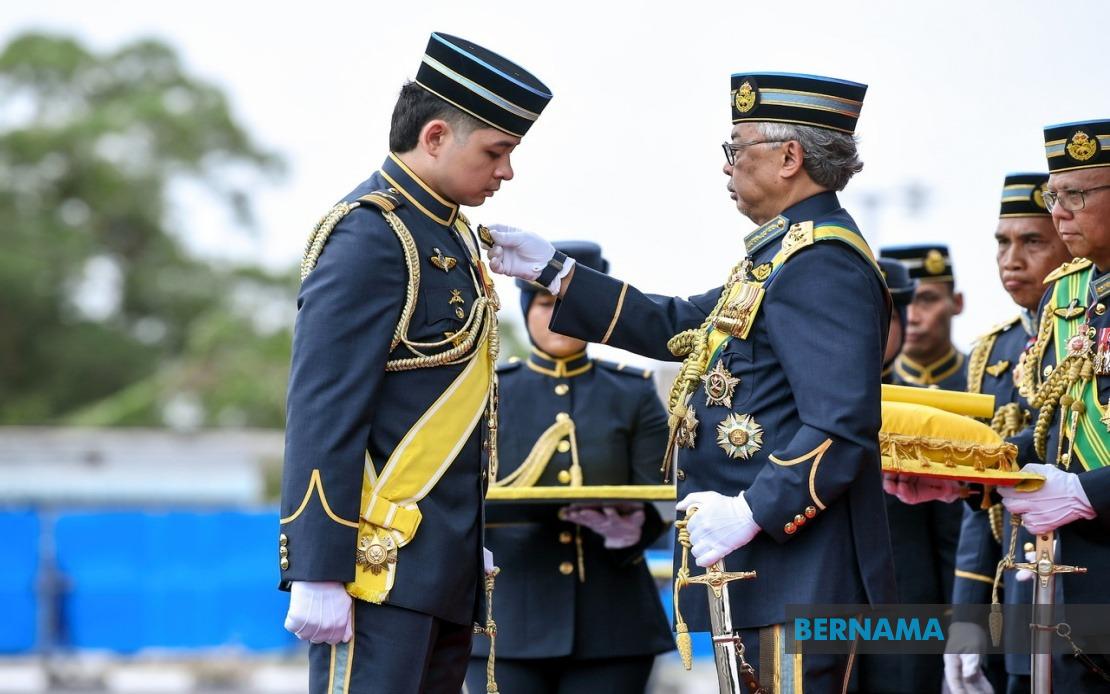
In a milestone for Malaysia's royal institution, Tengku Hassanal Ibrahim Alam Shah Ibni Al-Sultan Abdullah Ri'ayatuddin Al-Mustafa Billah Shah, the Tengku Mahkota of Pahang, has become the first member of the royal family to successfully complete helicopter pilot training through the Royal Malaysian Air Force (RMAF) Air College in Alor Setar. The achievement underscores a deepening engagement between the monarchy and the armed forces, signalling a modernisation of royal participation in military affairs that extends beyond ceremonial roles.
The Tengku Mahkota received his RMAF Flying Wings alongside 39 other military graduates at a formal presentation ceremony held at the Air College parade ground on August 15. The occasion brought together trainee pilots and weapons systems officers from all three branches of the Malaysian Armed Forces, highlighting the institution's role as a centralised hub for advanced aviation training across the defence establishment. The wings were formally conferred by his father, the Sultan of Pahang, Al-Sultan Abdullah Ri'ayatuddin Al-Mustafa Billah Shah, who holds the honorary position of Colonel-in-Chief of the RMAF, adding ceremonial weight to the proceedings.
The Tengku Mahkota underwent intensive helicopter flight training from early June through the end of July, piloting the EC120B Colibri aircraft during the 67(A)/26 Basic Helicopter Flying Course. This dual-engine helicopter, favoured for its reliability and operational versatility, provided the platform for rigorous evaluation across multiple competency areas. His progression through the curriculum was marked by success in four critical assessment phases: the Basic Handling Test, which evaluates fundamental aircraft control; the Instrument Flying Test, demanding proficiency in navigating by instruments alone; the Final Navigation Test, assessing real-world route planning and execution; and the Final Handling Test, the culminating evaluation of overall piloting capability.
The ceremony encompassed graduates from four distinct training programmes, reflecting the RMAF Air College's comprehensive scope. Beyond the Tengku Mahkota's helicopter course, two other helicopter pilot cohorts graduated, alongside a basic fixed-wing pilot course and a weapons systems officer programme. This variety of streams underscores the modernisation of Malaysia's air defence architecture, which increasingly relies on sophisticated systems requiring specialised personnel across multiple disciplines. The presence of such diversity at a single ceremony demonstrates the scale of institutional investment in developing qualified aviation professionals throughout the Malaysian defence ecosystem.
Royal participation in active military training—as opposed to honorary patronage—carries symbolic importance within Southeast Asia's constitutional monarchies. The Tengku Mahkota's willingness to undergo the same rigorous evaluation standards as career military personnel reinforces public confidence in the armed forces and illustrates how contemporary royalty can blend traditional ceremonial authority with substantive institutional engagement. This approach resonates with regional trends, where younger royals increasingly seek to deepen practical ties with their nations' security apparatus.
Air Force Chief General Tan Sri Muhamad Norazlan Aris used the occasion to reflect on the broader significance of military training beyond technical competency. In his address, he emphasised that graduating from pilot training represents not an endpoint but rather the commencement of heightened responsibility and trust within the defence establishment. He highlighted the role of perseverance, psychological resilience, and disciplined training protocols in producing capable aviators, while also acknowledging the support systems—particularly family networks—that sustain officers throughout demanding coursework. These remarks speak to a professional military culture that recognises aviation careers demand sustained commitment and institutional backing.
The general further noted that the wings presented at the ceremony symbolise not merely personal achievement but rather the hopes and responsibilities invested by the service and the nation itself. This framing elevates individual accomplishment into a collective endeavour, positioning each graduate as a representative of broader national aspirations for defence capability. For the Tengku Mahkota specifically, the message carries particular resonance: his successful completion signals that royal status does not exempt individuals from the same exacting standards applied throughout the officer corps.
The recognition of six outstanding graduates across various disciplines—flying proficiency, academic performance, discipline, and leadership qualities—reinforces merit-based advancement within Malaysia's defence hierarchy. This differentiation acknowledges that technical certification alone does not capture the full range of competencies required for military aviation careers. Leadership capacity, particularly among officers destined for command roles, receives equal weight alongside flying hours and examination results, reflecting sophisticated human resource management within the RMAF.
For Malaysian defence and security observers, the Tengku Mahkota's achievement represents a positive indicator of institutional health within the RMAF. A military establishment confident enough to maintain rigorous training standards for all participants, regardless of status, suggests strong professional culture and adherence to meritocratic principles. This matters particularly in a region where civil-military relations and the integrity of defence institutions remain subjects of intense scrutiny and concern. The willingness of royal family members to subject themselves to impartial evaluation and maintain institutional discipline bolsters public confidence in both the monarchy and the armed forces.
The timing of this milestone—in 2025, during a period of renewed regional security attention—positions the Tengku Mahkota's qualification within a broader narrative of Malaysia strengthening its aviation capabilities and demonstrating institutional continuity. As Malaysia navigates complex security challenges including maritime domain awareness, counter-terrorism operations, and regional air defence coordination, having senior leaders with genuine operational understanding of air power represents a strategic asset. The Tengku Mahkota's training experience provides him with first-hand knowledge of aviation operations that will inform his future contributions to national defence planning and decision-making.
Looking forward, the precedent established by the Tengku Mahkota's participation in active military training may influence how future members of Malaysia's extended royal family engage with defence institutions. Rather than limiting royal involvement to cutting ribbons and attending parades, this example demonstrates the possibility of more substantive, hands-on participation that deepens understanding of military operations and personnel challenges. Such engagement, if sustained across the institution, could strengthen coordination between political leadership and military command during crisis situations and policy formulation.
The presence of allied officers and international defence observers at such ceremonies underscores Malaysia's confidence in displaying its defence capabilities and institutional arrangements to the world. The Tengku Mahkota's completion of international-standard helicopter training, alongside officers from neighbouring nations and allied partners, demonstrates that Malaysia's aviation standards remain competitive and professionally executed. This matters for Malaysia's defence diplomacy, particularly as Southeast Asian nations increasingly coordinate on maritime security, disaster response, and counter-terrorism operations requiring reliable air assets and professional aviators.

