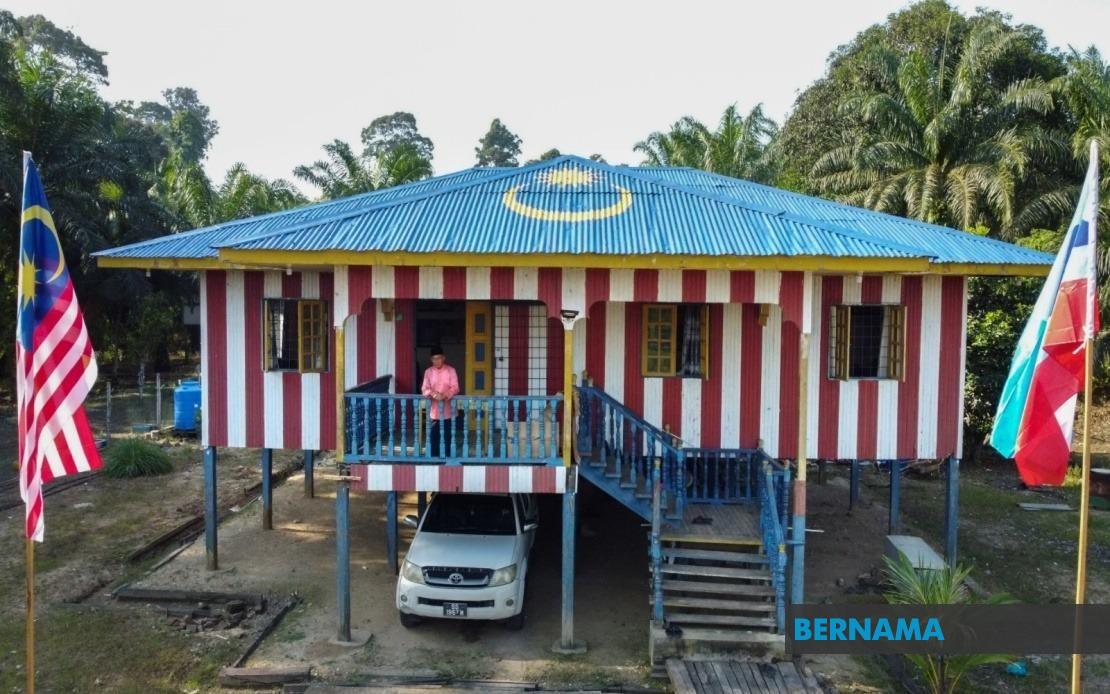
In the Batu 15 area of Sandakan, an extraordinary house has emerged as a bold testament to one Malaysian's unwavering devotion to his nation. Teratak Gemilang, the residence of 68-year-old entrepreneur Mohd Halikin Angga, stands out dramatically from its surroundings with its vibrant red, white, blue and yellow exterior—a faithful recreation of the Jalur Gemilang that adorns the nation's flag. Beyond its striking visual appeal, the home serves as a repository of Malaysia's political history, housing an intimate gallery of portraits depicting the country's successive leaders from independence to the present day.
Mohd Halikin's inspiration for this two-decade transformation traces back to 2004, rooted in sentiment rather than mere aesthetics. The entrepreneur, whose parents had endured the colonial era, felt compelled to create a permanent expression of national pride that would transcend the temporary nature of annual flag displays. His motivation deepened upon witnessing the fate of flags after National Day celebrations—discarded, wind-torn, or carelessly dropped from passing vehicles onto the roadside. This juxtaposition of reverence and neglect prompted him to conceive a structure that would embody Malaysia's spirit continuously, requiring no removal or storage.
The house itself has been meticulously designed to reflect Malaysia's national symbolism. The deep-blue roof features a golden-yellow crescent moon and 14-pointed star, direct representations of the flag's most recognizable elements. The walls display the characteristic bold red and white stripes, while numerous Jalur Gemilang flags flutter proudly throughout the compound. The attention to detail extends beyond mere colour replication; Mohd Halikin invested his own resources and labour into the project, personally wielding the brush to ensure his vision was faithfully executed.
Stepping inside Teratak Gemilang reveals the proprietor's deeper purpose—the creation of a living museum documenting Malaysia's political trajectory. The living room serves as a gallery displaying official portraits of the Yang di-Pertuan Agong and the Yang di-Pertua Negeri Sabah, alongside photographs of every prime minister from Tunku Abdul Rahman Putra Al-Haj through to the incumbent. This chronological arrangement provides visitors with a visual narrative of the nation's leadership across generations, transforming a private residence into an informal civic education space.
Among Mohd Halikin's most prized possessions is a historic photograph documenting a pivotal moment in Malaysian history. The image captures Tunku Abdul Rahman meeting with 20 North Borneo leaders in 1961, a gathering that proved instrumental in discussions surrounding Malaysia's formation. The entrepreneur discovered this photograph in a newspaper during an Umrah flight in 2005 and sought permission from cabin crew to preserve it. His determination to locate and frame this particular image reflects his philosophical approach to national memory—that significant historical moments deserve preservation and visibility within domestic spaces.
Mohd Halikin's patriotism extends beyond architecture and visual displays into the realm of family legacy. Among his seven children, three bear names honouring prominent national figures and statesmen. His eldest was named after Tun Dr Mahathir Mohamad, his second after Tun Abdullah Ahmad Badawi, while his sixth daughter, Nur Zahirah, was named in reference to the 13th Raja Permaisuri Agong. Rather than viewing names as arbitrary identifiers, Mohd Halikin conceptualizes them as vessels of historical memory and aspirational intention—a method through which subsequent generations might maintain connection to the contributions of past leaders.
The practical implications of maintaining Teratak Gemilang have proven substantial over more than two decades. Yet Mohd Halikin has demonstrated unwavering commitment to preserving the property's distinctive appearance. The house has become an informal tourist attraction, particularly during National Month, when visitors frequently pause to photograph its striking facade. This organic visitation pattern demonstrates how individual acts of patriotic expression can generate broader community engagement, transforming private property into a shared cultural landmark.
For Sabah specifically, Teratak Gemilang carries particular resonance. The state, with its diverse multiracial composition, represents Malaysia's plural character in microcosm. Mohd Halikin has explicitly articulated his hope that his home will reinforce communal unity across Sabah's various ethnic and religious communities, particularly during commemorative periods such as National Day and Malaysia Day. This objective reflects an understanding that patriotism need not be exclusionary; rather, shared national symbols can provide common ground for citizens of disparate backgrounds.
The house's significance extends beyond Sandakan's municipal boundaries to address broader questions about how Malaysians express and transmit national identity. In an era of competing narratives and divisive discourse, Teratak Gemilang represents an alternative model—one predicated on personal initiative, historical consciousness, and inclusive symbolism. Mohd Halikin's decision to permanently paint his residence in national colours, rather than resort to temporary decorations, suggests a philosophical commitment to consistency and permanence in the expression of patriotic sentiment.
Looking toward Malaysia Day 2026 and beyond, Mohd Halikin remains resolute in his commitment to maintaining the house as a patriotic beacon. His vision transcends individual gratification; rather, he perceives Teratak Gemilang as an ongoing project of national affirmation and intergenerational communication. The entrepreneur's life work—documented in paint, framed photographs, and family naming conventions—demonstrates that meaningful patriotism often emerges not from grand institutional gestures, but from individual citizens who choose to embed their love of country within the physical and social fabric of their immediate communities. In doing so, Mohd Halikin has created something that extends far beyond architecture: a personal manifesto in brick and colour that speaks to Malaysia's past while inspiring its future.

