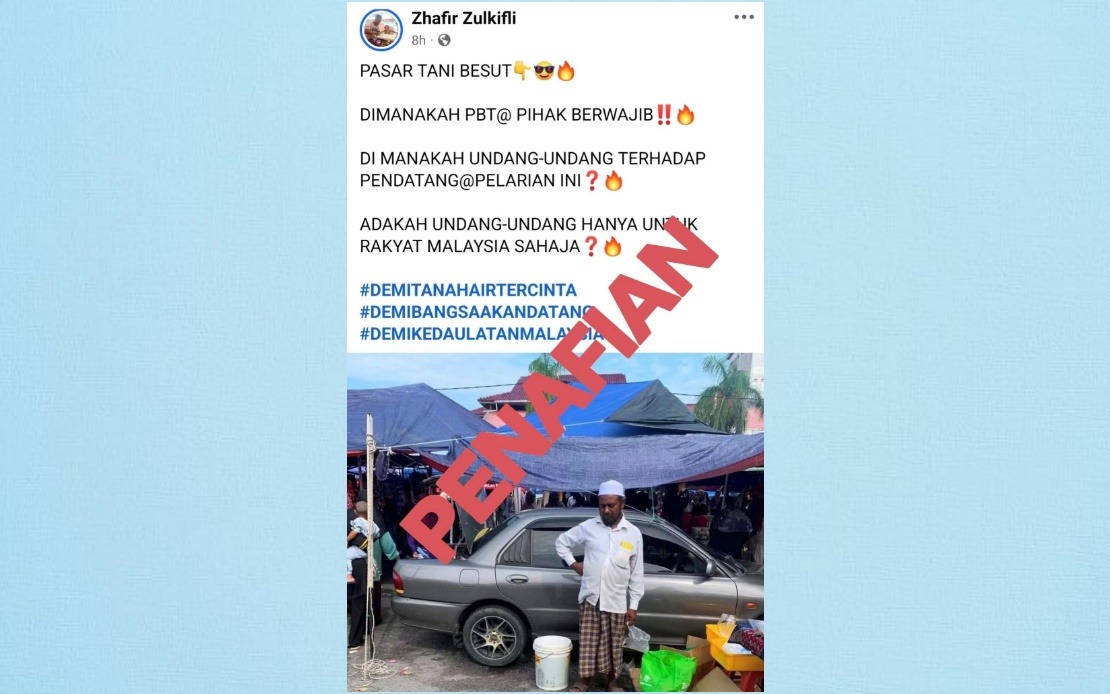
The Terengganu Federal Agricultural Marketing Authority (FAMA) has moved to clear its name after a social media claim circulated widely suggesting non-Malaysian citizens were operating as traders at farmers' markets it supervises. The authority issued a formal statement here in Jertih, asserting that no such violation occurred at any facility under its direct management, and that the incident referenced in the viral post actually took place at a separate venue entirely outside FAMA's operational remit.
The clarification came after a Facebook post gained significant traction yesterday, featuring images of what appeared to be a foreign national selling vegetables at a morning market in the Besut district. Rather than dismiss the allegation outright, FAMA provided specific operational details to demonstrate the distinction between markets it oversees and the one where the incident allegedly occurred. This measured response underscores growing tensions around informal market operations and the accountability structures supposed to regulate them across Malaysia's agricultural sector.
According to FAMA's statement, the authority operates precisely two farmers' markets in the Besut area, each with clearly defined scheduling to serve the local community. The Jerteh Farmers' Market operates every Thursday between 7 am and 1 pm, while the Alor Lintang Farmers' Market runs on Saturdays during the same hours. Both facilities maintain standardised operating procedures consistent with FAMA's nationwide mandate to facilitate legitimate agricultural commerce and protect consumer interests through regulated market structures.
The Kuala Besut Morning Market, where the viral incident took place, operates under different management entirely and does not fall within FAMA's supervision or regulatory oversight. This distinction matters considerably because it affects the jurisdictional responsibility for vendor verification, immigration compliance checks, and enforcement of trading regulations. The separation between various market types—farmers' markets, morning markets, and other informal trading venues—often remains unclear to the general public, creating confusion about which authority bears responsibility for standards enforcement.
This episode reflects broader concerns circulating through Malaysian social media regarding informal sector employment and immigration compliance. Viral posts alleging foreign nationals working in unregulated market settings frequently generate heated online discussion, often without distinguishing between verified incidents and unconfirmed allegations. The rapid spread of such claims can damage reputations of legitimate authorities and create public anxiety about market safety and regulatory effectiveness, necessitating quick clarification from relevant agencies.
Terengganu FAMA's proactive response demonstrates awareness of how misinformation can undermine public confidence in agricultural marketing institutions. By providing specific operational details and drawing explicit distinctions between facilities, the authority attempted to rebuild credibility and redirect blame toward whoever manages Kuala Besut Morning Market. However, the response also highlights systemic challenges in market regulation across Malaysia, where multiple overlapping authorities govern different venue types with varying enforcement standards.
The incident raises important questions about border control and informal employment practices affecting Malaysia's markets. Small-scale trading at morning markets and similar venues often operates in grey zones where documentation and verification procedures remain inconsistent. Workers in these settings—both Malaysian and foreign—frequently operate without formal contracts or comprehensive background checks. This structural vulnerability creates opportunities for employment violations and immigration breaches, making farmers' markets and similar venues potential focal points for regulatory concern.
For readers in Malaysia and the broader region, this dispute illustrates how quickly unverified claims spread through social media and the consequent burden on government agencies to maintain public trust through transparent communication. FAMA's clarification was necessarily swift, as allowing misinformation to persist unchallenged risks broader erosion of confidence in agricultural marketing systems. Similar patterns affect other Southeast Asian countries, where informal market sectors operate across jurisdictional boundaries with varying regulatory oversight.
Looking forward, the incident suggests a need for clearer public communication about market governance structures and responsibility divisions between authorities managing different venue types. Citizens visiting morning markets, farmers' markets, and informal trading sites would benefit from understanding which agencies hold regulatory oversight and how to report concerns about non-compliance. Enhanced vendor verification procedures and more visible compliance signage could help prevent future allegations while demonstrating genuine commitment to maintaining market standards.
The controversy also underscores the importance of distinguishing between different agricultural trading venues in Malaysia's informal economy. Farmers' markets, often promoted as premium spaces for quality produce and direct producer-consumer transactions, maintain stricter vendor requirements than traditional morning markets. Blurring these distinctions in public perception could inadvertently damage the positioning of legitimate farmers' markets, which represent important initiatives for supporting local agriculture and sustainable food systems across the country.
Terengganu FAMA's management of this situation, while defensive, provides a template for how authorities elsewhere might respond to similar allegations. The combination of factual correction, operational transparency, and jurisdictional clarification offers a more sophisticated approach than outright denial. Nevertheless, resolving underlying questions about vendor verification processes and enforcement mechanisms across Malaysia's diverse market ecosystem remains an ongoing challenge requiring sustained attention from multiple government agencies and stakeholders committed to maintaining the integrity of agricultural commerce.

