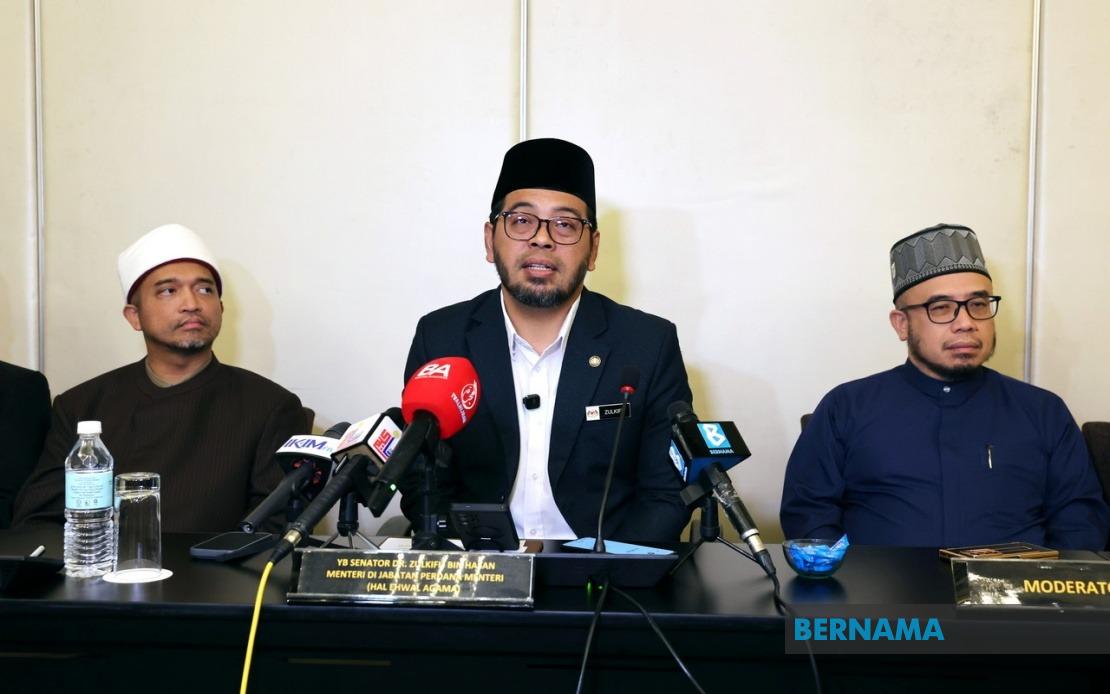
Malaysia's Minister in the Prime Minister's Department (Religious Affairs), Dr Zulkifli Hasan, has made clear that the Islamic legal concept of 'kafir harbi'—traditionally referring to non-believers in a state of conflict with Islam—has no place in contemporary Malaysia. Speaking in Putrajaya on August 10, he argued that applying such terminology to fellow Malaysians contradicts the fundamental principles binding the nation together, and that all citizens are unified under the Federal Constitution regardless of their faith.
The minister's comments emerged from a dedicated roundtable discussion convened specifically to examine the contentious term and its implications for the Malaysian context. The forum, titled "'Kafir Harbi' in Malaysia: A Discussion," brought together various stakeholders to deliberate on whether this classical Islamic concept remains relevant or appropriate in a multi-religious, multi-ethnic nation bound by secular constitutional law.
Dr Zulkifli articulated a core principle underlying Malaysia's constitutional order: citizens derive their primary obligation not from religious doctrine but from the Federal Constitution itself. This framing positions the Malaysian state as a secular constitutional entity in which religious law operates only within designated spheres of authority, primarily affecting Muslim personal matters. By this logic, the invocation of 'kafir harbi' against citizens of other faiths—or indeed against Muslims who may not subscribe to a particular theological interpretation—becomes fundamentally at odds with Malaysia's legal and political architecture.
The minister emphasised that Malaysia functions as an integrated society where all inhabitants share both rights and responsibilities as fellow citizens and compatriots. This assertion reflects a deliberate attempt to reframe national belonging in civic rather than religious terms. The underlying message is that whatever one's personal faith, one's membership in the Malaysian nation is predicated on acceptance of constitutional governance and participation in the shared project of nation-building, not on religious alignment.
Recognising the sensitivities involved, Dr Zulkifli committed to a coordinated, whole-of-government approach to addressing the issue. The Department of Islamic Development Malaysia (JAKIM), the primary governmental body responsible for Islamic affairs, will take the lead in collaborating with other agencies and ministries to launch a comprehensive information and awareness campaign. This inter-agency strategy signals an understanding that the challenge of clarifying Malaysia's constitutional principles and countering potentially divisive rhetoric cannot be confined to religious authorities alone.
The decision to involve multiple government departments reflects a sophisticated appreciation of how disputes over religious terminology can undermine broader integration efforts. By framing the response as one of public education and clarification rather than prohibition or penalty, the government seeks to build understanding across society. The approach also acknowledges that confusion about the appropriateness of such terms may exist among both Muslim and non-Muslim citizens, and that addressing it requires sustained dialogue and explanation.
The minister's call for all Malaysians to strengthen unity and foster closer bonds carries particular weight in a nation where communal tensions have periodically threatened cohesion. His appeal for mutual respect and cultural and religious understanding signals that government sees the 'kafir harbi' issue as symptomatic of broader challenges in maintaining inter-religious harmony. By explicitly urging citizens to recognise and appreciate one another's faiths and traditions, Dr Zulkifli reaffirms that Malaysia's continued stability depends on conscious commitment to pluralism at the societal level.
For Malaysian policymakers, the statement represents an effort to demarcate the boundaries of acceptable religious discourse within a constitutional democracy. The underlying tension is ancient and familiar: how can a nation simultaneously guarantee religious freedom and maintain public order? By taking a clear stance that certain historically-rooted Islamic concepts are unsuitable for application within Malaysia's constitutional framework, the government attempts to establish guardrails around religious speech without formally censoring it.
The implications for Malaysian Muslims are particularly significant. The minister's position implicitly affirms that Islam in Malaysia operates within a constitutional context that overrides classical Islamic jurisprudence in matters of state and citizenship. This has long been Malaysia's practical arrangement, but explicit government articulation of this principle can help clarify confusions or disputes about the relationship between Islamic law and constitutional law—a tension that periodically surfaces in Malaysian public discourse.
For non-Muslim minorities in Malaysia, the statement offers reassurance that government leadership recognises the incompatibility between certain religious framings and the inclusive constitutional order. However, the reliance on awareness campaigns and voluntary compliance rather than formal legal measures also reflects the government's cautious approach to regulating religious speech, reflecting both constitutional free speech protections and sensitivity about appearing to restrict Islam.
Looking forward, the success of JAKIM's collaborative effort will depend on consistent messaging from government figures, religious scholars, and community leaders. The challenge lies in shifting public understanding of how religious identity functions within Malaysia's civic framework without appearing to subordinate Islam to secularism—a perception that could provoke backlash from conservative constituencies. The government's framing, which emphasises shared citizenship and constitutional obligation rather than secular override of religion, attempts to navigate this delicate balance.
The statement also signals an ongoing commitment to what Malaysian leaders describe as 'unity in diversity'—the idea that a nation of distinct religious, ethnic, and cultural communities can coexist peacefully when bound by shared constitutional principles and mutual respect. Whether such messaging proves sufficient to prevent the future deployment of contested religious terminology in divisive ways will become clear only through time and continued societal commitment to the principles Dr Zulkifli articulated.

