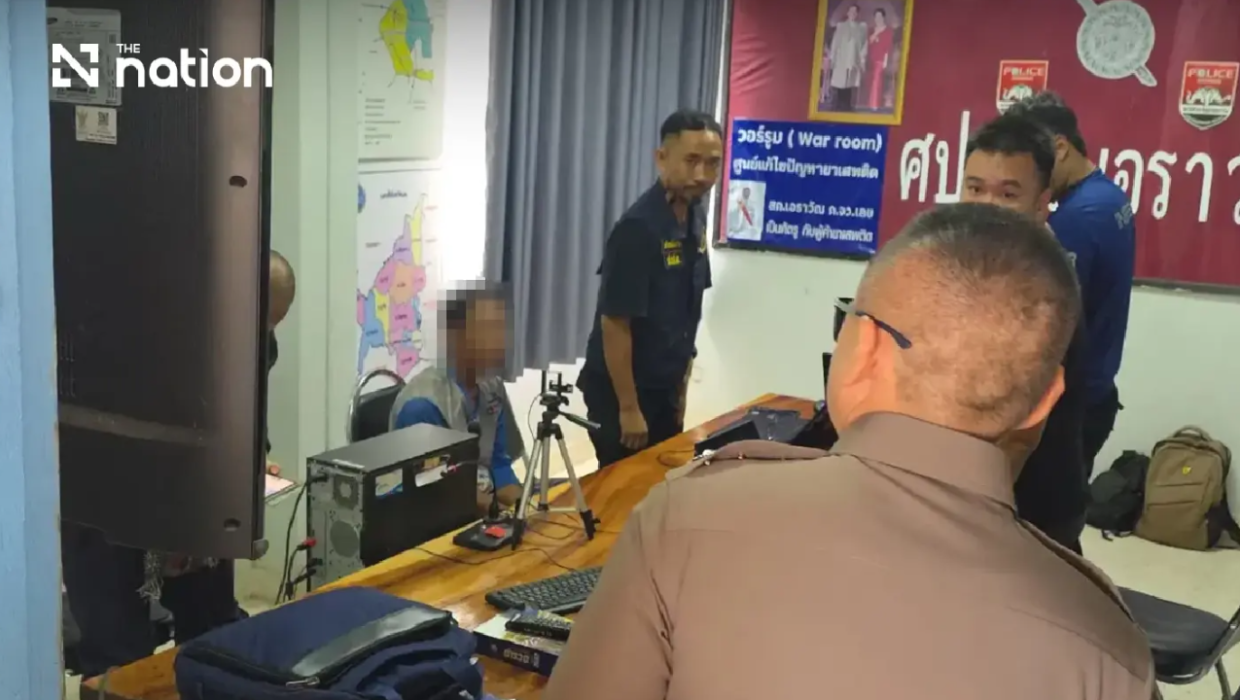
Thai authorities have arrested a husband-and-wife pair in the northeastern province of Loei as part of a widening criminal investigation into an international drug trafficking network. The arrests came after investigators traced connections to a Thai Airways flight attendant who was apprehended at Melbourne Airport in Australia while allegedly carrying roughly one kilogram of heroin concealed in her luggage. The case underscores the sophisticated methods employed by regional narcotics syndicates that exploit commercial air travel and involve operatives across multiple countries.
Thе detained couple, identified as Athit, 43, and Thatsaphon, 42, came under police scrutiny when authorities in Thailand began working backwards from the Melbourne seizure to identify the source of the illegal shipment. Officers from Chiang Khan Police Station, coordinating with the Office of the Narcotics Control Board (ONCB) and other specialized units, initially moved to apprehend the couple at a residential address in That subdistrict of Chiang Khan district in Loei province during the afternoon of Thursday, July 2. Finding the house unoccupied, investigators employed locational intelligence to track down Athit, who was discovered working on temple roof repairs at Wat Tham Pha Mak Ho in a neighbouring district.
During initial questioning at Erawan Police Station, Athit provided a confession that painted a picture of systematic involvement in courier work for unknown handlers. According to police records, the 43-year-old Thai national admitted to being paid 8,000 baht—approximately US$240—per completed assignment to send parcels destined for Bangkok on at least six separate occasions. Investigators determined that three shipments had been dispatched through a commercial parcel service operating in Chiang Khan town itself, with two additional parcels originating from Ban That locality and one from Erawan district. The most recent parcel allegedly left on June 28, 2026, suggesting the operation had been running for an extended period before police intervention.
Thatsaphon, identified as a Lao national and Athit's spouse, was apprehended separately after authorities located a black Mitsubishi Triton pickup truck bearing Loei registration plates abandoned in a rubber plantation within the Pha Nang-Pha Koeng area of Pha In Plaeng subdistrict. The discovery of the vehicle at this remote location provided investigators with crucial corroborating evidence of the couple's involvement in the supply chain. When brought in for questioning, Thatsaphon maintained that she had no knowledge of or participation in the alleged smuggling activities, though police proceeded to transfer both detainees into the formal custody procedures administered by the ONCB pending further investigation.
The structure of this operation reveals hallmarks of contemporary transnational drug networks operating throughout Southeast Asia. Rather than concentrating all criminal activities in a single location or among a small group, the organization appears to have compartmentalized responsibilities across different jurisdictions and ethnic groups. This layering—with Thai nationals handling domestic logistics, a Lao operative supervising the Loei-based parcel dispatch system, and a Thai Airways employee positioned at a critical international transit point—reflects a deliberate strategy to minimize the exposure of any single individual to the full scope of the conspiracy. Each participant possessed only partial knowledge of the operation, a tactic designed to frustrate law enforcement investigations and reduce legal liability should any component be discovered.
The ONCB's secretary-general characterized the case as representative of the methodologies employed by sophisticated criminal enterprises attempting to circumvent international border controls and law enforcement detection systems. Officials emphasized that the successful identification of domestic operatives depended significantly on real-time cooperation between Thai and Australian law enforcement bodies, particularly the ability to rapidly share investigative findings and trace shipment origins across international boundaries. The seizure at Melbourne Airport thus functioned as a critical trigger that unwound an entire supply network when subjected to thorough forensic investigation and cross-border intelligence sharing.
For Malaysian and regional observers, this case illustrates the permeability of borders and the ease with which narcotics trafficking organizations can establish distribution chains spanning multiple countries. Thailand's geographical position in mainland Southeast Asia, combined with its extensive airline connectivity and relatively porous borders with Laos, Cambodia, and Myanmar, renders it particularly vulnerable to becoming a transit point for international drug trafficking. The involvement of a commercial airline employee highlights how legitimate transportation infrastructure can be compromised by criminal syndicates seeking to exploit regular international flight schedules to move contraband with minimal detection risk.
The investigation is entering a more complex phase as authorities move beyond the initial arrests to pursue higher-level conspirators. Police have indicated that they are actively seeking to identify individuals who ordered the parcels, provided financial support for the operation, or assisted in logistics and coordination. The parcels themselves are now under forensic analysis to determine whether they contained the same heroin found in the Thai Airways attendant's luggage, which would establish a definitive evidentiary chain linking the arrested couple directly to the Melbourne seizure. Investigators are also examining financial records and mobile phone communications to map the full network of participants.
The ONCB has committed to intensifying its investigation through expanded legal action against anyone determined to have participated in the smuggling operation at any organizational level. This language reflects an intention not merely to prosecute the arrested couple but to pursue upstream suppliers and downstream distributors, dismantling the network from multiple angles simultaneously. The agency has signalled plans to enhance cooperation frameworks with foreign law enforcement counterparts to interdict transnational trafficking routes, disrupt the physical movement of narcotics across borders, and trace and freeze financial flows generated by drug sales—components of Thailand's broader national drug-suppression policy.
For Malaysia, the case carries implications beyond Thai borders. Malaysian law enforcement agencies monitor similar trafficking patterns and increasingly deploy joint task forces with regional neighbours to identify and neutralize transnational drug networks. The sophistication evident in the Loei case—the use of couriers with minimal knowledge of the full operation, reliance on commercial parcel services, employment of airline staff—represents the contemporary reality of drug smuggling in an era of digital communications and international commerce. Malaysian authorities have implemented stricter aviation security protocols and enhanced cargo screening procedures at Kuala Lumpur International Airport partly in response to similar threats identified in regional intelligence assessments. This Thai case provides fresh evidence of the techniques that Malaysian border security and customs officials must remain vigilant against.

