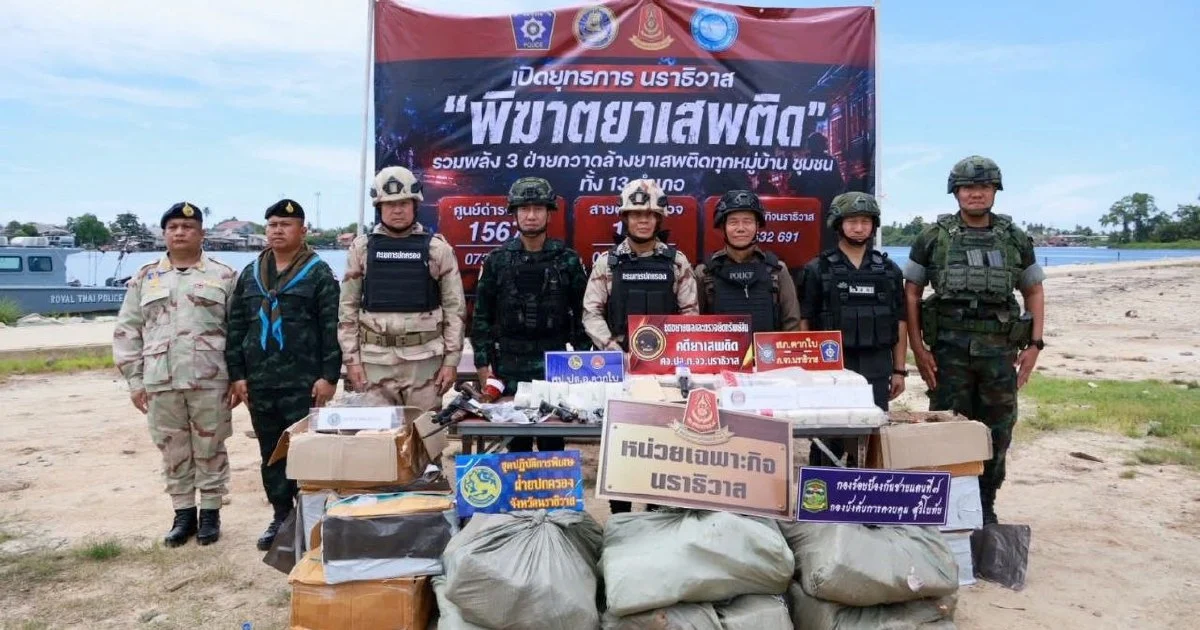
Thai law enforcement has intensified its grip on transnational drug trafficking operations in the southern border province of Narathiwat, arresting 233 individuals suspected of involvement in major narcotics distribution rings during a comprehensive month-long enforcement campaign. The scale of the operation underscores the sophisticated nature of drug movements through Southeast Asia's porous border corridors, where criminal syndicates exploit geographical proximity and weak enforcement coordination between nations to move contraband with alarming efficiency.
Among those detained, authorities have identified individuals with suspected operational connections to Malaysian-based trafficking networks, a development that highlights the persistent vulnerability of cross-border supply chains in the region. The investigation has revealed intricate coordination between Thai and Malaysian criminal actors who leverage the porosity of shared maritime and land boundaries to facilitate the movement of illicit drugs, particularly targeting lucrative markets in both nations and beyond. This discovery reinforces long-standing concerns about how organised crime groups exploit the legal and enforcement gaps that characterise bilateral border management across the Malay Peninsula and southern Thailand.
Narathiwat, strategically positioned along Thailand's eastern maritime boundary and sharing extensive terrestrial and water borders with Malaysia, has emerged as a critical transit zone for regional drug trafficking operations. The province's geography—characterised by mangrove forests, coastal inlets, and numerous river systems—provides ideal cover for smuggling operations that move products northward into Thailand or westward toward Malaysian distribution networks. Enforcement challenges are compounded by limited resources dedicated to surveillance in remote areas and the competing demands placed on security forces dealing with other security concerns in the region.
The arrested suspects reportedly operated within organised hierarchies typically found in transnational trafficking networks. These structures generally feature distinct operational layers: sourcing and manufacturing operations, typically based in production zones upstream in the supply chain; transportation and logistics specialists who arrange movement across borders; and street-level distribution agents who interface with retail networks. The involvement of Malaysian-linked operators suggests that these networks have established reliable relationships built over years, with embedded trust mechanisms and proven track records for avoiding detection.
Drug trafficking remains a persistent challenge throughout Southeast Asia, with criminal organisations continuously adapting their methods to circumvent law enforcement initiatives. Thailand itself faces substantial internal demand for methamphetamine and heroin, partly driven by economic marginalisation in rural areas and limited livelihood alternatives in provinces like Narathiwat. The convergence of supply-side availability from neighbouring countries and domestic demand creates a market environment where trafficking syndicates find consistent business opportunities despite escalating enforcement efforts.
Malaysia has similarly confronted intensifying drug trafficking pressures, particularly in border states where peninsular proximity to Thai production and transit routes creates systematic vulnerabilities. Malaysian authorities have repeatedly seized substantial drug consignments destined for local consumption or transshipment to international markets. The discovery of Malaysian-linked suspects in the Thai operation provides crucial intelligence for cross-border coordination, potentially enabling more targeted enforcement actions on the Malaysian side of the boundary.
The month-long Thai operation reflects a broader regional shift toward sustained enforcement campaigns rather than episodic interventions. Extended crackdowns allow authorities to map organisational networks, identify key operatives, and disrupt established trafficking routines—approaches generally more effective than isolated drug seizures that leave underlying networks intact. Thailand's commitment to extended operations in Narathiwat suggests awareness that seasonal or short-term enforcement creates minimal disruption to well-established trafficking infrastructure.
Cross-border trafficking intelligence has become increasingly important for both Thai and Malaysian law enforcement agencies, particularly as digital communications and evolving smuggling methods make traditional interdiction more challenging. The identification of Malaysian connections during this operation provides valuable opportunity for deepening bilateral intelligence cooperation, enabling both nations to pursue complementary enforcement strategies targeting the same criminal actors and networks.
Regional observers note that sustained success against transnational trafficking requires not merely arrest capacity but also coordinated prosecution, asset forfeiture, and disruption of financing mechanisms that sustain these operations. Individual arrests, while necessary, generate limited long-term impact unless accompanied by financial investigations that target the proceeds flowing to criminal leadership and their overseas backers. Both Thailand and Malaysia have developed sophisticated financial investigation units in recent years, though resource constraints and jurisdictional complexities continue to limit their effectiveness in tracking international money movements.
The Narathiwat operation also signals Thailand's willingness to devote significant enforcement resources to border security despite competing demands from multiple security challenges in the region. This commitment reflects recognition that drug trafficking fuels broader criminality and social destabilisation while generating revenue streams that support other illicit activities. For Malaysian authorities, the arrest information provides intelligence that should enable more targeted operations against domestic distribution networks and importation operations that service Malaysian markets.
Looking forward, the effectiveness of this crackdown will depend substantially on complementary actions taken by Malaysian law enforcement against suspects with identified ties to the arrested Thai individuals. Regional trafficking networks operate as seamless entities across political boundaries, treating national borders as mere logistical challenges rather than enforcement barriers. Disrupting these networks therefore requires bilateral coordination that extends beyond intelligence sharing to include joint investigation protocols, coordinated arrest timing, and aligned prosecution strategies.
The operation underscores persistent reality that border regions throughout Southeast Asia remain areas of acute law enforcement vulnerability where resourced criminal enterprises routinely outmanoeuvre fragmented state capacity. Addressing this imbalance requires not merely individual country initiatives but multilateral frameworks that enable rapid information sharing, coordinated enforcement, and harmonised legal standards for prosecuting transnational offences. Until such systems are fully operationalised, trafficking networks will continue exploiting bilateral borders as natural safe havens where jurisdictional limitations prevent effective pursuit.

