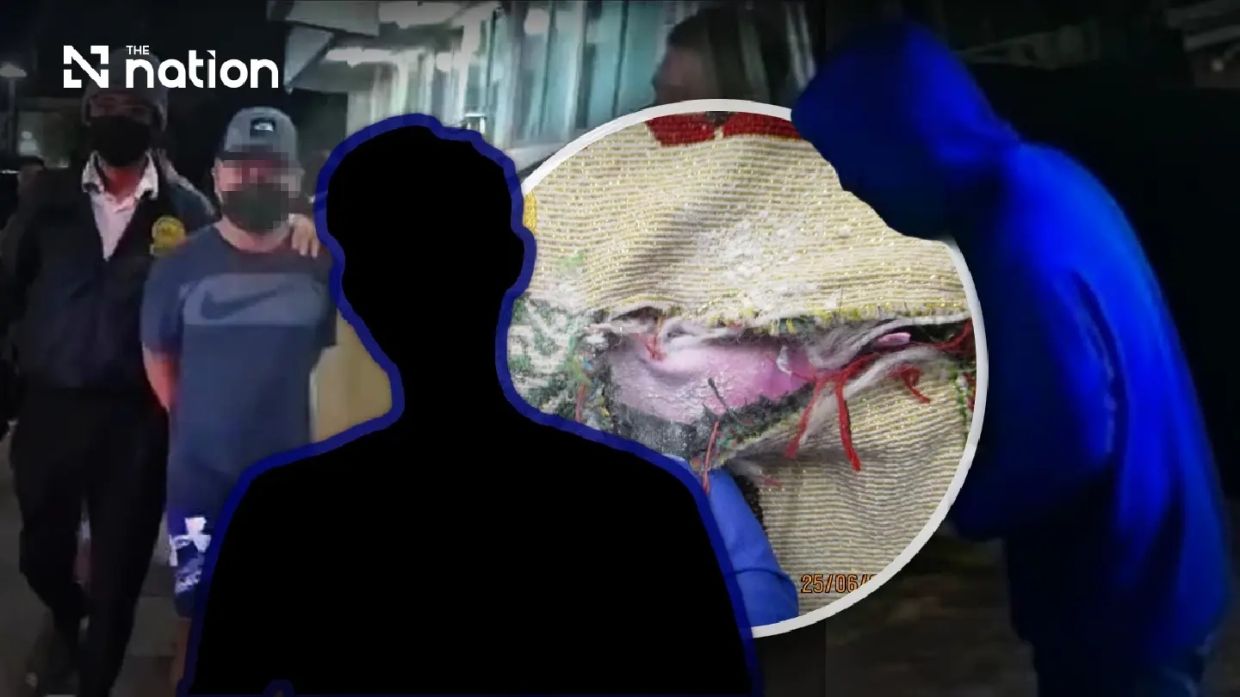
Thai police have made a significant arrest in an international drug trafficking investigation, detaining a man identified as Ekkawit on suspicion of delivering heroin concealed in an elephant-print fabric bag destined for Australia. The Metropolitan Police Bureau's deputy commissioner Pol Maj Gen Theeradej Thamsuthee confirmed the overnight arrest in Phayao, marking a major development in what investigators describe as a sophisticated smuggling operation spanning multiple countries and involving dozens of participants across various roles.
According to police allegations, Ekkawit served as a crucial logistics operative within the trafficking network, acting as the physical intermediary who transferred the contraband from one hand to another. His role appears to have involved receiving the prepared bag from upstream sources and delivering it to Uthai, a man arrested earlier while wearing a distinctive blue hood, who subsequently passed the package to a female flight attendant named Mina for transportation to Australia. This relay system, investigators suggest, was designed to distribute accountability and reduce the risk of any single individual being caught with the complete shipment.
Communication between Ekkawit and Uthai was conducted through messaging applications using the pseudonym "Rin Rin," a practice that has become standard among traffickers seeking to avoid law enforcement surveillance. Police allege that through this online identity, Ekkawit coordinated arrangements for Uthai to collect the elephant-print bag from Chiang Kham district in Phayao province. The choice of such a distinctive, patterned bag—rather than generic luggage—suggests either deliberate compartmentalisation within the network or possible communication through physical markers that would be recognisable to multiple handlers.
During initial questioning, Ekkawit acknowledged his participation in the scheme, revealing that he received compensation of THB100,000 per operation. His admissions to interrogators indicated this was not a singular criminal act but part of an established routine, claiming he had executed similar deliveries on two or three previous occasions. The relatively substantial payment suggests his position held genuine responsibility; he was not a mere foot soldier but someone trusted with handling significant quantities of narcotics and managing the physical transfer points where interdiction remained possible.
Ekkawit's testimony also illuminated the network's internal structure, particularly regarding an individual operating under the chat alias "Rose Rose," who allegedly functioned as a coordinator with broader authority over multiple operatives. According to Ekkawit's account, Rose Rose contacted the flight attendant Mina directly to recruit her for the Australia leg of the smuggling operation, indicating this person wielded sufficient influence to identify and approach potential couriers. Investigators subsequently discovered that Ekkawit and the Rose Rose operator are close relatives, with photographic evidence showing them travelling together, both hailing from Phayao province and suggesting family or kinship ties may have formed the operational foundation of this trafficking cell.
The operational methodology revealed through police investigation demonstrates considerable sophistication in money flows and asset management. After Ekkawit would purchase an elephant-print bag in Chiang Mai—establishing clear separation between purchasing and smuggling phases—he would notify Rose Rose of the acquisition. A designated milestone would be established at a specific kilometre marker where Ekkawit would deposit the empty bag, whereupon an associate would retrieve it, transport it across the Thai-Lao border, arrange for heroin concealment (which Ekkawit claimed occurred in Laos, though investigators expressed scepticism), and return the loaded bag. One to two days after the heroin insertion, Rose Rose would arrange for the bag's collection, with cash compensation of THB100,000 left alongside it at the same kilometre marker. Ekkawit would then retrieve both the bag and payment before transferring the narcotics to Uthai through a THB60,000 cash deposit made via an automated machine, creating a financial trail that compartmentalised each transfer.
Police have identified Rose Rose as someone with substantial communications responsibility, using anonymous messaging accounts to contact and coordinate with numerous individuals willing to participate in the transportation phase, including both Mina and others not yet publicly identified. This coordinative function suggests Rose Rose possessed knowledge of multiple potential couriers and maintained an active recruitment pipeline. However, narcotics investigators have determined that Rose Rose likely does not represent the network's apex but rather functions as a mid-tier manager subordinate to unidentified higher-ranking organisers who conceivably control financial assets, source regions, and destination markets.
Uthai, the intermediary arrested earlier, has claimed to have executed the courier-intermediary role five or six times previously, though investigators remain unconvinced by this account, suspecting it was rehearsed before arrest. Police discovered that Uthai maintained a rental room in Phra Nakhon Si Ayutthaya province for at least five to six months, suggesting possible operational bases at multiple locations or extended deployments related to trafficking coordination. The gap between Uthai's claimed frequency and police suspicions indicates the actual scope of his involvement may be substantially broader than admitted.
The investigation underscores Thailand's role as both a transit hub and source region for narcotics trafficking destined for Australia and other Pacific markets. The use of airline staff as couriers has become increasingly prevalent as traffickers seek to exploit the trusted position of flight crews and the reduced scrutiny they face during international travel. For Southeast Asian governments, the case demonstrates how regional smuggling networks extend tentacles into the formal aviation sector, compromising border security mechanisms that depend partly on the integrity of transport workers. Malaysian and regional authorities monitor such cases closely, recognising that trafficking networks operating in Thailand frequently establish parallel operations across the broader region.
The Metropolitan Police Bureau indicated that Ekkawit would be taken to identify specific locations throughout Phayao connected to the smuggling operation before transfer to the Narcotics Suppression Bureau (NSB) for further interrogation. Deputy National Police Chief Pol Gen Samran Nuanma was scheduled to conduct personal questioning, indicating the case's significance within Thailand's law enforcement hierarchy. Police explicitly stated they are pursuing arrests of the network's remaining members, with particular focus on identifying and apprehending Rose Rose and the senior organisers believed to orchestrate operations from above the coordinator level.
This investigation also highlights the operational gaps that allow such networks to function. The delay in apprehending multiple members—with Uthai arrested earlier, followed by Ekkawit's overnight detention, and ongoing searches for Rose Rose—suggests the compartmentalised nature of the operation limited each participant's knowledge of the complete network. However, the chain of communications through messaging applications, the documented family relationships, and the consistent payment methods are gradually allowing investigators to map the network's structure. For regional law enforcement, the case provides valuable intelligence about how modern drug trafficking networks operate, the financial mechanisms employed, and the vulnerabilities that exist in using legitimate transportation infrastructure for illicit purposes.

