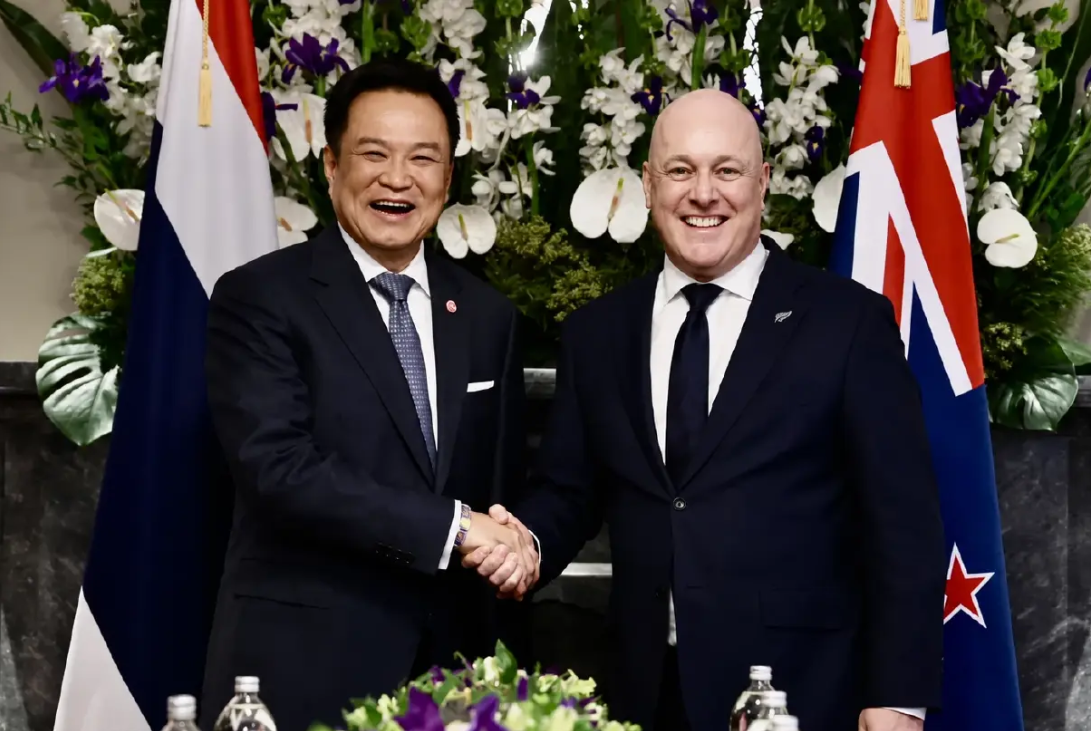
Thailand and New Zealand have formally elevated their bilateral relationship to a strategic partnership, establishing a comprehensive framework for deeper cooperation across multiple sectors and setting a target to triple trade to US$7.5 billion by 2045. The milestone was marked by Prime Minister Anutin Charnvirakul and New Zealand Prime Minister Christopher Luxon signing the Joint Declaration on Strategic Partnership at Government House in Wellington on August 21, coinciding with celebrations of seven decades of diplomatic relations between the two countries.
The timing of Anutin's official visit proved particularly significant, as it allowed both leaders to reflect on the longevity of their nations' connection while charting a path forward that moves beyond traditional diplomatic courtesies into concrete economic and security arrangements. The signing ceremony, held at noon local time, included the presence of senior government officials from both nations, underscoring the importance accorded to the occasion. Anutin characterised the visit as the commencement of a new chapter in the two countries' enduring friendship, with the joint declaration formalising a relationship elevation that carries substantial implications for regional affairs.
Beyond the main declaration, the two governments inked four separate cooperation agreements during the visit, demonstrating the breadth of their collaborative ambitions. These included a cultural cooperation accord, a memorandum of understanding between Thailand's Office of the Civil Service Commission and Education New Zealand to strengthen institutional ties, and a partnership agreement between the Royal Thai Police and their New Zealand counterparts focused on information-sharing and coordination in tackling cross-border crime. A private-sector agreement between Chata Instruments Company Limited and Aeroqual Limited was also formalised, reflecting the private business dimension of the expanding relationship.
The strategic partnership framework is structured around four interconnected pillars of cooperation, enshrined in the Thailand–New Zealand Joint Plan of Action 2026–2030. The political and security pillar commits both nations to intensified collaboration on transnational challenges, particularly human trafficking, online fraud networks, and organised crime that transcend borders. Enhanced law-enforcement coordination and intelligence-sharing mechanisms will enable more effective responses to these persistent regional threats that affect Southeast Asia and the Pacific alike. This dimension proves especially relevant given the rising sophistication of criminal networks exploiting digital technologies and migration routes throughout Asia.
The economic pillar represents perhaps the most tangible facet of the partnership, with both countries committing to aggressive trade expansion while maintaining focus on innovation and sustainability. The target of reaching US$7.5 billion in bilateral trade by 2045—roughly 246 billion baht—represents a significant upward trajectory from current levels and suggests confidence in the capacity of both economies to identify new complementarities. Beyond simple trade volume increases, the nations plan to further develop the Thailand–New Zealand Closer Economic Partnership agreement to unlock fresh opportunities for cross-border investment, particularly in sectors aligned with global sustainability priorities. Food security, renewable energy, sustainable agriculture, and green economy transition initiatives have been identified as high-potential areas where joint endeavours could yield competitive advantages.
Educational and cultural exchange forms the third strategic pillar, with both governments recognising that lasting relationships require deep people-to-people connections. Initiatives encompassing skills development, capacity-building, and academic partnership will strengthen institutional linkages between Thai and New Zealand educational establishments. The cultural cooperation agreement signals a commitment to preserving and promoting understanding of each nation's heritage while facilitating artistic and scholarly exchanges. Anutin emphasised that enhanced connectivity between citizens represents a cornerstone of the relationship, particularly as the countries commemorate their 70 years of formal diplomatic ties.
The fourth pillar addresses regional and multilateral dimensions, positioning the Thailand–New Zealand partnership within broader Asian and Pacific frameworks. Both nations have committed to intensified cooperation through Mekong-focused initiatives, ASEAN-led mechanisms, and the Asia-Pacific Economic Cooperation forum. This architecture reflects both countries' recognition that bilateral prosperity increasingly depends on stable regional governance structures and multilateral systems that favour rule-based international order. The emphasis on supporting peace, stability, resilience, and sustainable development through established international forums signals a shared commitment to counterbalancing unilateral pressures that have characterised recent geopolitical contestation.
Thai Airways' planned resumption of direct Bangkok–Auckland services in March 2027 constitutes a particularly consequential element of the partnership's practical implementation. Anutin has indicated his preference for accelerating this timeline if operationally feasible, recognising that direct air connectivity functions as a critical enabler of trade, tourism, education, and personal exchanges. The restoration of this route would substantially reduce travel friction between the two countries, making business engagement more accessible and lowering barriers to cultural tourism in both directions. For Malaysian readers, this development illustrates how aviation connectivity increasingly serves as a strategic tool for relationship deepening, comparable to regional initiatives within Southeast Asia itself.
An additional diplomatic achievement during the visit involved Anutin securing New Zealand's backing for Thailand's aspirational bid to join the Organisation for Economic Co-operation and Development. Luxon's expression of full support provides Thailand with momentum in pursuing OECD membership, a credential that would enhance the nation's standing among developed and advanced emerging economies. Such institutional recognition carries implications beyond Thailand itself, as successful applications from Asian nations shift global economic governance demographics and potentially create new partnerships and standards-setting opportunities relevant to the entire region.
The strategic partnership between Thailand and New Zealand demonstrates how middle-power nations with complementary strengths can construct multifaceted relationships extending well beyond traditional diplomatic courtesy. For Malaysian and Southeast Asian observers, the partnership model offers instructive lessons about deepening regional integration while maintaining strong extra-regional partnerships that diversify economic and security relationships. The emphasis on addressing transnational challenges through enhanced coordination, coupled with explicit commitments to sustainable development and green economy transitions, positions both nations as serious participants in the emerging global order. As the partnership framework transitions from ceremonial announcement to practical implementation through 2030 and beyond, the success or constraints encountered will likely influence how other ASEAN nations approach relationship elevation with distant democratic partners.
Looking forward, the substantive cooperation frameworks established during Anutin's visit suggest that Thailand and New Zealand view each other not as peripheral relationships requiring occasional diplomatic attention, but as strategic partners capable of generating meaningful mutual benefits. The tripling of bilateral trade, renewed aviation connectivity, enhanced security cooperation, and deepened educational exchanges represent ambitious yet achievable targets that reflect genuine alignment of interests. For Malaysia and other Southeast Asian economies, this partnership trajectory underscores the ongoing importance of cultivating multifaceted relationships with developed Pacific democracies, particularly as regional economies navigate transitions toward sustainability and innovation-driven growth. The Thailand–New Zealand model demonstrates that strategic partnership elevation, when grounded in concrete cooperation agreements and clear economic objectives, can translate ceremonial declarations into tangible outcomes benefiting businesses, workers, and citizens across borders.

