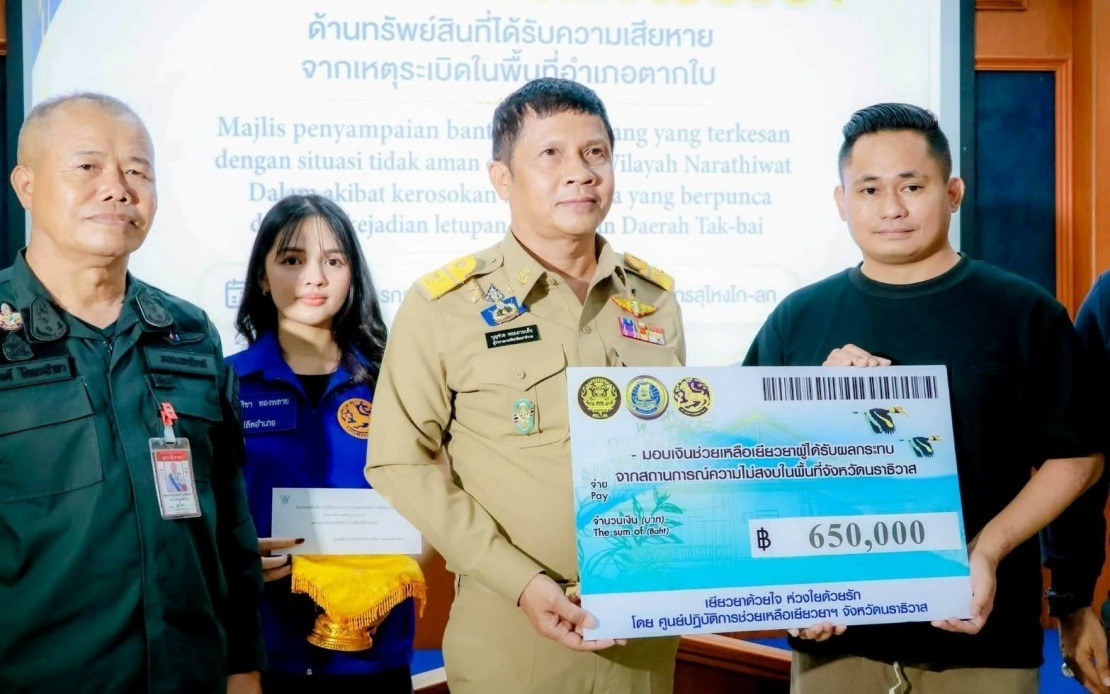
The Thai government has moved to compensate a Malaysian citizen wounded in a bombing incident that occurred in Thailand's southernmost province, presenting 650,000 baht through an official victim assistance scheme. The payment, equivalent to roughly RM80,000, was handed over on Friday to Muhammad Yusri Udin, 38, during a formal ceremony held at the Sungai Golok Customs Office in Narathiwat. The gesture reflects diplomatic attention to the incident and underscores Thailand's responsibility toward foreign nationals affected by security incidents within its borders.
The explosion that prompted the compensation occurred on June 29 in Tak Bai district when an improvised explosive device concealed within a roadside drainage channel detonated near the Sapom junction shortly before noon. The blast wounded two Malaysian nationals in what authorities have characterized as a case of mistaken identity or collateral damage rather than a targeted attack. Muhammad Yusri and Abdullah Syarapi Abd Rahman, aged 45, both sustained injuries during the blast, becoming unintended casualties in what investigators believe was an operation orchestrated by a militant faction active in the region.
Narathiwat Governor Boonchuay Homyamyen used the compensation handover as an opportunity to articulate the Thai government's stance on the security situation in the province. His public remarks conveyed both regret for the incident and reassurance regarding future safety measures, demonstrating Bangkok's intent to manage perceptions among international visitors and neighbouring countries whose citizens transit through the area. The governor's emphasis on strengthened security protocols reflects broader concerns about maintaining tourist confidence in a region long affected by periodic violence and armed group activity.
The compensation mechanism through which the payment was distributed represents an established Thai government response to civilian casualties from security-related incidents. Rather than treating such payments as ad-hoc decisions, the Thai administration operates a dedicated fund specifically designed to address injuries and property destruction arising from conflicts and attacks. This systematic approach enables rapid disbursement and provides affected parties with formal recognition of their losses, though the adequacy of compensation levels remains subject to interpretation depending on the severity of injuries sustained.
Background context illuminates why this particular incident carries diplomatic significance. The southern border provinces of Thailand, including Narathiwat, have experienced sporadic violence linked to separatist movements and armed groups for decades. Malaysian citizens regularly cross into these areas for commerce, tourism, or transit purposes, making them statistically vulnerable to incidents despite stringent security deployments. The presence of Malaysian victims in this bombing underscores how regional instability can directly affect Malaysian interests and citizens, necessitating coordinated responses between Bangkok and Kuala Lumpur.
Following the explosion, Thai authorities initiated a multifaceted investigative response that included the detention of a 40-year-old suspect within hours of the incident. Security forces conducted comprehensive forensic examinations at the blast site and undertook explosive ordnance disposal operations to secure the area and prevent secondary incidents. The rapid investigative tempo suggests a serious commitment to identifying those responsible, though rebel groups operating in southern Thailand often operate through decentralized cell structures that complicate attribution and prosecution.
Governor Boonchuay's statement that the Thai government would not remain passive in addressing security concerns carries particular weight given the recurring nature of attacks in the region. His commitment to restoring tourist confidence speaks to an economic imperative alongside humanitarian concerns, as southern Thailand depends significantly on cross-border commerce and tourism revenues. Each security incident in the area creates negative publicity that authorities must actively counteract through both operational responses and diplomatic engagement with neighbouring countries.
For Malaysian policymakers and citizens, the incident and its handling reveal both vulnerabilities and mechanisms for redress when Malaysians encounter violence abroad. While the 650,000 baht compensation represents concrete acknowledgement of liability, questions inevitably arise regarding whether such amounts adequately cover medical expenses, lost income, and trauma resulting from bombing attacks. The Thai government's systematic approach through an established fund demonstrates institutional capacity to respond, yet the adequacy of compensation structures warrants ongoing diplomatic dialogue between Malaysian and Thai authorities.
The incident also reflects broader regional security challenges that extend beyond any single nation's control. Armed groups operating across the Malaysia-Thailand border region exploit porous boundaries and difficult terrain to conduct operations, creating risks for civilians on both sides of the frontier. Enhanced cross-border security cooperation, intelligence sharing, and coordinated responses to militant activities represent essential components of addressing such threats comprehensively rather than through reactive compensation payments alone.
Looking forward, the handling of this incident establishes a precedent for how Thai authorities respond to foreigner casualties while also highlighting the need for preventive security measures. Governor Boonchuay's assurances regarding strengthened protection mechanisms will be tested through implementation, with Malaysian officials likely monitoring whether promised security enhancements materialize in practice. The compensation payment, while materially significant, represents only one dimension of a more complex challenge involving cross-border stability, intelligence operations, and the fundamental security of civilians transiting through conflict-affected regions.

