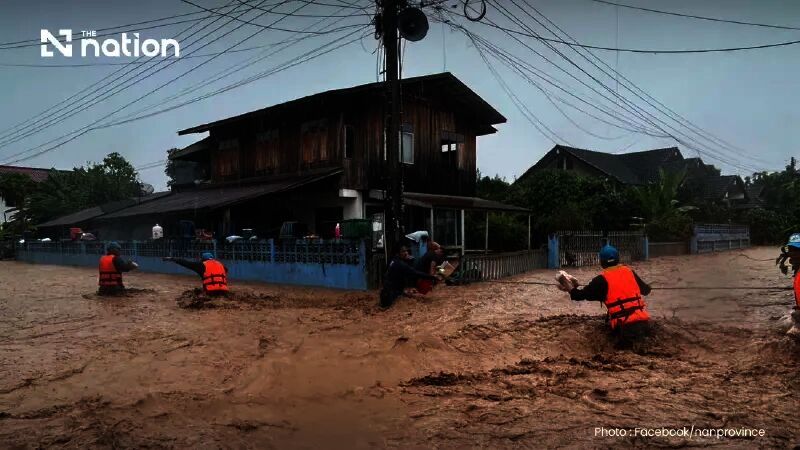
Thailand's government has activated emergency protocols across its northern regions following unprecedented rainfall that has transformed roads into impassable waterways and displaced communities. The declaration of Nan province as a disaster zone on Wednesday underscores the severity of the hydrometeorological crisis, with authorities simultaneously placing the neighbouring provinces of Phayao and Lamphun on heightened alert. The cascading floodwaters have severed critical transportation links and necessitated the evacuation of vulnerable populations from at-risk areas, marking one of the season's most severe weather events to affect the kingdom's mountainous north.
Prime Minister Anutin Charnvirakul is overseeing the national response from Australia, where he is engaged in official diplomatic engagements. Despite his geographical distance, he has issued comprehensive directives to mobilize Thailand's entire governmental apparatus, including military units ordinarily outside the civilian disaster response hierarchy. This extraordinary concentration of resources reflects the magnitude of the challenge facing provincial administrators and local communities. Government spokesperson Rachada Dhnadirek articulated the premier's specific operational mandates during a Wednesday briefing, emphasizing that response coordination must prioritize rapid deployment and preemptive action.
The strategic thrust of the government's emergency protocols centres on water management and infrastructure reinforcement in chronically vulnerable zones. Anutin has explicitly directed that specialized teams and heavy earthmoving equipment be stationed in high-risk areas to enable instantaneous intervention when flooding incidents materialize. The emphasis on proactive water drainage from perennially flood-prone localities reflects lessons learned from previous seasonal disasters that have devastated northern farming communities and urban settlements. This approach represents a shift toward preventing the accumulation of standing water rather than responding solely to acute crisis situations.
Humanitarian considerations have been embedded into the government's operational framework, with Anutin mandating that response prioritization mechanisms protect the most vulnerable demographic segments. The elderly, patients with severe mobility constraints requiring constant medical oversight, children, and residents inhabiting geographically precarious locations have been designated as priority beneficiaries for evacuation and protective measures. This vulnerability-centred approach acknowledges that flooding's most severe consequences typically affect populations with limited capacity for self-protection. The directive also encompasses rapid damage assessment protocols and continuous environmental monitoring to enable timely public warnings if rainfall accumulation or hydrological conditions deteriorate.
The threat landscape extends across multiple regions and encompasses diverse hazard typologies that compound the flooding danger. Authorities have issued flood watches encompassing Thailand's northern, north-eastern, and central zones, warning residents of multiple cascading hazards through the week's end. Beyond inundation from fluvial discharge, the advisory specifically cautions against flash flood incidents that can materialize with minimal warning in areas draining elevated terrain. Landslide activity represents an additional critical concern in mountainous districts where soil saturation reduces slope stability. This multiplicity of hazards requires integrated response systems that address phenomena occurring across different temporal scales and geographic contexts.
Deputy Prime Minister Yodchanan Wongsawat, who holds portfolio responsibility for coordinating northern flood management across provincial administrations, has personally transmitted urgent preparedness directives to the executive leadership of the three affected provinces. These orders mandate comprehensive flood preparation protocols that extend beyond emergency response frameworks to encompass prevention and mitigation initiatives. The intervention at this senior governmental level signals the crisis's significance within Thailand's executive hierarchy and reinforces accountability mechanisms within provincial administrations. Governors are now obligated to demonstrate tangible flood readiness measures or face implicit consequences for inadequate preparation.
The meteorological foundation underlying these emergency declarations stems from seasonal forecasting models indicating a convergence of atmospheric conditions conducive to extreme precipitation. Thailand's Meteorological Department has issued outlooks for August that project recurring thunderstorm activity, regionally concentrated heavy rainfall, and wind dynamics sufficient to trigger the full spectrum of water-related hazards. These atmospheric predictions suggest the current flooding represents one manifestation of broader seasonal hydrological risks rather than an isolated anomalous event. The forecasted weather patterns extend through the remainder of the month, implying sustained vulnerability for communities across affected zones.
For Malaysia and Southeast Asia more broadly, Thailand's flooding crisis carries implications extending beyond immediate humanitarian concerns. Cross-border river systems connect Thailand's northern precipitation zones to Myanmar and Laos, meaning that Thai flooding patterns often reflect broader sub-regional hydrological dynamics. The synchronization of Thai emergency declarations with broader monsoon activity across mainland Southeast Asia suggests that other nations in the region may face comparable precipitation-driven challenges during equivalent seasonal windows. This interconnectedness of hydrological systems underscores the necessity for multilateral coordination mechanisms that enable real-time information sharing regarding rainfall, water levels, and downstream flooding risks.
The deployment of military resources alongside civilian emergency management agencies illustrates how contemporary natural disasters increasingly blur conventional distinctions between defence and civilian protection frameworks. Thai military units possess specialized engineering capabilities, logistics coordination systems, and personnel reserves that civilian authorities alone cannot mobilize at equivalent speed or scale. This integration of defence institutions into flood response represents standardized practice within Thailand's emergency management architecture, reflecting the recognition that certain catastrophic natural events require societal-level mobilization transcending traditional civilian administrative structures. The precedent set by mobilizing armed forces in this context may establish templates for future disaster response across the region.
The economic ramifications of extended northern flooding extend into agricultural production systems that underpin Thailand's export-oriented food supply chains. Inundation of croplands during critical growth phases can devastate harvest prospects for subsequent marketing periods. Infrastructure damage to transportation networks connecting northern production zones to central commercial hubs disrupts supply chain continuity and increases logistics costs. For Malaysia and other ASEAN nations dependent on Thai agricultural exports or integrated regional supply networks, extended flooding scenarios could transmit commodity price pressures and supply availability constraints across borders. This economic dimension adds urgency to Thailand's disaster response beyond the immediate humanitarian imperatives.

