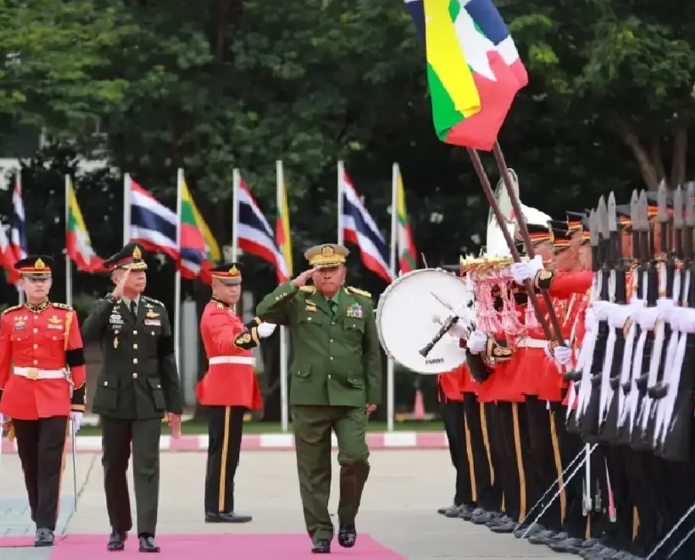
Thailand's senior military commander extended a formal welcome to Myanmar's chief of armed forces on Thursday as the country's coup-installed leadership accelerates efforts to rehabilitate its international standing after years of diplomatic exile. The visit represents a significant diplomatic breakthrough for Myanmar's military establishment, which has faced severe global isolation and sanctions since orchestrating the 2021 overthrow of Aung San Suu Kyi's democratically elected government. This marks the first foreign journey undertaken by Myanmar's current military chief since assuming the role, underscoring the strategic importance both nations place on bilateral engagement.
Myanmar's junta finds itself at a crossroads as it attempts to reposition itself within the international community. The armed forces, which have presided over a devastating civil conflict estimated to have claimed around 100,000 lives, have pivoted toward diplomatic outreach following elections held at the beginning of 2026. These polls, which the military carefully controlled and restricted, served as the centrepiece of the junta's strategy to present itself as transitioning back toward civilian governance. Following the electoral exercise, former coup leader Min Aung Hlaing transitioned to the presidency in civilian dress, while Ye Win Oo, a loyalist with deep connections to the previous military administration, assumed operational command of the armed forces.
The Thailand meeting between military chief Ukris Boontanondha and Ye Win Oo reflects Bangkok's pragmatic recalibration of its Myanmar policy. Rather than maintaining punitive distance from the junta, Thailand has opted to engage directly, a shift exemplified by Prime Minister Anutin Charnvirakul's red-carpet reception of Min Aung Hlaing earlier this month. Thai Foreign Minister Sihasak Phuangketkeow articulated the government's rationale succinctly, stating that engagement is premised on operational necessity rather than endorsement, declaring simply that "it's not about legitimacy, it's about reality." This framing reflects Bangkok's calculation that Myanmar's instability poses immediate challenges along the shared 2,400-kilometre border, making dialogue preferable to continued estrangement.
The border region itself has become a flashpoint of humanitarian concern and strategic instability. Myanmar's civil war, sparked by the military's seizure of power, has created conditions of persistent insecurity that threaten spillover effects into Thailand and other neighbouring territories. Armed groups, displaced populations, and competing military factions have created an environment of chronic instability that regional governments cannot ignore regardless of their political misgivings about the junta's rule. This geographic reality explains why countries sharing borders with Myanmar have proven more willing to engage with the military leadership than distant Western nations maintaining principled opposition.
Ye Win Oo himself carries a controversial profile that illustrates the contradictions embedded in regional engagement. He previously served as a spymaster for the military regime and played a direct operational role in the 2021 coup, earning him international sanctions from the United States and other Western governments. His appointment to military leadership signifies Myanmar's commitment to continuity within the security establishment rather than any genuine liberalisation of governance. That Thailand would welcome such a figure underscores how regional geopolitical calculation can override human rights concerns and international consensus regarding accountability.
International assessment of Myanmar's recent elections has been sharply divided, reflecting fundamentally different approaches to the country's political trajectory. Democracy advocacy organisations have characterised the polls as a theatrical exercise designed to legitimise military rule under a civilian veneer while systematically excluding competing political voices. Most significantly, Aung San Suu Kyi remains politically sidelined, her party marginalised from participation, and dissidents face imprisonment for challenging military authority. From this perspective, the elections represent cosmetic reform masking unchanged authoritarian control rather than genuine democratic transition.
Conversely, neighbouring nations including Thailand have treated the electoral exercise as a sufficient pretext for normalising relations. This divergence reflects a fundamental split in the international community's approach to Myanmar's future. Western governments and human rights bodies maintain that engagement should remain conditional upon demonstrated progress toward genuine democracy and accountability for wartime conduct. Regional states, by contrast, appear convinced that maintaining pressure through isolation has achieved minimal results and that selective engagement offers better prospects for influence over Myanmar's trajectory, particularly regarding border stability.
Recent documentation from United Nations investigators has complicated the diplomatic thaw by providing fresh evidence of military misconduct. The UN's Independent Investigative Mechanism released its annual report detailing systematic escalation of aerial bombardment targeting civilian populations, widespread patterns of arbitrary detention, documented instances of torture, and allegations of sexual violence perpetrated by Myanmar's armed forces. These findings directly contradict Myanmar's government narrative, which dismisses international criticism as baseless politicisation rooted in inaccurate and unverifiable allegations. The timing of the UN report underscores the tension between diplomatic normalisation and ongoing military atrocities.
The Special Advisory Council for Myanmar has issued sharp criticism of Bangkok's outreach strategy, arguing that Thailand has fundamentally compromised its credibility by providing diplomatic legitimacy to military leadership responsible for massive civilian casualties and ongoing rights violations. The council characterised Ye Win Oo's visit as compounding Thailand's abandonment of principle, suggesting that each successive gesture of hospitality toward Myanmar's military compounds Bangkok's reputational damage within international human rights discourse. This perspective emphasises that some forms of diplomatic engagement carry costs that extend beyond bilateral relations to affect broader standing within the global community.
The deeper implication of Thailand's welcoming stance involves a recalibration of how regional governments balance multiple competing interests. Economic ties, border stability, refugee flows, and counterinsurgency cooperation alongside ideological commitment to democracy all jostle for priority within Bangkok's decision-making calculus. Myanmar's military leadership, recognising that isolation has failed to produce internal political change, has shrewdly pivoted toward cultivating relationships with pragmatic regional neighbours while accepting continued Western sanctions. This strategy acknowledges that Southeast Asian governments prioritise concrete bilateral interests over the international consensus regarding democratic governance and military accountability.
Looking forward, Thailand's engagement with Myanmar military leadership suggests a widening gap between regional realpolitik and international human rights standards. Malaysia and other Southeast Asian nations face similar calculations regarding Myanmar policy, caught between sympathy for democratic principles and recognition that geographic proximity demands practical engagement with the military establishment controlling Myanmar's government and security apparatus. The success or failure of the junta's rehabilitation strategy may ultimately depend less on international criticism than on whether regional powers, beginning with Thailand, conclude that normalising relations serves their strategic interests better than maintaining principled distance from military rule.

