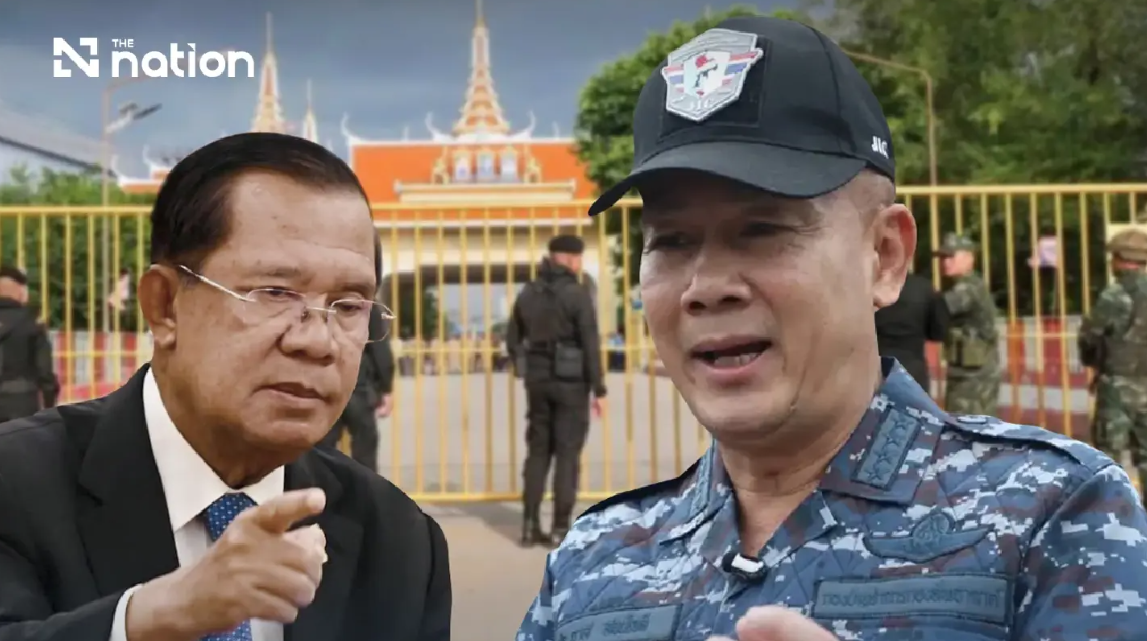
Thailand's defence establishment has firmly pushed back against allegations from Cambodian Senate President Hun Sen that the kingdom exploited its campaign against online fraud networks to justify military encroachment on neighbouring territory. Air Chief Marshal Prapas Sonjaidee, who heads the Joint Information Centre monitoring the Thailand-Cambodia situation, issued the rebuttal on Friday, characterising Hun Sen's remarks—delivered at an international gathering—as a serious misrepresentation framed as twenty-first-century conflict tactics.
The dispute centres on how to interpret military actions near the shared border. Hun Sen contended that Thailand conflated the suppression of scam operations with territorial acquisition, weaponising counterintelligence efforts to advance geopolitical ends. Prapas rejected this framing as fundamentally confused, insisting that the purposes served by any contested location demanded separate and rigorous analysis. When assessing whether forces should be positioned at a site, officials must examine its actual function—whether it housed troops, stored weaponry or facilitated combat operations—through the lens of applicable law and evidence, he argued.
Central to the Thai position is an insistence on temporal sequencing in any conflict narrative. Prapas contended that accounts of armed clashes cannot begin arbitrarily on the date one side chose to respond; they must instead trace causation backward to identify who initiated hostilities. According to Bangkok's documentation and intelligence, Cambodia initiated weapons use in a manner affecting Thai civilian zones. Thailand's subsequent military activities, therefore, constituted defensive measures aimed at neutralising immediate threats and safeguarding both service personnel and non-combatants. This distinction between aggression and response, Prapas suggested, was not merely semantic but essential to assessing responsibility and justifying force.
Hun Sen's assertion that Thai troops now occupy Cambodian soil prompted Prapas to invoke the bilateral ceasefire agreement underpinning current arrangements. That accord specifies that military contingents remain at positions occupied when the ceasefire activated, refrain from advancing toward one another, minimise escalatory rhetoric and curtail provocative behaviour. The stationing of forces at agreed coordinates does not equate to territorial seizure, Prapas argued, nor does maintaining such positions constitute occupation under international principles. To characterise compliance with a signed treaty as a violation of it represented a fundamental logical inconsistency that muddied rather than clarified the dispute.
Despute and boundary demarcation, in Prapas's view, belong to specialised bilateral mechanisms rather than military command structures, media outlets or unilateral declarations. If genuine disagreement exists regarding the precise line separating the two nations, those disagreements must be resolved through established diplomatic and technical channels, not through force or rhetorical claims. Both nations have acknowledged these institutional frameworks, making their invocation the proper remedy for territorial ambiguity. Sidestepping them in favour of competitive narratives would only entrench hostilities.
The humanitarian dimension received particular emphasis in Prapas's response. He affirmed that protecting civilians constitutes a universal ethical principle transcending national borders, asserting that Thai and Cambodian children held equal moral standing and that educational institutions in both countries deserved security. However, applying this principle demanded comprehensive examination of harm inflicted across the boundary, encompassing weapon types, firing trajectories, geographic coordinates, timing and declared targets. Equally significant was the principle that civilian infrastructure must not be converted to military use in ways that endanger non-combatants. Both parties should accept such standards without reservation.
The accusation that Thailand wielded information warfare to undermine Cambodia's international standing prompted acknowledgement that disinformation and propaganda campaigns represent genuine contemporary security challenges. Yet Prapas insisted that countering such tactics through competing accusations merely perpetuated the cycle rather than breaking it. The antidote lay in public disclosure of substantiating evidence, chronological sequences and factual detail subject to external verification. When both sides selectively present information supporting their preferred narrative while alleging the opponent engages in psychological manipulation, genuine clarity becomes impossible and the information battlefield expands.
On Thailand's underlying intentions, Prapas offered categorical assurances: the kingdom harboured no desire for war, sought no territorial aggrandisement and did not regard Cambodia's population as adversarial. Simultaneously, Bangkok maintained obligations to defend its inhabitants and armed forces against genuine threats. Cooperation on suppressing transnational criminal networks remained feasible and desirable. Disputed questions about military site usage should be resolved through evidentiary analysis and legal frameworks, not rhetorical assertion. The sequential chronology of recent clashes required complete disclosure rather than selective framing commencing only when Thailand mounted its defensive reaction.
Prapas's prescription for de-escalation emphasised restoration of ceasefire discipline, with both militaries maintaining agreed positions while reducing inflammatory communication and cultivating conditions conducive to negotiation. Border demarcation must proceed through established joint mechanisms functioning independently of military considerations or media speculation. These steps reflected the interests of ordinary people throughout both nations, who desired substantive peace rather than intensifying cycles of competing accusations and information campaigns.
The broader significance of this exchange extends beyond bilateral relations to illustrate how Southeast Asian neighbours navigate territorial ambiguity and military proximity in an era of competing narratives and digital information systems. Malaysia and other regional states observe how Thailand and Cambodia handle their disputes—whether through escalating rhetorical confrontation or through disciplined invocation of agreements and institutional processes. The Thai official's emphasis on factual transparency, chronological honesty and mechanism-based dispute resolution rather than unilateral pronouncements offers a framework potentially applicable to other regional tensions, including maritime boundary disagreements and resource allocation conflicts affecting multiple Southeast Asian nations.
The path forward, as Prapas articulated it, requires both parties to silence weapons, clarify facts through documented evidence and evidence chains, and recommit to negotiation as the means of resolution. Without such commitment from both Bangkok and Phnom Penh, the information warfare battlefield will only expand, diverting resources and political will from genuine security cooperation and development challenges facing the broader region. The underlying dispute over sovereignty and border demarcation cannot be resolved through increasingly sophisticated propaganda techniques or competing victimhood narratives, but only through the disciplined application of evidence, law and mutual institutional frameworks that both nations have already accepted.

