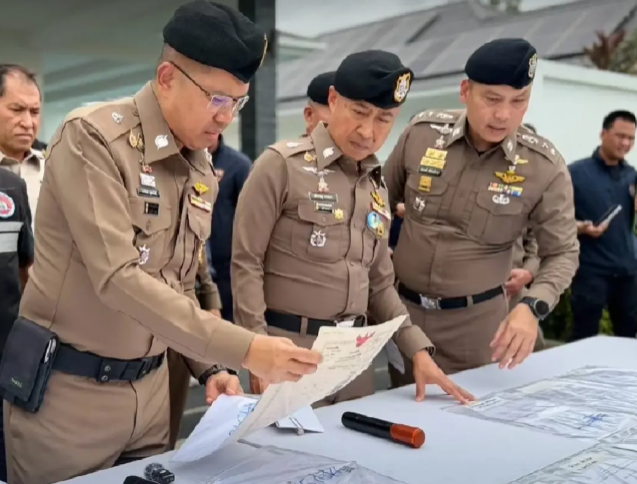
Thailand's law enforcement authorities have intensified their campaign against illegal foreign property ownership, arresting 13 foreign nationals during coordinated raids across Hua Hin in Prachuap Khiri Khan province. The operation, conducted on Monday with the deployment of more than 200 police officers and government officials, represents the sixth major phase of a nationwide crackdown targeting sophisticated schemes that exploit nominee ownership structures to allow foreigners to circumvent Thailand's strict constitutional restrictions on foreign land acquisition.
The individuals detained during the Hua Hin sweep comprised nationals from multiple countries, including three British citizens, four Chinese nationals, and one person each from Italy, France, the Netherlands, Austria, the Philippines and the United States. While courts had previously issued arrest warrants for 45 foreign nationals in connection with this phase, police also summoned 39 Thai nationals for questioning regarding their alleged participation in the schemes. None of those arrested have yet been formally charged in court, as investigators continue examining the evidence gathered during the operation.
The focus of the raids centred on an upmarket residential development in the Thap Tai subdistrict featuring detached houses and contemporary pool villas, each priced between 10 and 20 million baht. Police identified six companies operating within this development that allegedly maintained Thai shareholders as fronts for foreign beneficial owners, with four entities connected to the scheme's initial phase and two to its subsequent iteration. The broader investigation spans 33 companies suspected of functioning as property-holding vehicles, with the total value of assets under scrutiny reaching approximately 300 million baht.
The investigative findings paint a picture of deliberate circumvention of Thai property law through purportedly professional intermediaries. Foreign nationals interrogated by police indicated they had sought legal and accounting consultation regarding property acquisition in Thailand, with these professional advisors ostensibly recommending the establishment of Thai-registered companies as a purportedly compliant mechanism for foreign property ownership. Many detainees claimed they believed such arrangements aligned with Thai legal requirements, though investigators suspect the structures were intentionally designed to obscure foreign control and beneficial ownership while creating the veneer of legitimate Thai business operations.
Thai nationals recruited as nominee shareholders presented a strikingly consistent narrative during questioning, claiming they had agreed to the arrangement without financial investment or genuine involvement in company management. These individuals stated they had neither contributed capital toward share purchases nor received documentation related to their supposed shareholdings, suggesting a carefully orchestrated fiction designed to withstand cursory regulatory scrutiny. Their accounts indicate they served purely nominal functions within corporate structures, lending Thai identity to enterprises that remained functionally foreign-controlled.
The operational sophistication revealed through police investigations underscores how established legal and accounting firms may have become complicit in facilitating these arrangements, whether through explicit knowledge or willful blindness regarding their clients' intentions. Though law enforcement has not publicly identified the professional entities involved, the systematic nature of the schemes suggests coordination and standardised procedures rather than isolated instances of individual fraud. This dimension of the investigation carries profound implications for professional accountability and regulatory oversight within Thailand's legal services sector.
During the Hua Hin operations, authorities seized extensive documentation including company registration papers, accounting records, computer equipment, mobile devices and electronic data. Investigators will now conduct forensic analysis of financial transactions and money flows to identify additional participants, beneficiaries and international networks potentially connected to the property schemes. Police have also indicated that the inquiry will examine whether government officials facilitated these activities through corruption or regulatory negligence, recognising that such schemes require at least tacit institutional tolerance to operate effectively across multiple provinces and extended periods.
This operation represents merely the latest iteration of Thailand's concerted effort against foreign-owned property schemes. The campaign commenced with investigations targeting Koh Phangan in Surat Thani province, subsequently expanding through five additional phases that have progressively moved through Thailand's primary tourist and expatriate centres. Phase 3 investigations encompassed Phuket, Phang Nga and Krabi, examining 89 properties valued exceeding 1.05 billion baht, whilst Phase 4 focused on Chonburi. Most recently, Phase 5 targeted 31 companies and 29 land parcels in Chiang Mai worth approximately 633 million baht.
The cumulative scale of the investigation demonstrates the systemic nature of foreign property ownership violations across Thailand. The first five operational phases collectively examined 233 land parcels and buildings spanning more than 160 rai (25.6 hectares) with an estimated combined valuation of 2.539 billion baht. Courts have approved 133 arrest warrants arising from these earlier operations, with 20 cases having progressed to conviction, indicating that the investigation has generated actionable legal outcomes despite the complexity of tracing beneficial ownership through corporate veils.
The implications of Thailand's nominee ownership crackdown extend beyond simple property law enforcement and touch upon fundamental constitutional principles. Thailand's 2017 constitution restricts foreign land ownership to protect national interests and prevent strategic resource accumulation by non-citizens. However, the persistent sophistication and scale of circumvention schemes indicate ongoing tension between Thailand's desire to attract international investment and capital, and its constitutional commitment to limiting foreign property acquisition. This investigation reveals how globalised wealth and international financial networks can systematically exploit regulatory gaps and professional intermediaries to effectively nullify legislative intent.
For Malaysian and regional investors, the Thai operation underscores the legal risks inherent in property acquisitions that circumvent host country restrictions, regardless of apparent professionalism or legitimacy of intermediaries. The Thai government's demonstrated willingness to pursue criminal investigations across multiple provinces over extended periods suggests that such schemes face eventual exposure and prosecution, with participants facing arrest warrants, asset seizure and potentially criminal conviction.
Thailand's authorities have signalled their commitment to expanding the campaign throughout remaining provinces and tourist destinations. The police department encourages public reporting of suspected illegal foreign business activity through local police stations or the national police hotline at 1599, operating continuously. For legitimate foreign investors seeking property in Thailand, the investigation underscores the importance of engaging licensed lawyers, understanding constitutional restrictions on foreign ownership, and ensuring full compliance with Thai property law rather than seeking circumvention mechanisms that expose investors to criminal liability.

