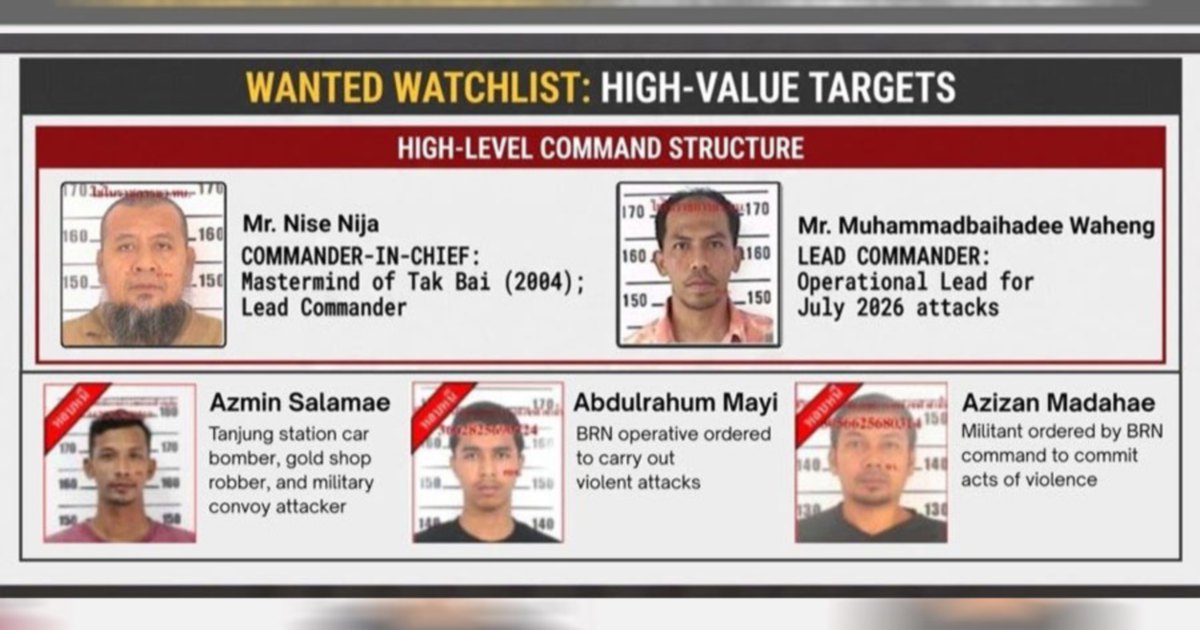
Thai authorities have widened their investigation into a devastating attack on a security outpost by issuing formal arrest warrants for five individuals believed responsible for the ambush that took place on July 22 along Bukit Sami Municipal Road in the Tanjong Mas subdistrict of Ra-ngae, Narathiwat. The issuance of warrants marks an escalation in law enforcement efforts to bring those accountable to justice and reflects the growing urgency surrounding security operations in Thailand's restive southern border region.
The targeted checkpoint positioned along Bukit Sami Municipal Road served as a critical security installation protecting a strategically significant area in Ra-ngae. The assault demonstrated tactical coordination and preparation by those who carried it out, suggesting involvement by organized groups rather than isolated individuals. The location's proximity to the Malaysia-Thailand border adds another layer of complexity to the investigation, as cross-border movements and regional militant networks continue to complicate security operations throughout southern Thailand.
Narathiwat province, situated in Thailand's southernmost reaches, has been a flashpoint for periodic violence and security tensions for more than two decades. The broader region encompasses Narathiwat, Pattani, and Yala provinces, where longstanding communal grievances and separatist sentiment have fueled sporadic insurgent activity. For Malaysian observers and officials, developments in neighboring Narathiwat carry direct implications, as any escalation in cross-border tensions or militant movements can affect the stability of northern Peninsular Malaysia, particularly Kelantan and Perlis states.
The warrant issuance demonstrates that Thai security forces have gathered sufficient investigative groundwork to identify specific suspects, even if their apprehension remains pending. This tactical approach differs from earlier phases of the investigation where authorities might have sought broader intelligence sweeps. The identification of five distinct individuals suggests that investigators have developed credible leads through witness testimony, forensic analysis, or intelligence gathering, though the warrants themselves do not indicate the specific evidence underlying suspicions against each suspect.
From a regional security perspective, the attack reflects patterns observed across Southeast Asia where militants employ asymmetric tactics against hard targets like security installations. Such assaults serve multiple objectives for insurgent actors: generating publicity for their cause, inflicting casualties on perceived occupiers or oppressors, and demonstrating continued operational capacity despite government counterinsurgency efforts. The choice of a security checkpoint as a target maximizes symbolic impact while exploiting concentrated vulnerabilities where personnel congregate predictably.
Thailand's government has prioritized counterinsurgency operations in its southern provinces through sustained military presence, intelligence operations, and community engagement initiatives. The July 22 incident, however, indicates that significant security gaps persist and that organized groups retain capability to mount sophisticated attacks. Malaysian authorities have maintained ongoing security dialogue with their Thai counterparts to address transnational security challenges, though the porous nature of the border and diverse terrain make comprehensive interdiction extraordinarily difficult.
The investigation's progression toward formal warrants suggests collaboration among various Thai law enforcement agencies, including military intelligence units that operate extensively throughout the southern border region. International cooperation mechanisms may also come into play, particularly if investigators determine that any suspects have fled across the Malaysian border or maintained operational links with Malaysian-based networks. Such cross-border coordination has expanded significantly in recent years through bilateral security agreements and intelligence-sharing protocols.
For Malaysian citizens and businesses operating near the border areas, security incidents in Narathiwat carry practical implications regarding travel safety and commercial activities. While outright spillover of violence into Malaysian territory remains rare, the underlying security environment shapes transport routes, tourism patterns, and cross-border trade dynamics. Local authorities in Kelantan maintain heightened alertness during periods of elevated activity in neighboring Thai provinces, recognizing that security threats rarely respect international demarcations.
The apprehension of suspects, if achieved, will likely proceed through Thailand's military and civilian court systems, where political sensitivities and jurisdictional complexities frequently influence proceedings. Previous cases involving suspected insurgents have illustrated how Thailand's judicial processes intersect with national security imperatives, sometimes resulting in outcomes that international observers have questioned. The arrest warrants therefore represent a step in a potentially protracted legal and political process rather than imminent resolution.
Future developments in this investigation will illuminate broader patterns regarding militant capabilities, organizational structures, and operational planning in southern Thailand. Intelligence derived from suspect interrogations, if arrests materialize, could provide valuable insights for Malaysian security agencies facing similar threats in their own jurisdictions. The incident underscores the ongoing requirement for sustained counterterrorism collaboration and intelligence sharing throughout the Greater Mekong Subregion, where porous borders and fragmented governance structures create persistent vulnerabilities that militant and criminal networks routinely exploit for operational advantage.

