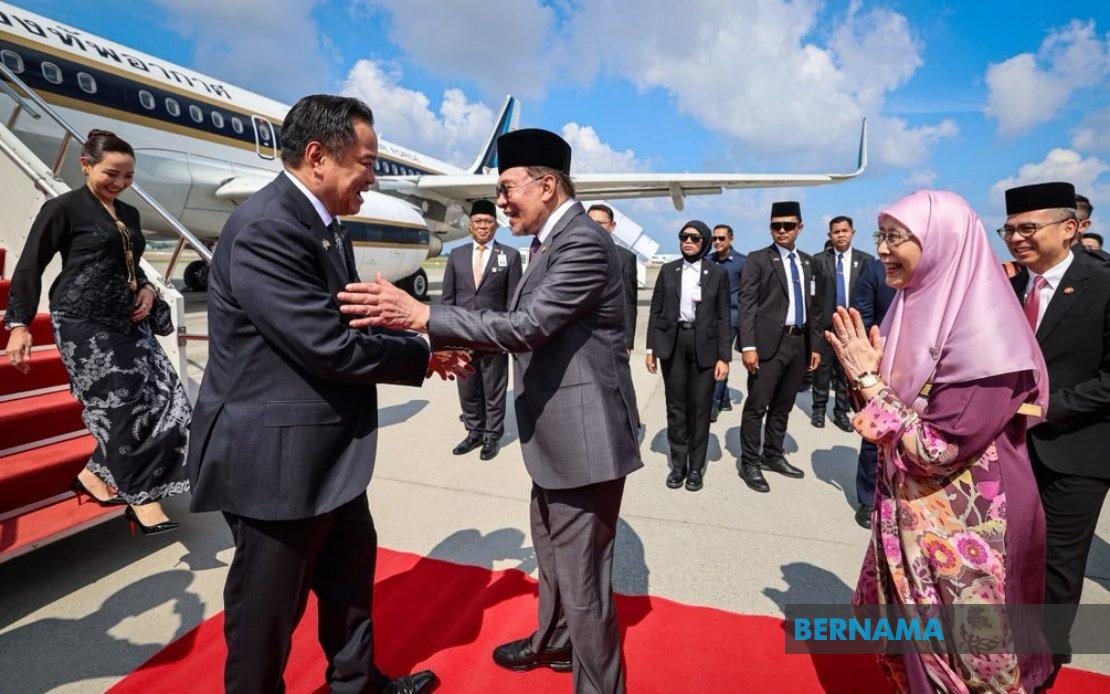
Thailand's Prime Minister Anutin Charnvirakul touched down in Malaysia on July 9 for a two-day official visit, marking his first trip to the country since resuming office in March 2026. Accompanied by his spouse Thananon Charnvirakul, the Thai leader arrived at Kuala Lumpur International Airport's Bunga Raya Complex at 11.11 am, where he received a formal welcome from Prime Minister Datuk Seri Anwar Ibrahim and his wife Datuk Seri Dr Wan Azizah Wan Ismail.
The arrival ceremony underscored the diplomatic significance of the engagement, with Communications Minister Datuk Fahmi Fadzil designated as the receiving minister. A guard of honour comprising 34 officers and personnel from the First Battalion of the Royal Ranger Regiment, commanded by Major Muhammad Nur Addeen Mustaza, lined the tarmac in a traditional show of respect. Following the ceremonial proceedings and the playing of both nations' national anthems, Anutin was formally introduced to Malaysian Cabinet ministers and senior government officials, establishing the high-level nature of the bilateral exchange.
The timing of this visit reflects the growing momentum in Malaysia-Thailand relations, particularly given the substantial economic interdependence between the neighbouring nations. As Malaysia's sixth-largest trading partner globally and second-largest among ASEAN member states, Thailand occupies a crucial position in the country's regional economic strategy. The latest trade figures demonstrate the deepening commercial relationship: bilateral commerce reached RM118.57 billion in 2025, equivalent to US$27.73 billion, and the upward trajectory has continued into 2026 with first-quarter trade totalling RM31.33 billion compared to RM27.35 billion during the same period the previous year.
The centrepiece of Anutin's visit involves substantive bilateral discussions and the advancement of cross-border cooperation mechanisms. At Perdana Putra, the Thai leader will engage in formal talks with Anwar to take stock of progress across the Malaysia-Thailand bilateral relationship and identify new areas for collaboration. These discussions carry particular weight given the shared challenges and opportunities facing both nations within the ASEAN framework, where close coordination remains essential for regional stability and prosperity.
A significant outcome of the talks will be the signing and exchange of a memorandum of understanding focused on agricultural cooperation. This development carries considerable practical implications for both economies, as agriculture remains a substantial sector in each country's economic portfolio. The MoU reflects both governments' recognition that coordinated approaches to farming practices, supply chain management, and agricultural trade can generate mutual benefits while strengthening food security across the region. For Malaysian farmers and agribusinesses, enhanced access to Thai expertise and markets could open new commercial opportunities, while Thai agricultural producers would gain similar advantages in the Malaysian market.
Beyond these formal diplomatic and commercial arrangements, Anwar will host an official luncheon in Anutin's honour at the Seri Perdana Complex, a customary courtesy that provides an informal setting for deeper personal rapport between the leaders. Such occasions often facilitate candid discussions on matters too delicate for formal meeting rooms, allowing leaders to build the interpersonal relationships that underpin effective bilateral cooperation.
On July 10, the second day of the visit, both Prime Ministers will travel to Bukit Kayu Hitam in Kedah for a joint event of considerable symbolic and practical importance: the official opening of a newly constructed road linking the Immigration, Customs, Quarantine and Security (ICQS) Complex on the Malaysian side with Thailand's Customs, Immigration and Quarantine (CIQ) Complex in Sadao. This infrastructure project exemplifies how both nations are working to facilitate seamless cross-border movement whilst maintaining robust security and regulatory oversight. For businesses operating in the border region and for ordinary citizens requiring cross-border access, the improved connectivity represents tangible progress in reducing transaction costs and administrative friction.
The infrastructure development at Bukit Kayu Hitam-Sadao is particularly noteworthy given the region's significance as a major gateway for trade and people movement between Malaysia and Thailand. By streamlining customs and immigration procedures through modern facilities and improved connectivity, both countries are signalling their commitment to deepening integration while maintaining necessary border controls. This balance between facilitation and security has become increasingly important in contemporary cross-border management, and Malaysia's eastern seaboard states like Kedah stand to benefit substantially from such improvements.
Anutin's visit arrives at a moment when Thailand faces significant domestic political considerations following his reappointment as Prime Minister just months earlier. By undertaking this official journey, he demonstrates Thailand's commitment to maintaining strong regional partnerships independent of internal political developments. For Malaysia, the visit reinforces the importance of bilateral relationships based on shared geographic proximity, economic complementarity, and cultural understanding that transcends short-term political fluctuations.
The agricultural cooperation initiative and infrastructure development projects outlined during this visit reflect a broader strategic vision both nations are pursuing: deepening ASEAN integration through practical cooperation on issues that directly affect citizens' daily lives and economic prosperity. As regional competition intensifies from external powers, Malaysia and Thailand's willingness to strengthen ties through tangible collaboration in trade, agriculture, and cross-border efficiency demonstrates the enduring relevance of bilateral engagement within Southeast Asia.
Looking forward, the initiatives agreed during Anutin's visit may establish templates for other ASEAN partnerships seeking to deepen cooperation beyond traditional diplomatic courtesies. The emphasis on sectoral collaboration, particularly in agriculture where both nations possess significant capabilities, suggests a pragmatic approach to regional integration that prioritises concrete benefits over rhetorical flourishes. For Malaysian stakeholders across government, commerce, and civil society, the outcomes of these two days will likely reverberate through enhanced opportunities in the Thai market and improved operational efficiency for cross-border business ventures.

